Artwork
The Four Seasons
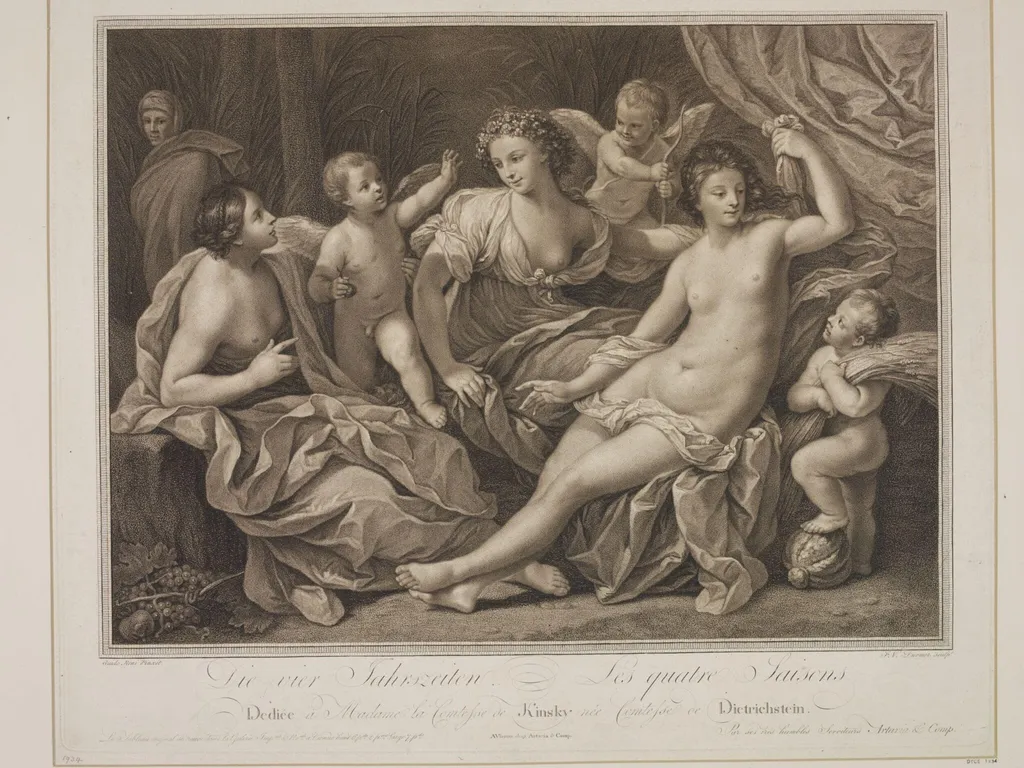
The Four Seasons is a print by Franz Valentin Durmer. It dates from 1850 and is held in the collection of the Victoria and Albert Museum.
About this work
Overview
The work is a paper print titled *The Four Seasons*, produced in 1850 by Franz Valentin Durmer after a design by the 17th‑century Italian painter Guido Reni. It survives in a second state that is identified by the inclusion of inscribed letters, distinguishing it from an earlier version.
Subject & Meaning
The composition presents four female figures, each representing a season, accompanied by three children in an idyllic, pastoral setting.
The composition presents four female figures, each representing a season, accompanied by three children in an idyllic, pastoral setting. The women are shown either draped in flowing garments or nude, reclining among vines, clouds and rocks. A child bearing a flag and another perched on a stone add narrative detail, while the central figure reclines with a relaxed posture, suggesting a serene passage of time.
Technique & Style
Durmer employed a chiaroscuro approach, using delicate gradations of light and shadow to model the forms and create a luminous atmosphere. The print imitates the tonal richness of a painted surface, with careful hatching that conveys depth and a soft, almost glowing rim around the figures. The overall effect is one of gentle three‑dimensionality within a flat paper medium.
History & Provenance
Created in the mid‑19th century, the print reflects the period’s interest in reviving classical motifs through reproductive media. The second state, marked by added lettering, indicates a later alteration or edition, possibly for identification or cataloguing purposes. While the original drawing by Reni dates to the Baroque era, Durmer’s 1850 version demonstrates the continued circulation of Reni’s iconography in European print culture.
Artist & collection
Artist
Franz Valentin Durmer’s prints feel like weather reports from the 1790s—every line crisp enough to catch the wind.

![Omnia Vincit Amor [Apollo and Daphne], by Robert van Audenaerd](https://artifactworldgallery.com/img/robert-van-audenaerd--omnia-vincit-amor-apollo-and-daphne--7af37b2f424f6e58-w320.webp)