Artwork
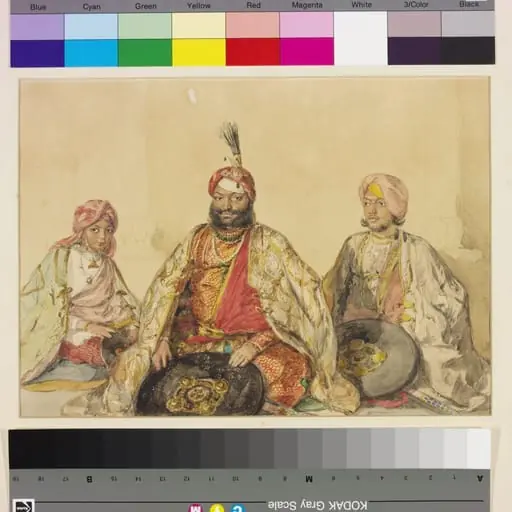
Rajah Ali Gour, a Gukkur chief of Khanpore in Huzzara
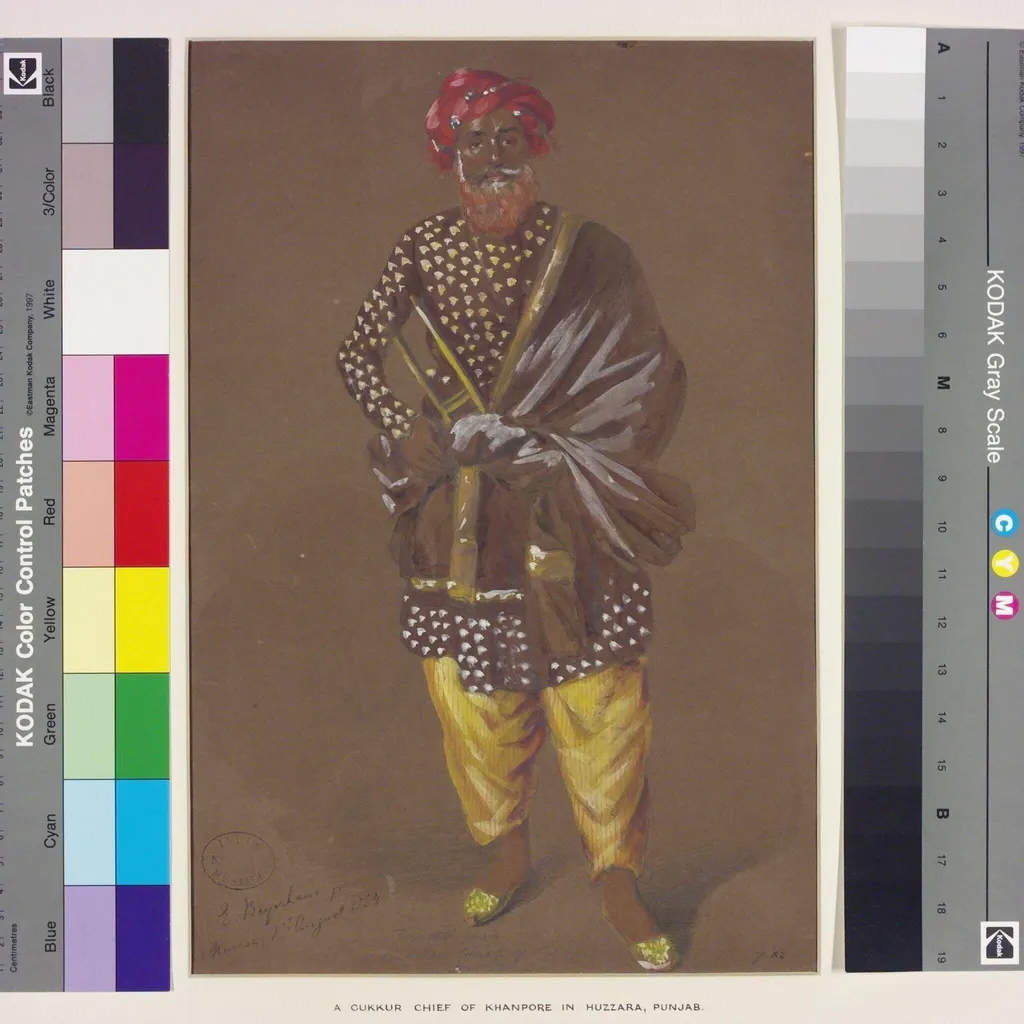
Rajah Ali Gour, a Gukkur chief of Khanpore in Huzzara is a paint painting by the Patna School of Painting artist E. Beyerhaus. It dates from 1854 and is held in the collection of the Victoria and Albert Museum. The work is a mid‑nineteenth‑century portrait painted in 1854 by E.
About this work
Overview
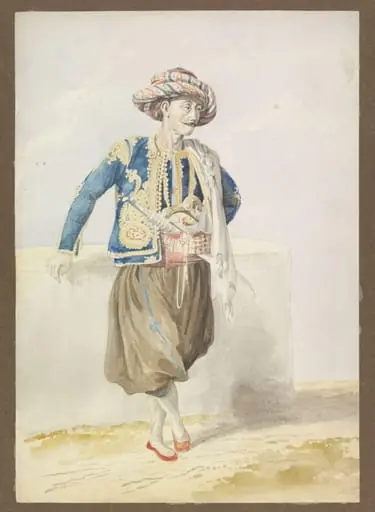
The work is a mid‑nineteenth‑century portrait painted in 1854 by E. Beyerhaus. It presents a seated figure in elaborate Indian dress against a uniform brown backdrop, rendered with careful attention to texture and detail. The composition centers the subject’s face and sword, creating a clear focal point within the limited colour scheme.
Subject & Meaning
The sitter is Rajah Ali Gour, identified as a chief of the Gukkur community from Khanpore in the Huzzara region. His attire—a red turban, gold‑trimmed brown robe, yellow trousers and gilded footwear—along with the sword he holds, signal his authority and ceremonial role within his society.
Technique & Style
Beyerhaus employs a realistic approach, using fine brushwork to delineate the intricate patterns of the fabrics and the metallic sheen of the sword. The limited palette of reds, golds, and browns enhances the three‑dimensionality of the clothing, while the flat brown background isolates the figure, emphasizing his status.
History & Provenance
Originally recorded in the India Office collection, the portrait was later transferred, as noted by Sir G. Birdwood. Documentation from the Asia Department registers and the Central Inventory confirms its movement and acquisition during a 2023 provenance research project, ensuring its current cataloguing within the museum’s holdings.
Artist & collection
Artist
This artist painted a single portrait so striking it feels like the sitter stepped out of the frame.