Artwork
Landscape with Farm and Fields in Flat Country
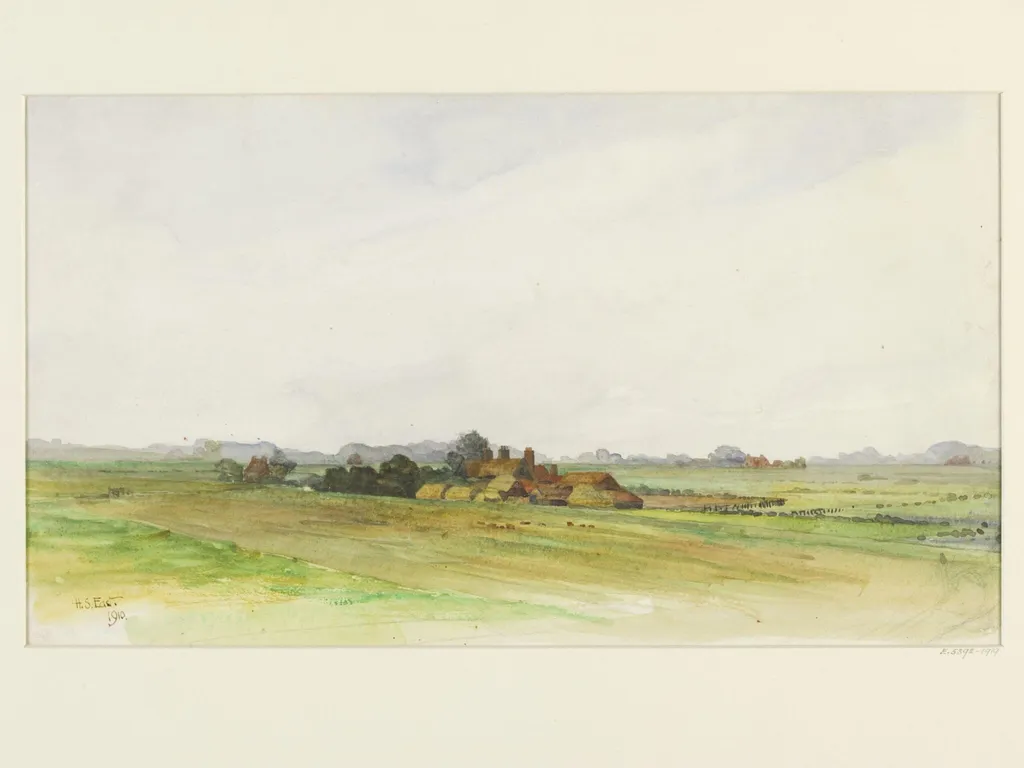
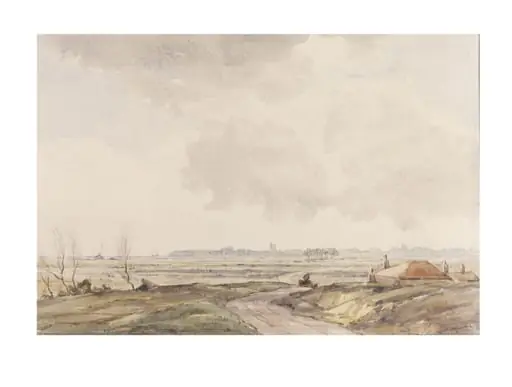
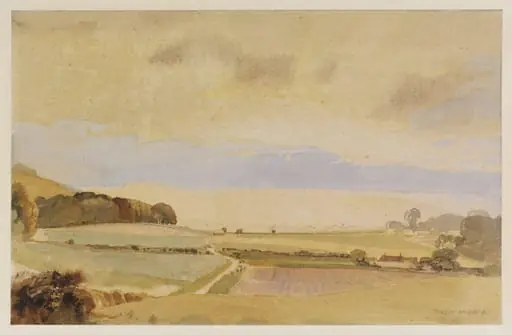
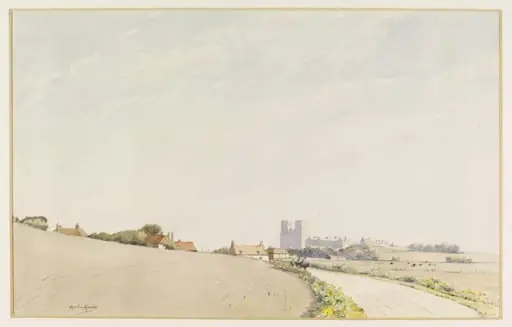
Landscape with Farm and Fields in Flat Country is a drawing by Hubert Springford A.R.I.B.A. East. It dates from 1910 and is held in the collection of the Victoria and Albert Museum. A watercolor drawing from 1910 captures a quiet rural scene in a low-lying region.
About this work
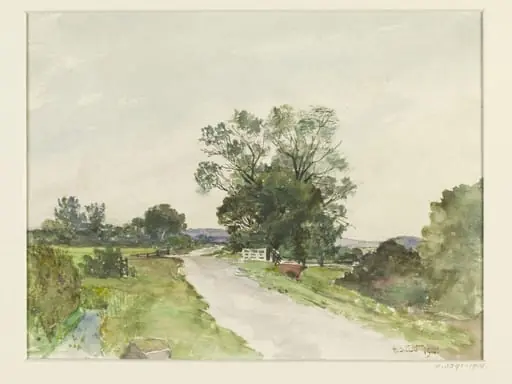
This sketch shows a quiet countryside scene with flat fields stretching toward a line of small houses and trees.
This sketch shows a quiet countryside scene with flat fields stretching toward a line of small houses and trees. The colors are soft—light greens and yellows in the fields, with a pale sky fading into the distance. A fence runs along the bottom edge, and the buildings look simple, with dark roofs and light walls.
The artist used quick, loose strokes to suggest light and shadow, keeping things simple but lively. The date "1910" is signed in the corner, showing this was made over a century ago.
If you like this style, check out the Victoria and Albert Museum to see more works like it.
Overview
A watercolor drawing from 1910 captures a quiet rural scene in a low-lying region. The composition centers on open fields, a modest farmstead, and a sparse line of trees, all rendered with minimal detail. The artist employed loose brushwork and restrained tones to evoke a sense of stillness and distance, emphasizing the flatness of the terrain rather than dramatic elevation or detail.
Subject & Meaning
The scene presents an unidealized view of agricultural life, focusing on ordinary structures and undisturbed land. There is no human presence, and the buildings appear functional, not ornamental. The absence of narrative or symbolism suggests an interest in the quiet rhythm of the countryside, perhaps reflecting a personal observation rather than a staged composition.
Technique & Style
The artist used watercolor with a light, fluid hand, allowing washes to blend softly across the paper. Fields are suggested with pale greens and yellows, while roofs and fences are defined by quick, dark strokes. Shadows are implied rather than modeled, and the sky fades gently into the horizon. The technique prioritizes atmosphere over precision, capturing the essence of the landscape in a few deliberate marks.
History & Provenance
Signed and dated 1910, the work originates from a period when many artists turned to rural subjects as industrialization reshaped the landscape. Its modest scale and informal style suggest it may have been a personal study rather than a commissioned piece. The drawing’s survival indicates it was preserved within a private collection or artist’s archive before entering institutional hands.
Context
In early 20th-century Britain, watercolor was widely used for landscape studies, particularly among artists drawn to the countryside beyond urban centers. This piece aligns with a broader trend of recording everyday rural environments with sensitivity and restraint, often in contrast to the more dramatic or romanticized depictions of earlier generations.
Legacy
The drawing contributes to a body of work that values quiet observation over grandeur. Its simplicity and directness resonate with later 20th-century approaches to landscape, where authenticity and understatement became central. While not widely exhibited, it remains a representative example of amateur and professional artists’ engagement with the English countryside during a time of transition.
Artist & collection
Artist
Hubert Springford A.R.I.B.A. East
Hubert Springford drew quiet, flat landscapes in ink and pencil around 1895–1910, favoring wide skies above plowed fields and empty roads that stretch to the edge of the paper.