Artwork
Part of the cliffs of Gebel et Tayr
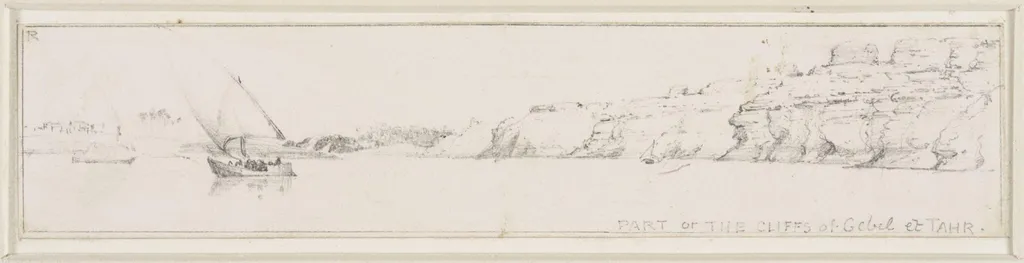
Part of the cliffs of Gebel et Tayr is a drawing by the Impressionist artist Edward William Cooke. It dates from 1874 and is held in the collection of the Victoria and Albert Museum. Edward Cooke created this pencil drawing in 1874 during a journey through Egypt, capturing a section of the Gebel et Tayr cliffs.
About this work
Overview
Edward Cooke created this pencil drawing in 1874 during a journey through Egypt, capturing a section of the Gebel et Tayr cliffs.
Edward Cooke created this pencil drawing in 1874 during a journey through Egypt, capturing a section of the Gebel et Tayr cliffs. The work is one of many field sketches made between January and April of that year, prompted by fellow artist F. Goodall. Cooke’s approach was immediate and observational, reflecting the practical needs of documenting landscapes while traveling. The drawing’s inscription confirms its geographic specificity, anchoring it to a real location rather than an imagined one.
Subject & Meaning
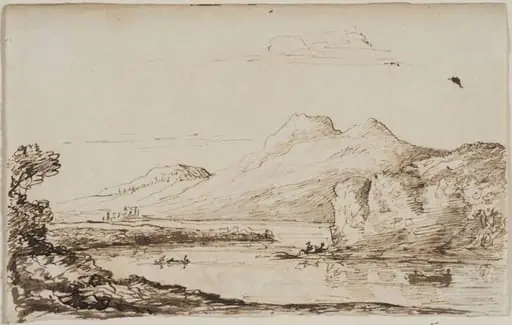
The scene portrays a rugged stretch of coastline with steep, eroded cliffs rising above choppy water and small boats near the shore. The focus is on geological form and atmospheric condition rather than human activity. The inclusion of vessels suggests local life but does not dominate the composition. The work functions as a visual record, preserving the character of a remote coastal feature during a period of increasing European interest in Egypt’s topography.
Technique & Style
Cooke employed swift, light pencil strokes to convey the texture of rock and movement of water. Shading is minimal and suggestive, using hatched lines to imply depth without heavy modeling. The sketch’s spontaneity reflects its on-site origin, with some areas refined later from memory. The absence of fine detail emphasizes immediacy, aligning with 19th-century travel sketching practices that prioritized rapid notation over polished finish.
History & Provenance
The drawing originated from Cooke’s 1874 expedition to Egypt, documented in his personal journal, which notes both on-location work and subsequent revisions. Its survival as a standalone sheet suggests it was retained for personal or archival use rather than intended for public display. No record of early exhibitions or ownership changes exists, indicating it remained within the artist’s circle or private collection until its current location.
Context
Cooke’s journey occurred during a period when British artists and travelers increasingly explored Egypt’s landscapes following archaeological and colonial interest in the region. His sketches contributed to a broader visual archive of Egyptian geography, distinct from monumental or archaeological subjects. This work reflects a quieter, topographical tradition—focused on natural form rather than ancient ruins—that complemented more celebrated Orientalist imagery of the era.
Legacy
Though not widely exhibited, Cooke’s Gebel et Tayr sketch exemplifies the role of amateur topographical drawing in 19th-century travel culture. It preserves a moment of direct engagement with a remote landscape, offering insight into how artists recorded place before photography became commonplace. The work remains a modest but valuable artifact of observational practice, illustrating the quiet discipline behind field sketching in an age of exploration.
Artist & collection

 Untitled
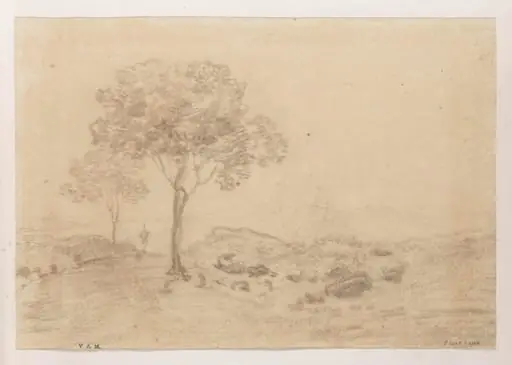 Two trees in a landscape
 Banks of the Loire (Bord de la Loire)
 Saint Maurice in Bourgogne (Saint Maurice en Bourgogne)
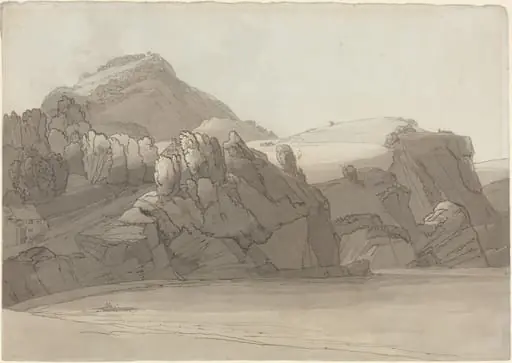 A Rocky Shore at Coombmartin, Devon (Combe Martin Bay)
 View from the shore over the Thames or the Medway
 Landscape with Hills and Water
 An Ancient Wall with a Ruined Gate
 View of the Unkelstein and Unkel
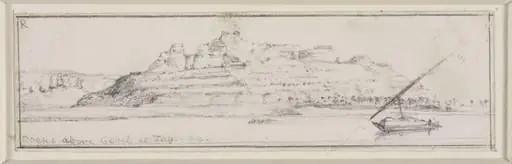 Rocks above Gebel et Tayr