Artwork
View of the Drachenfels and Königswinter
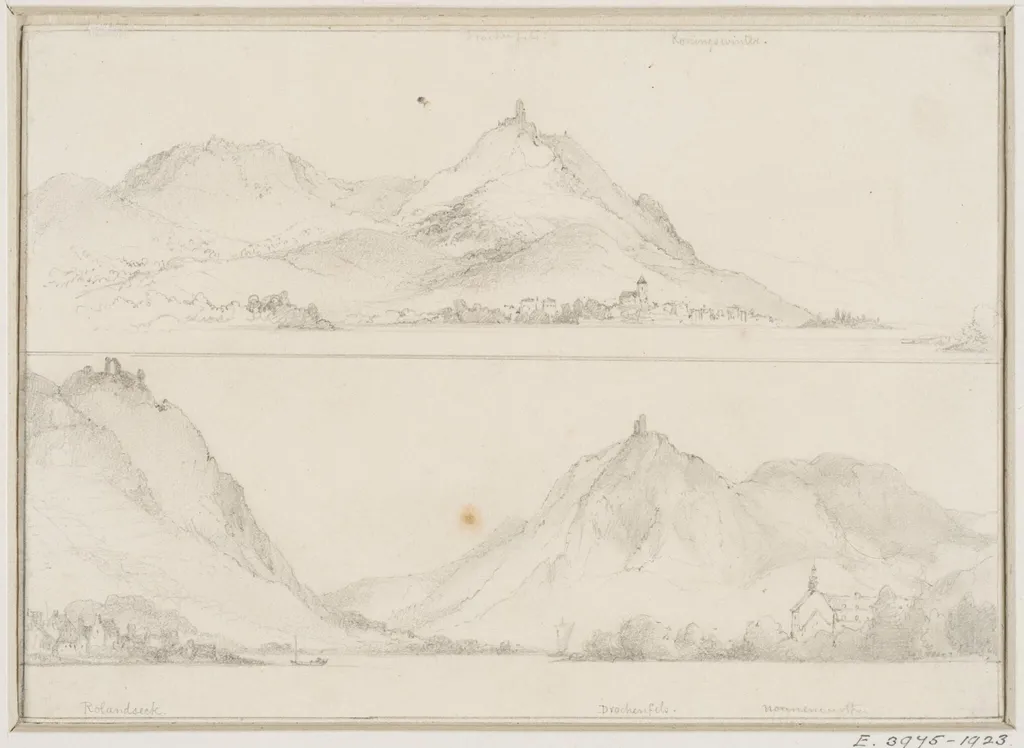
View of the Drachenfels and Königswinter is a drawing by Edward William Cooke. It dates from 1850 and is held in the collection of the Victoria and Albert Museum. Edward Cooke created this 1850 pencil drawing as a paired study of the Drachenfels and Königswinter, two landmarks along the Rhine.
About this work
Overview
Edward Cooke created this 1850 pencil drawing as a paired study of the Drachenfels and Königswinter, two landmarks along the Rhine.
Edward Cooke created this 1850 pencil drawing as a paired study of the Drachenfels and Königswinter, two landmarks along the Rhine. Both scenes appear on one sheet, arranged vertically, with the upper view more detailed than the lower. The composition emphasizes geological form over atmospheric effect, using minimal shading to define terrain. No color or ink is used; the entire image relies on the subtlety of graphite lines.
Subject & Meaning
The upper panel identifies the Drachenfels and Königswinter by name, anchoring the drawing in a specific geographic context. Below, a simplified version repeats the mountain silhouette without labels, suggesting a comparative study. The inclusion of a village with a church implies human habitation within the landscape, but the focus remains on natural structure rather than narrative or cultural symbolism.
Technique & Style
Cooke employed light, precise pencil strokes to model the jagged rock formations, avoiding heavy shading or cross-hatching. The sky is left blank, directing attention to the terrain’s contours. Buildings and trees are rendered as simplified silhouettes, their forms suggested rather than defined. This restrained approach reflects a topographical intent, prioritizing accuracy over expressive flourish.
History & Provenance
The drawing is part of a broader body of work by Cooke, who traveled through the Rhine Valley in the mid-19th century. It likely served as a field study, later referenced for more finished works. The piece entered the Victoria and Albert Museum’s collection through documented acquisition, consistent with the institution’s focus on 19th-century British draftsmanship.
Context
During the 1840s–1850s, British artists increasingly documented European landscapes as part of a growing interest in geology and regional identity. Cooke’s work aligns with this trend, capturing the Rhine’s dramatic topography with scientific curiosity rather than romantic idealization. His sketches were often used for educational or archival purposes, not public exhibition.
Legacy
This drawing contributes to a record of how 19th-century British observers interpreted German landscapes. Its restrained technique and geographic specificity distinguish it from more theatrical Romantic depictions of the region. Today, it remains a reference for understanding the intersection of travel, observation, and draftsmanship in Victorian-era art practice.
Artist & collection

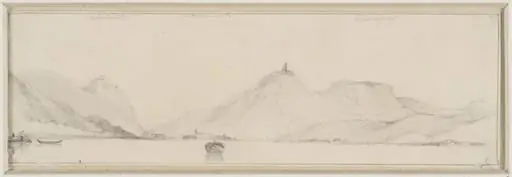 View of Rolandseck, Nonnenwerth and Siebengebirge
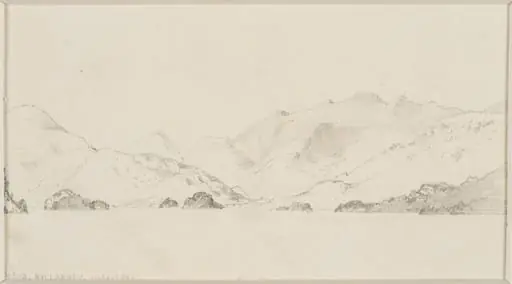 Killarney
 Sketches made during the Campaign of 1854-55 in the Crimea, Circassia and Constantinople
 Sutherland Album
 Grassdale Pikes
 The Sabine Hills and Rocca Santo Stefano Seen from Civitella
 Brodick Bay, Arran
 Eagle's Nest, Killarney
 Fort William, Scotland
 Ben Nevis