Artwork
Untitled
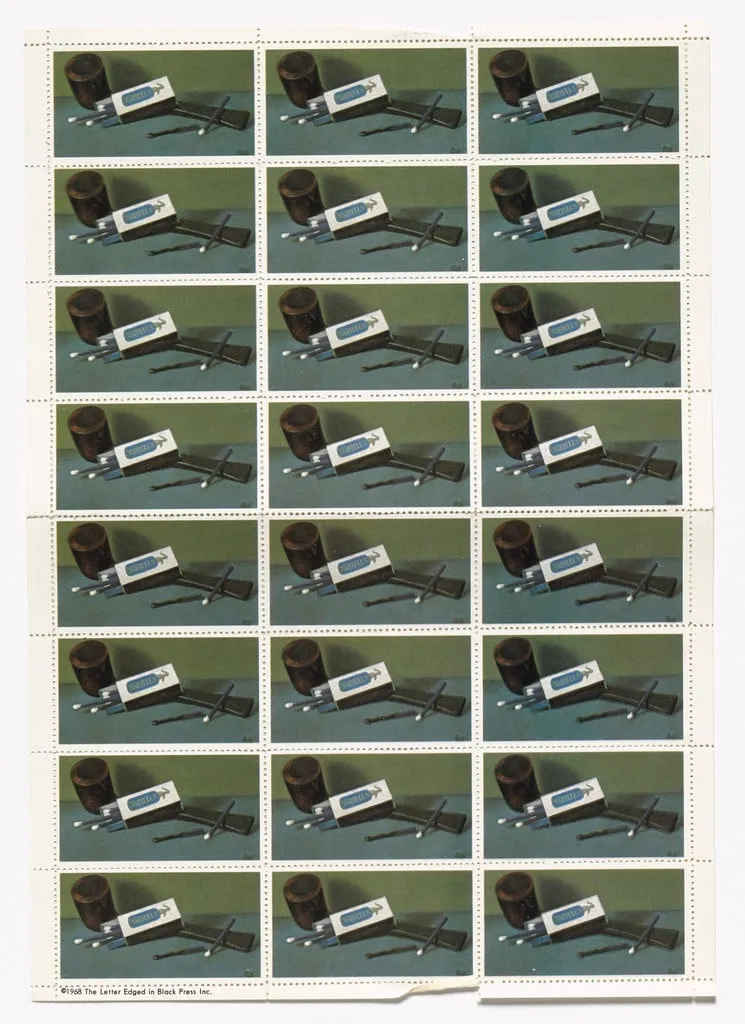
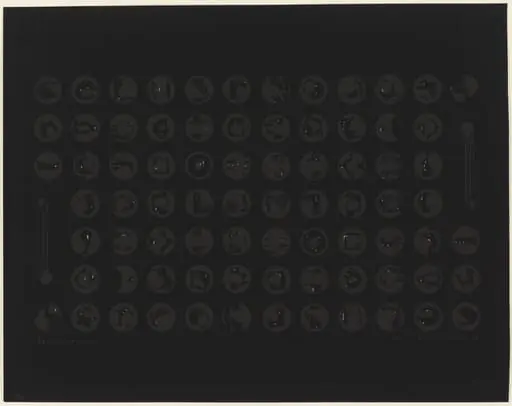
Untitled is an ink print by Edward Fitzgerald. It dates from 1968 and is held in the collection of the Museum of Modern Art.
About this work
Overview
The work belongs to a body of prints exploring industrial aesthetics and the quiet absurdity of mundane objects.
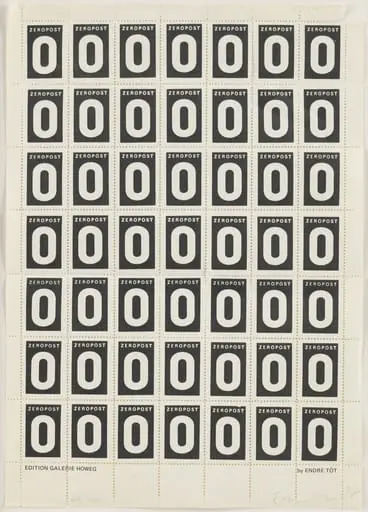
Created in 1968, this offset lithograph by Edward Fitzgerald is part of The Museum of Modern Art’s collection. It presents a grid of twelve identical rectangular boxes, each tilted slightly to suggest subtle motion. The composition is restrained, relying on repetition and minimal variation to generate visual tension. The work belongs to a body of prints exploring industrial aesthetics and the quiet absurdity of mundane objects.
Subject & Meaning
The image features twelve boxes, each labeled with white text and containing a pair of crossed tools resembling a knife and scissors. These items, commonly associated with office or domestic use, are rendered with clinical precision but lack clear function or context. Their arrangement evokes a sense of ritual or systematized order, inviting speculation about labor, bureaucracy, or the anonymity of everyday tools.
Technique & Style
Fitzgerald employed offset lithography to achieve sharp, flat planes of color and uniform detail. The background is a solid green, isolating the boxes against a neutral field. Each box is rendered identically, yet their slight rotational variation disrupts mechanical repetition, introducing a perceptual rhythm. The limited palette—brown, white, blue, and green—enhances the work’s impersonal, graphic quality.
History & Provenance
The work was produced in 1968 and entered The Museum of Modern Art’s collection shortly thereafter. It is one of several prints by Fitzgerald from this period that examine the visual language of mass-produced objects. No record of prior ownership or exhibition history beyond MoMA’s acquisition is publicly documented, suggesting its significance emerged through institutional recognition rather than commercial circulation.
Context
Emerging during a time when conceptual and minimalist art challenged traditional representation, Fitzgerald’s print aligns with broader inquiries into repetition, industrial design, and the aesthetics of the ordinary. While not overtly political, the work resonates with contemporaneous critiques of standardization and the dehumanizing effects of bureaucratic systems in postwar America.
Legacy
Though Fitzgerald’s output was limited and largely overlooked during his lifetime, this print has become a reference point in discussions of 1960s American printmaking. Its quiet interrogation of form and function continues to influence artists interested in the intersection of design, labor, and visual monotony. It remains a quiet but persistent presence in institutional collections focused on conceptual art practices.
Artist & collection