Artwork
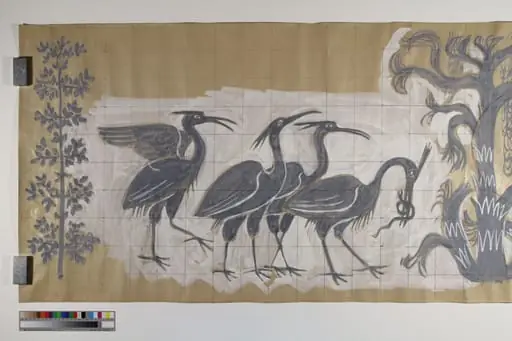
Eglin, Walter - Malerei, Entwurfszeichnung Wandbild Realschule Hofmatt, Gelterkinden (Prähistorische Jagd)
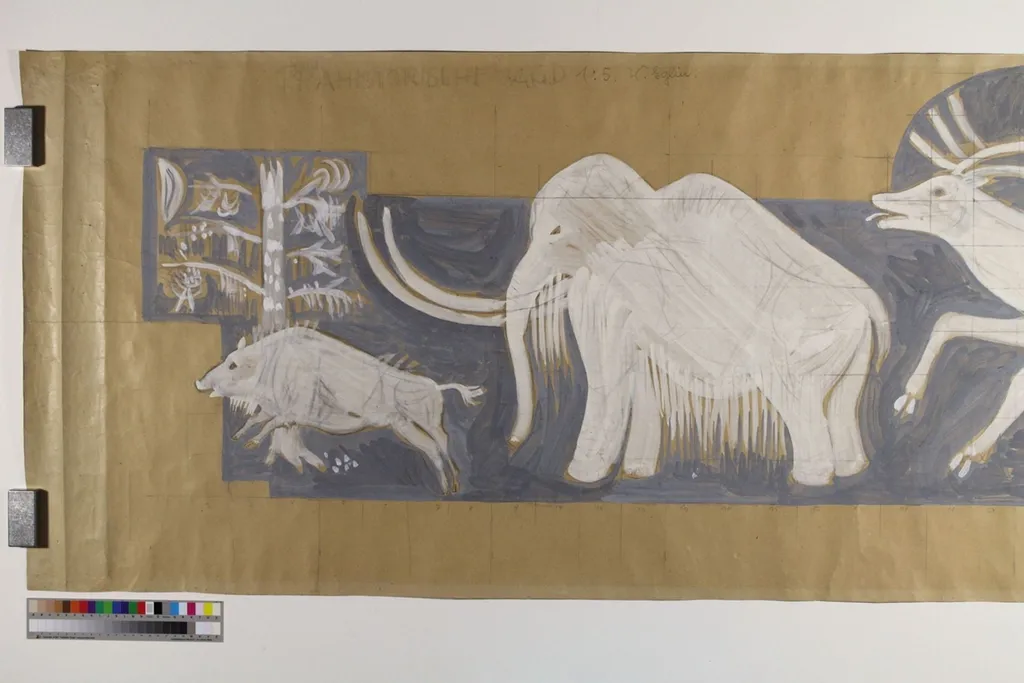
Eglin, Walter - Malerei, Entwurfszeichnung Wandbild Realschule Hofmatt, Gelterkinden (Prähistorische Jagd) is an unspecified painting by Walter Eglin. It dates from 1954 and is held in the collection of the Archaeology and Museum Baselland.
About this work
Overview
Walter Eglin’s 1954 composition, titled “Prehistoric Hunt,” was originally conceived as a design for a wall mural at the Realschule Hofmatt in Gelterkinden.
Walter Eglin’s 1954 composition, titled “Prehistoric Hunt,” was originally conceived as a design for a wall mural at the Realschule Hofmatt in Gelterkinden. The image, now part of the Museum of Ethnography’s collection, depicts a stylized hunting scene rendered in a flat, graphic manner. Its limited palette and bold outlines give the work a timeless, schematic quality that emphasizes form over naturalistic detail.
Subject & Meaning
The picture presents three large animals arranged in a dynamic tableau. A white boar appears to charge forward toward a larger white figure that may represent a horse or bovine, while a third creature, reminiscent of a reindeer, stands apart in the background. The composition suggests a narrative of pursuit, evoking prehistoric hunting practices and the relationship between humans, prey, and the surrounding landscape.
Technique & Style
Eglin employs a flat, stylized approach, using a restrained palette of white, dark blue, and gold. Sharp, clean outlines define each form, and the absence of gradated shading eliminates depth, reinforcing a two‑dimensional effect. The design’s simplicity and emphasis on geometric shapes align it with mid‑twentieth‑century graphic illustration and with visual strategies found in ethnographic art.
History & Provenance
Created in 1954 as a preparatory drawing for a school mural, the work later entered the holdings of the Museum of Ethnography, where it is displayed as part of the institution’s collection of visual documentation of cultural motifs. Its transfer to the museum reflects an interest in preserving educational art that also serves as a record of historic visual representations of hunting scenes.
Artist & collection
Artist
Walter Eglin spent his life in the small Swiss town of Sissach, where he balanced teaching art to kids with painting on the side.