Artwork
Gambo and Car Llusg below Cader Idris, Merionethshire
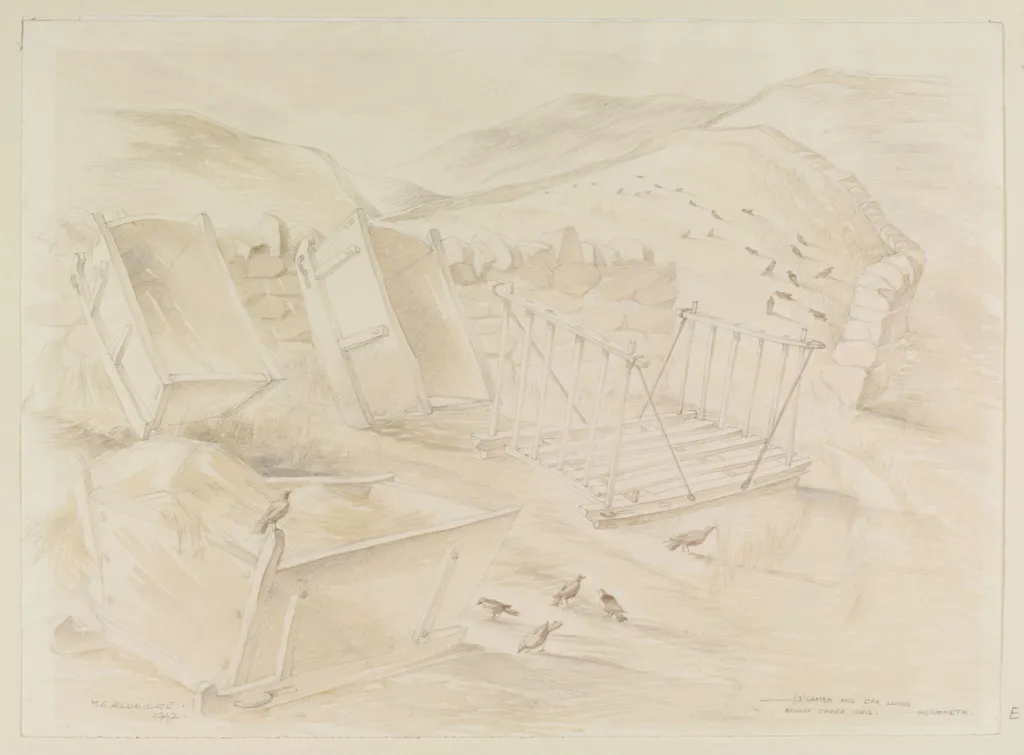
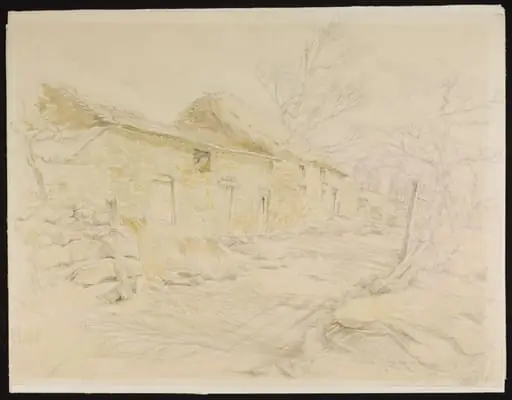
Gambo and Car Llusg below Cader Idris, Merionethshire is a watercolor work on paper by Mildred E. Eldridge. It dates from 1942 and is held in the collection of the Victoria and Albert Museum. Mildred E.
About this work
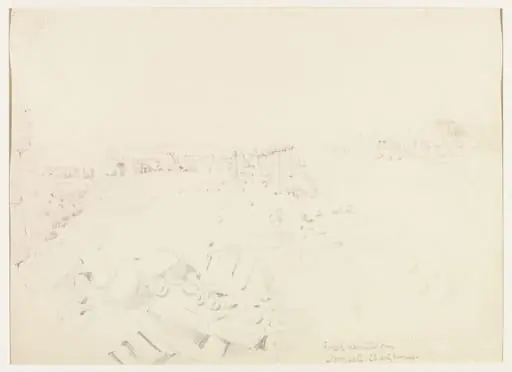
A few birds stand or walk on the ground near the chairs, and the background is a simple, hilly landscape drawn in light pencil strokes.
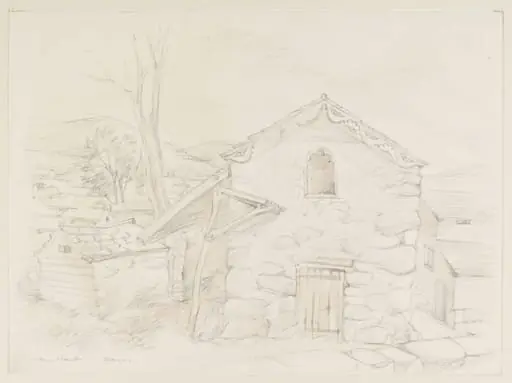
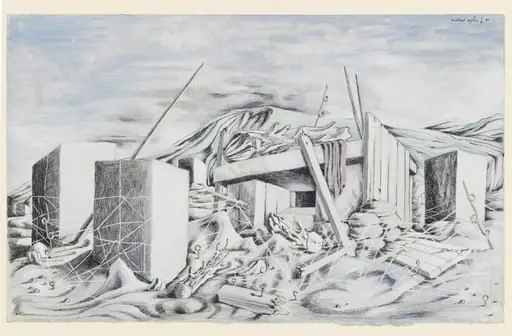
This sketch shows a row of empty wooden chairs stacked on a rocky hillside. The chairs lean against each other, some tipped over. A few birds stand or walk on the ground near the chairs, and the background is a simple, hilly landscape drawn in light pencil strokes.
The artist signed it in the corner with their initials and the year 1942. The chairs look ready for an event that never happened, left behind on the hill.
Next, look up Eldridge, Mildred E. to see more of her work.
Overview
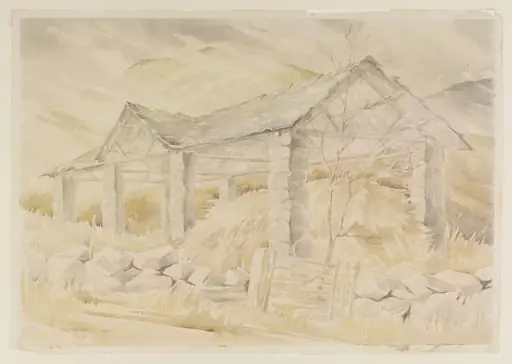
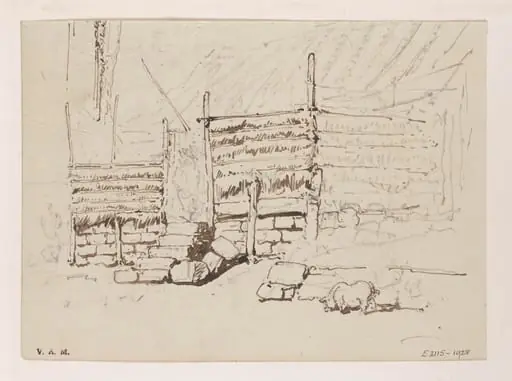
Mildred E. Eldridge’s 1942 watercolour records a quiet rural scene in Merionethshire. Two wooden cart cradles, known locally as gamboes, rest against a stone wall while low hills rise in the distance. A few birds scatter across the ground, adding a subtle sense of movement to the otherwise still composition.
Subject & Meaning
The painting captures a moment of traditional Welsh farming life, emphasizing the utilitarian gambo—a two‑wheeled cart once common in South Wales and the Marches. By focusing on everyday agricultural equipment, Eldridge highlights the continuity of local practices amid the broader disruptions of wartime Britain.
Technique & Style
Executed in transparent watercolour, the work relies on delicate washes to render the stone wall and rolling hills, while finer pencil strokes suggest the texture of the carts and the birds’ forms. The limited palette and soft edges convey a muted atmosphere appropriate to the early‑1940s landscape.
History & Provenance
Created for the Recording Britain project, the piece was part of a government‑sponsored effort to document the nation’s scenery and vernacular life during World War II. Eldridge signed the lower corner with her initials and the date, confirming its inclusion in the official archive of the scheme.
Context
The Recording Britain initiative, directed by Sir Kenneth Clark, sought to preserve visual records of places threatened by wartime bombing and post‑war development. Eldridge’s contribution reflects the project’s aim to reinforce a sense of national identity by celebrating regional customs and landscapes.
Artist & collection
Artist
Mildred E. Eldridge painted the hills and barns of 1940s Wales in watercolours. She left us five small scenes of rural life, each titled by the place it shows: a stone barn in Llanrhaeadr, peat cutters near Cefn Coch,…