Artwork
Untitled
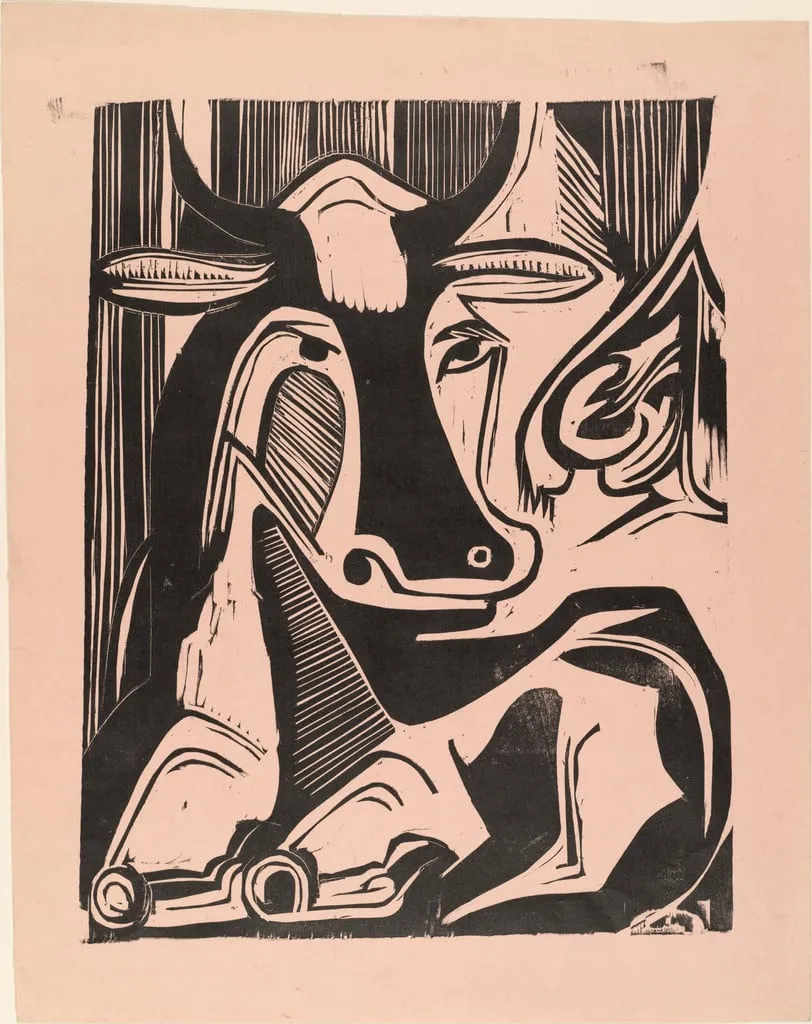
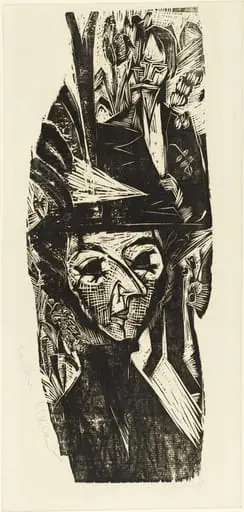
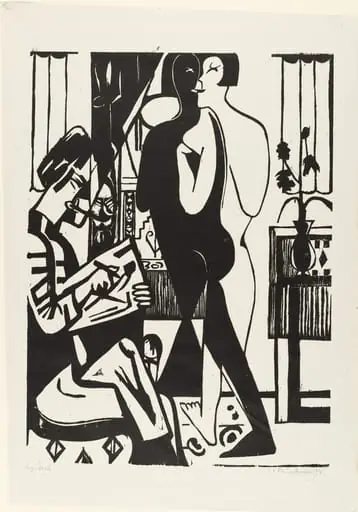
Untitled is an ink print by Ernst Ludwig Kirchner. It dates from 1929 and is held in the collection of the Museum of Modern Art.
About this work
Overview
The work exemplifies his sustained interest in the woodcut medium, where carved surfaces and inked impressions allowed for stark, emotionally charged imagery.
Ernst Ludwig Kirchner produced this woodcut in 1929, near the end of his active career. As a key figure in the German Expressionist movement and co-founder of Die Brücke, he turned to printmaking for its directness and capacity to convey psychological weight. The work exemplifies his sustained interest in the woodcut medium, where carved surfaces and inked impressions allowed for stark, emotionally charged imagery.
Subject & Meaning
The print depicts a solitary, hunched figure seated rigidly in a chair, its elongated neck and exaggerated hands suggesting physical and emotional strain. The face, rendered with minimal detail, conveys alertness or distress through large eyes and a clenched jaw. The vertical lines behind the figure evoke confinement or surveillance, reinforcing a sense of isolation. The posture and distortion imply inner tension rather than a literal scene.
Technique & Style
Kirchner employed the woodcut technique, carving away areas of a wooden block to leave raised lines that would receive ink. The resulting image relies on bold, unmodulated black forms against a pale ground, creating high contrast and graphic intensity. His use of sharp, angular lines and simplified anatomy reflects Expressionist priorities—emotional resonance over naturalism—and highlights the tactile, hand-carved quality of the medium.
History & Provenance
Created in 1929, this work dates from Kirchner’s later years, following his relocation to Davos, Switzerland, where he lived under medical care for mental health struggles. Though less publicly visible than his earlier Die Brücke years, he continued producing prints with renewed focus. This piece remains part of private and institutional collections, valued for its concise emotional power and technical clarity.
Context
In the late 1920s, German Expressionism had evolved from its radical early phase, yet Kirchner maintained its core concerns: alienation, psychological depth, and formal distortion. The woodcut’s claustrophobic composition reflects broader cultural anxieties of the Weimar era, even as Kirchner’s personal isolation grew. His continued use of printmaking aligned with a broader trend among artists seeking accessible, non-academic modes of expression.
Legacy
Kirchner’s woodcuts, including this untitled work, helped redefine printmaking as a vehicle for modern psychological expression. His emphasis on raw form and emotional immediacy influenced later generations of artists working in print and figurative art. Though less celebrated than his paintings, these prints remain essential to understanding his artistic evolution and the expressive potential of the medium.
Artist & collection
Artist
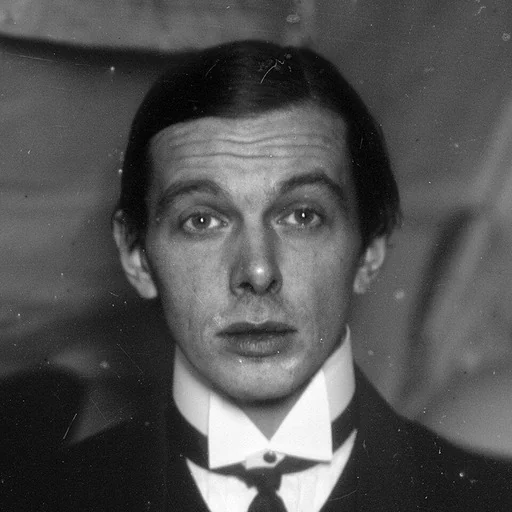
Ernst Ludwig Kirchner (6 May 1880 – 15 June 1938) was a German expressionist painter and printmaker.

![Dance Hall Bellevue [obverse], by Ernst Ludwig Kirchner](https://artifactworldgallery.com/img/ernst-ludwig-kirchner--dance-hall-bellevue-obverse--d1e14aac4297c69e-w320.webp)
![Nude Figure [reverse], by Ernst Ludwig Kirchner](https://artifactworldgallery.com/img/ernst-ludwig-kirchner--nude-figure-reverse--4b135f0364753e98-w320.webp)
![Two Nudes [obverse], by Ernst Ludwig Kirchner](https://artifactworldgallery.com/img/ernst-ludwig-kirchner--two-nudes-obverse--eb3914183f0bc96d-w320.webp)
![Dancing Couple in the Snow [reverse], by Ernst Ludwig Kirchner](https://artifactworldgallery.com/img/ernst-ludwig-kirchner--dancing-couple-in-the-snow-reverse--87ca007d7c05b553-w320.webp)