Artwork
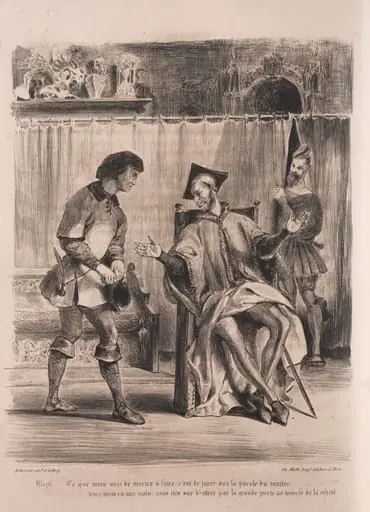
Illustrations for Faust: Faust seeks to allure Marguerite
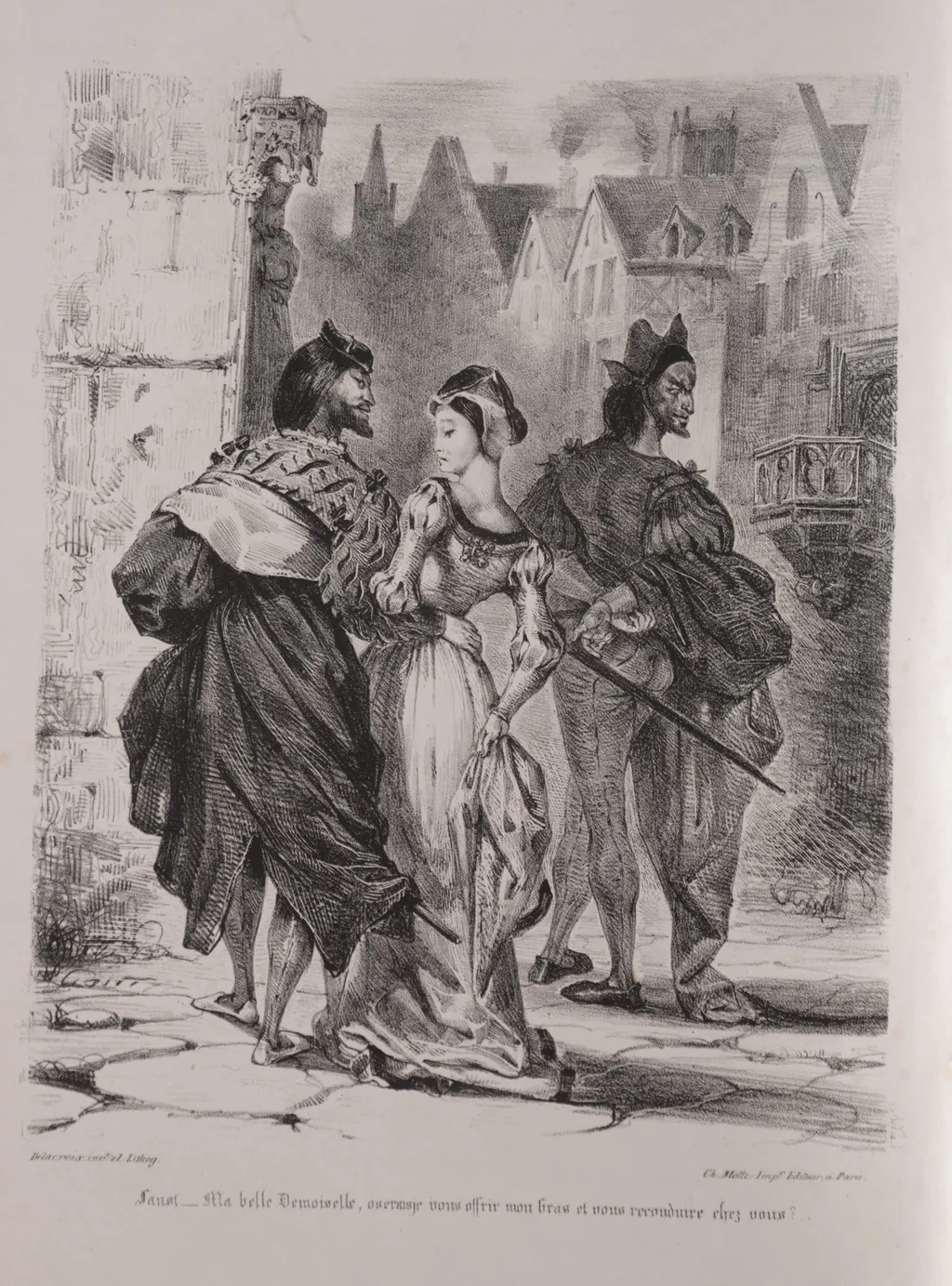
Illustrations for Faust: Faust seeks to allure Marguerite is a print by the Romanticist artist Eugène Delacroix. It dates from 1828 and is held in the collection of the Cleveland Museum of Art.
About this work
Overview
Delacroix, a central figure in French Romanticism, prioritized emotional resonance over formal polish, using loose brushwork to convey inner states.
Created in 1828, this ink drawing by Eugène Delacroix is one of a series illustrating Goethe’s *Faust*. Executed in a rapid, expressive manner, it captures a moment of psychological tension rather than narrative clarity. Delacroix, a central figure in French Romanticism, prioritized emotional resonance over formal polish, using loose brushwork to convey inner states. The work resides in The Cleveland Museum of Art’s collection as part of a broader exploration of literary themes in Romantic visual culture.
Subject & Meaning
The scene depicts Faust, accompanied by Mephistopheles, approaching Marguerite on a city street. Faust’s gesture suggests seduction, while Marguerite’s posture—tense, averted—reveals her apprehension. The figures’ contrasting demeanors underscore the moral imbalance of the encounter. Delacroix avoids overt symbolism, instead relying on body language and spatial dynamics to imply coercion and vulnerability, aligning with Goethe’s psychological depth and the Romantic preoccupation with inner conflict.
Technique & Style
Delacroix employed swift, fluid ink lines to suggest motion and emotional urgency. The sketchy rendering of clothing and architecture conveys immediacy rather than detail, echoing the influence of Rubens and Venetian colorists. Background elements like the church spire are barely suggested, directing focus to the figures’ interaction. The absence of shading and the emphasis on contour reflect a deliberate departure from Neoclassical refinement, favoring expressive spontaneity over polished finish.
History & Provenance
The drawing was produced as part of a commissioned series for an illustrated edition of Goethe’s *Faust*, though the project was never fully published. Delacroix completed several such illustrations between 1825 and 1828, exploring themes of temptation and transcendence. This particular sheet entered The Cleveland Museum of Art’s collection through established acquisition channels, preserving its role as a key example of Romantic literary illustration in 19th-century France.
Context
In the 1820s, French artists increasingly turned to literary sources to explore emotional and existential themes beyond historical or mythological subjects. Delacroix’s *Faust* illustrations emerged amid a cultural fascination with German Romantic literature and the figure of the tormented seeker. His approach contrasted with academic traditions, embracing subjectivity and dramatic intensity as valid artistic goals, helping to redefine the boundaries of visual narrative.
Legacy
Though not widely exhibited during his lifetime, Delacroix’s *Faust* drawings influenced later generations of illustrators and Symbolist painters who valued emotional ambiguity over literal storytelling. Their sketch-like quality anticipated modernist tendencies toward abstraction and psychological suggestion. Today, they remain important for understanding how Romantic ideals translated across media, bridging literature and visual art through intimate, evocative imagery.
Artist & collection
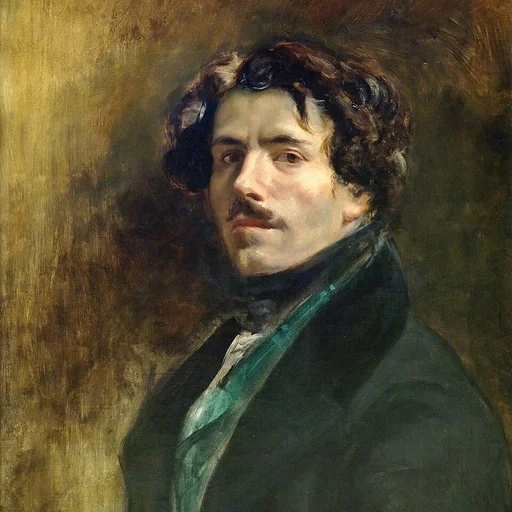
Artist
Ferdinand Victor Eugène Delacroix ( DEL-ə-krwah, -KRWAH; French: ; 26 April 1798 – 13 August 1863) was a French Romantic artist who was regarded as the leader of the French Romantic school.

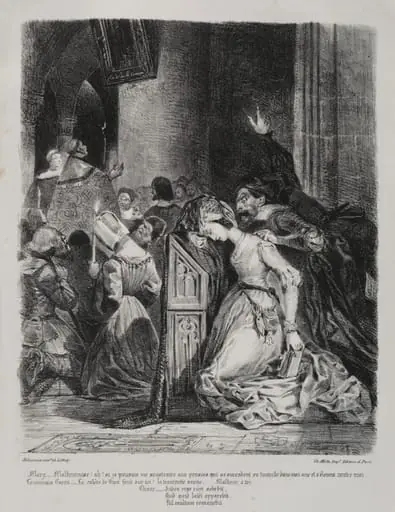 Illustrations for Faust: Marguerite at church
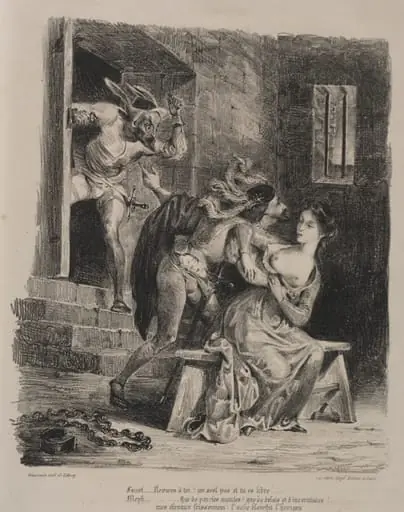 Illustrations for Faust: Faust in the prison of Marguerite
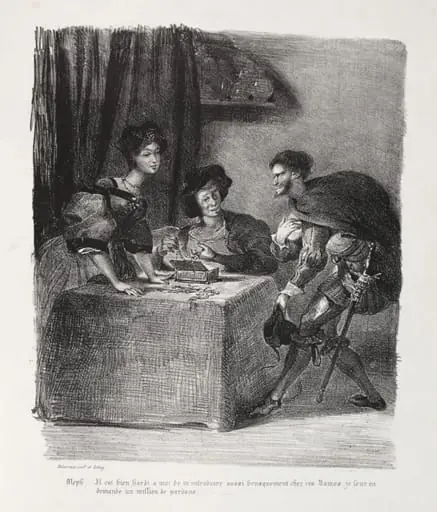 Illustrations for Faust: Méphistophelés is at Marthe
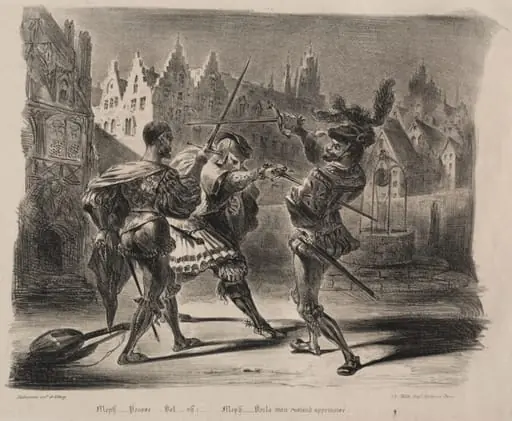 Illustrations for Faust: Duel of Faust and of Valentin
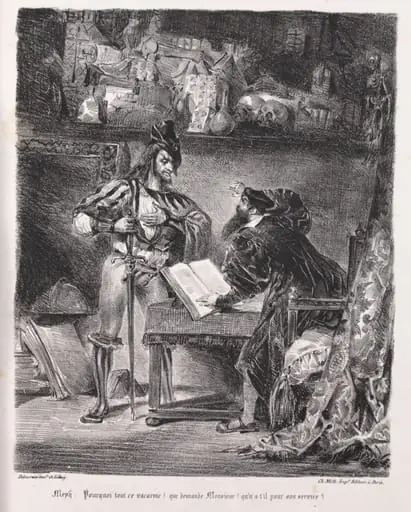 Illustrations for Faust: Méphistophélés visits Faust
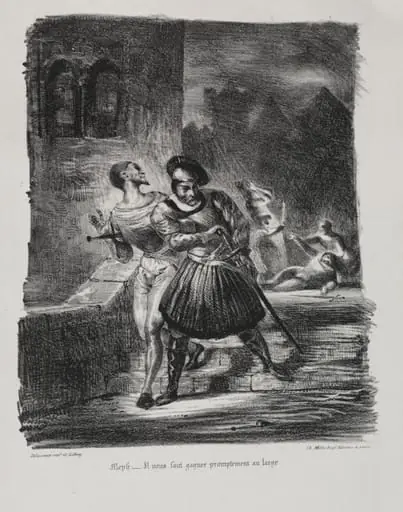 Illustrations for Faust: Méphistophélés and Faust flee after the duel
 Illustrations for Faust: Méphistophélé receives the schoolboy