Artwork
An Encampment in the Atlas Mountains
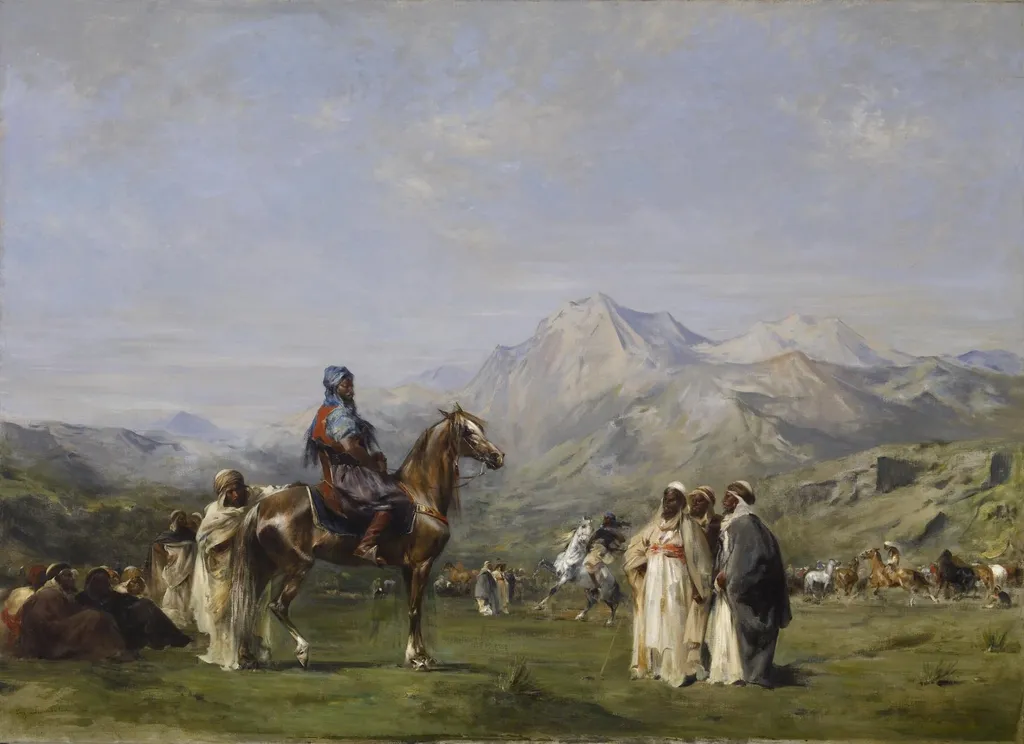
An Encampment in the Atlas Mountains is an oil painting by Eugène Fromentin. It dates from 1865 and is held in the collection of the Walters Art Museum.
About this work
Overview
The painting’s composition guides the viewer’s gaze toward the central horse and rider, while the surrounding landscape recedes into soft, atmospheric distance.
Painted in 1865 by Eugène Fromentin, this oil work captures a quiet moment in the Atlas Mountains. The scene centers on a mounted figure and a group of local figures in traditional dress, arranged with deliberate stillness. The painting’s composition guides the viewer’s gaze toward the central horse and rider, while the surrounding landscape recedes into soft, atmospheric distance. It reflects Fromentin’s interest in North African life during his travels.
Subject & Meaning
The painting portrays a moment of pause in daily travel, likely among Berber communities. The central horse and rider, dressed in vivid blues and oranges, command attention, while the seated figures engage in quiet observation. No overt narrative is given; instead, the work conveys a sense of dignity and stillness, emphasizing human presence within a vast, arid terrain. The absence of action invites contemplation of cultural routines and environmental harmony.
Technique & Style
Fromentin employed layered oil glazes to achieve subtle shifts in light and texture, particularly in the sky and distant mountains. The foreground figures are rendered with loose, confident brushwork, while the landscape behind is softened to suggest depth. Color is used not for drama but for tonal harmony—warm earth tones contrast with the cool blues of clothing and sky. The brushwork balances precision with spontaneity, reflecting both observation and emotional restraint.
History & Provenance
Created after Fromentin’s second journey to North Africa, the painting entered the Walters Art Museum’s collection in the early 20th century. It was acquired alongside other works from his travels, reflecting a growing Western interest in Orientalist subjects during the late 1800s. The painting’s provenance remains unbroken since its acquisition, preserving its original context within a collection focused on global artistic traditions.
Context
Fromentin painted this during a period when European artists increasingly traveled to North Africa, drawn by its landscapes and cultures. Unlike many contemporaries who emphasized exoticism, he sought authenticity through careful observation and respect for local customs. His approach aligned with emerging ethnographic interests, though still framed within the colonial gaze of the era. The work stands as a quiet counterpoint to more theatrical Orientalist depictions.
Legacy
The painting contributes to a nuanced body of 19th-century North African imagery, valued for its restraint and attention to detail. While not widely exhibited, it remains a key example of Fromentin’s mature style and his departure from sensationalism. Scholars recognize it as a thoughtful record of daily life, offering insight into how European artists engaged with non-Western subjects beyond stereotype.
Own this work as a print
Artist & collection

 Syrian Travel
 Eastern scene – Selling horses
 Leaving the Oasis
 Leaving the Oasis
 Riders Crossing the Desert
 The Slave Market, Constantinople
 Napoleon in Egypt
 A Caravan in the Desert
 Arabian fantasia
 Halt of Caravans at the Wells of Saba (Beersheba) in the Desert South of Hebron
 Seated Arab Man with Horse
 Une Caravane en Repos en Kabylie