Artwork
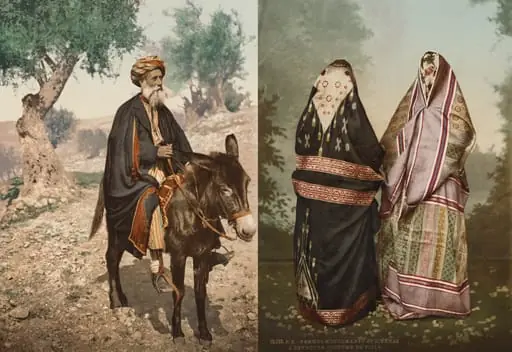
Femmes musulmanes Syriennes à Beyrouth, Costume de Ville (Two Women)
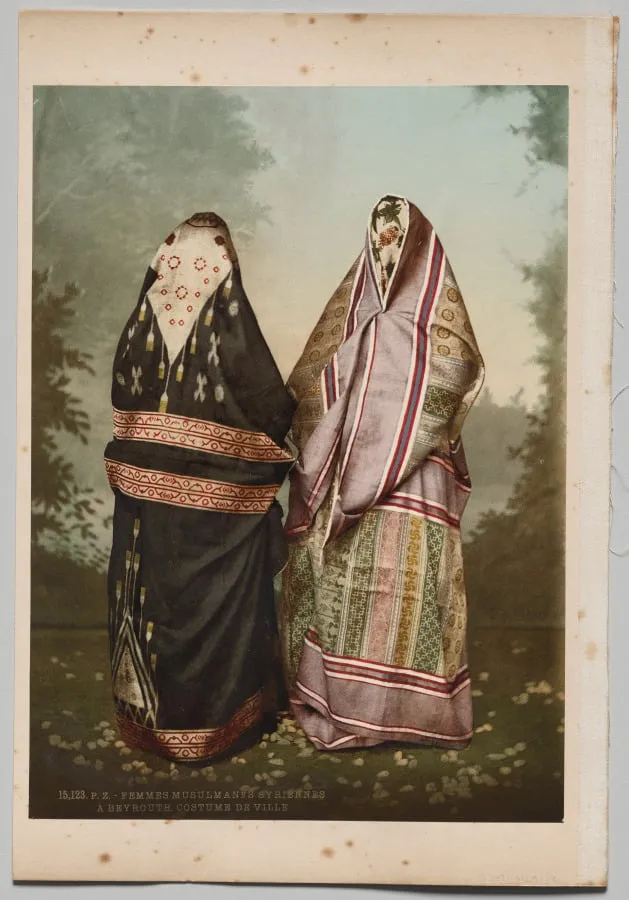
Femmes musulmanes Syriennes à Beyrouth, Costume de Ville (Two Women) is a photography by the Impressionist artist Félix Bonfils. It dates from 1884 and is held in the collection of the Cleveland Museum of Art.
About this work
Later, it became a photochrom — a hand-colored print made using multiple stones, each with a single ink.
Two women in long white robes and face veils stand side by side on a stone balcony in Beirut. Behind them, laundry hangs on a line, and palm trees rise into a soft blue sky. Their dark eyes look directly at the viewer.
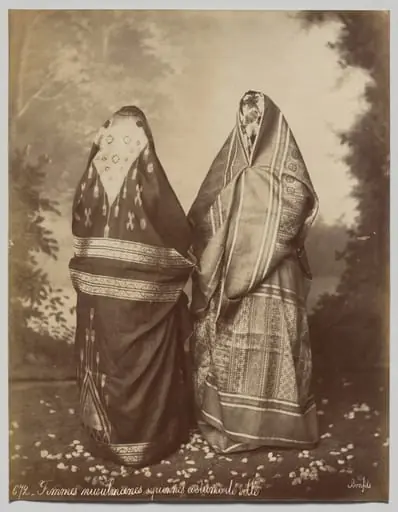
This image started as a photograph taken by Félix Bonfils in the 1880s. Later, it became a photochrom — a hand-colored print made using multiple stones, each with a single ink. The printers who added color had never seen Beirut or its light, yet tried to make it feel real.
For more early color views of the Middle East, look up the artist: Félix Bonfils (French, 1831–1885).
(Word count: 117)
Overview
This image began as a photograph by Félix Bonfils in the 1880s, capturing two Syrian Muslim women on a Beirut balcony. Later, it was transformed into a photochrom—a hand-colored print produced through lithographic stones, each applying a single hue to the monochrome base. Though mass-produced for Western audiences between the 1890s and 1910s, the coloring process relied on imagination rather than firsthand observation of the scene’s actual light and palette.
Subject & Meaning
The two women, dressed in long white robes and face veils, stand calmly on a stone balcony, their gaze meeting the viewer directly. Behind them, laundry dries on a line and palm trees frame the soft blue sky. Their stillness and direct eye contact convey dignity and presence, resisting exoticization. The setting suggests domestic life in late 19th-century Beirut, offering a quiet, unromanticized glimpse into everyday urban existence.
Technique & Style
The photochrom process involved transferring Bonfils’s negative onto multiple lithographic stones, each inked with a distinct color and layered to build a full-tone image. Printers, unfamiliar with Beirut’s environment, relied on textual descriptions or conventional color associations to assign hues. The result is a stylized realism: the sky is uniformly blue, the robes white with subtle tonal shifts, and shadows rendered in muted grays, creating a decorative, almost theatrical effect.
History & Provenance
Félix Bonfils, a French photographer based in Beirut, documented the Levant extensively from the 1860s until his death in 1885. His negatives were later licensed to commercial studios that produced photochroms for European and American markets. This particular image circulated widely in albums and as wall decorations, serving as both souvenir and visual artifact of a region increasingly viewed through a colonial lens.
Context
During the late 19th century, photochroms were among the first widely available color images of distant lands, catering to European curiosity about the Middle East. Beirut, under Ottoman rule, was a cosmopolitan port, yet these prints often flattened cultural specificity into picturesque stereotypes. The absence of the colorists’ direct experience underscores the gap between lived reality and the mediated images consumed abroad.
Legacy
Bonfils’s photographs, including this one, remain key records of Ottoman-era Syria and Lebanon. While the photochrom version reflects the commercialization of Eastern imagery, the original negative preserves a more authentic visual record. Today, these works are studied for their dual role: as historical documents and as artifacts of early visual globalization, revealing how perception was shaped by technology and distance.
Artist & collection

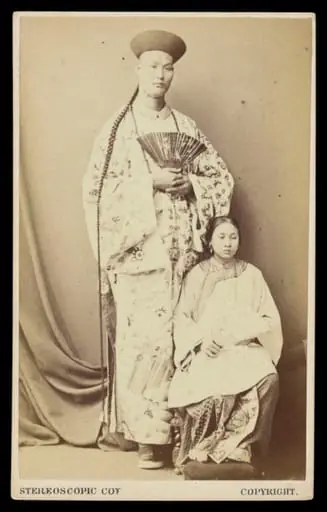 A portrait of Chang Woo Gow and Kin Foo
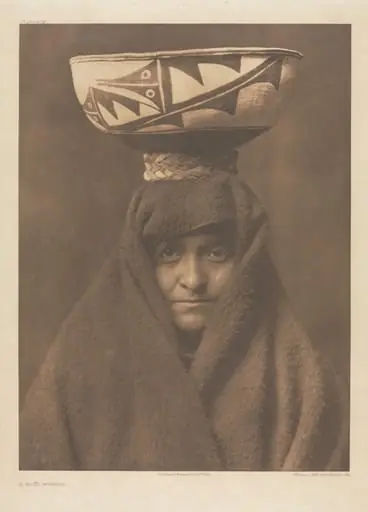 Portfolio XVII, Plate 614: A Zuñi Woman
 A lady on a walk with her maid
 Portfolio XVII, Plate 610: Zuñi Girls at the River
 Algerian Woman
 Portfolio XVI, Plates 544- 579
 Una Señora desfrasada en paseo
 Two Manipuri dancing-girls standing together holding hands.
 Melle. Rachel, dans Valéria
 Guy Little Theatrical Photograph