Artwork
Deer Hunt (La chasse au cerf)
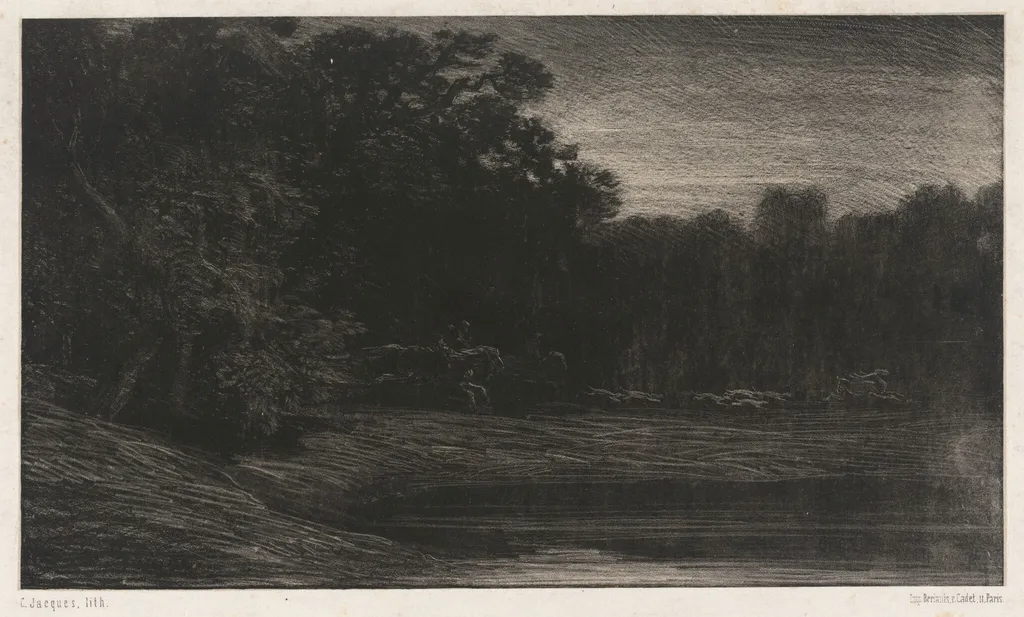
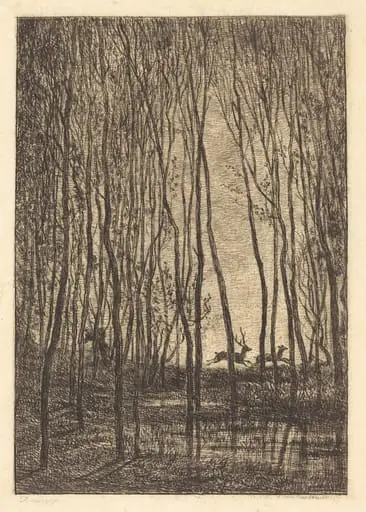
Deer Hunt (La chasse au cerf) is an ink print by the Impressionist artist Charles Émile Jacque. It dates from 1853 and is held in the collection of the National Gallery of Art.
About this work
This print shows a dark forest at dusk, with thick trees blocking most of the light.
This print shows a dark forest at dusk, with thick trees blocking most of the light. In the lower half, a group of deer moves through the shadows near a river. The sky is faint, almost erased, while the water has quick, sketchy lines.
The artist used a rough, scratchy style to show movement and mood. This was made in 1853 using a method that lets you draw directly onto stone.
Next, look up lithography to see how this print was made.
Overview
Deer Hunt (La chasse au cerf) is a lithograph created by Charles Émile Jacque in 1853, depicting a nocturnal forest scene with deer near a river.
Subject & Meaning
The print captures a serene, dusk-time moment in a dense forest, focusing on a group of deer moving through shadows by a river, evoking a sense of natural, unobserved life.
Technique & Style
Jacque employed a rough, scratchy lithographic technique to convey movement and atmospheric mood, characterized by heavy shading in the trees, sketchy river lines, and a subdued, faint sky.
History & Provenance
Created in 1853, the work utilizes the direct-drawing-on-stone method inherent to lithography, a technique pioneered in the late 18th century.
Context
Part of the mid-19th-century artistic landscape, Deer Hunt reflects the era's interest in naturalistic, everyday subjects, potentially aligning with emerging Realist movements in France.
Legacy
While specific legacy details of Deer Hunt are not highlighted, it contributes to Jacque's broader oeuvre and the historical development of lithography as an artistic medium.
Artist & collection


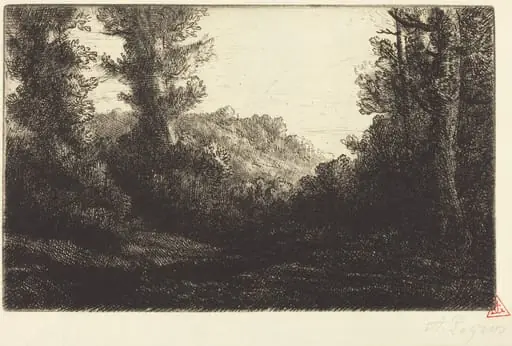 Edge of a Wood (Lisiere de bois)
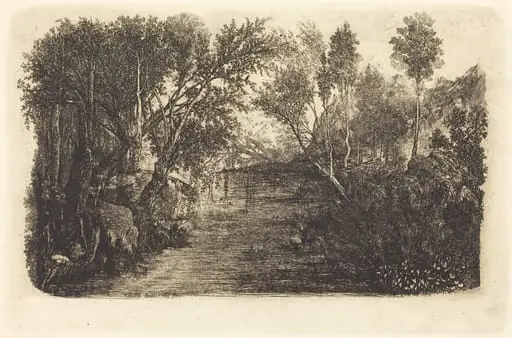 The Water's Course
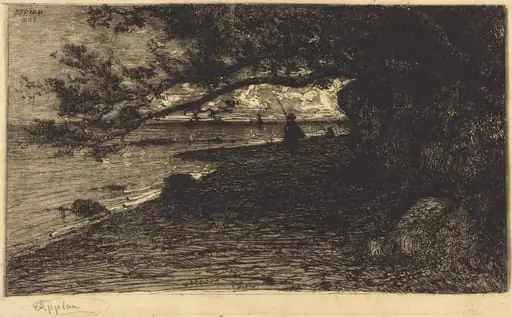 A Villefranche-sur-Mer
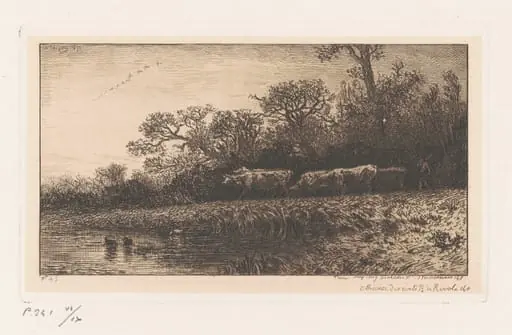
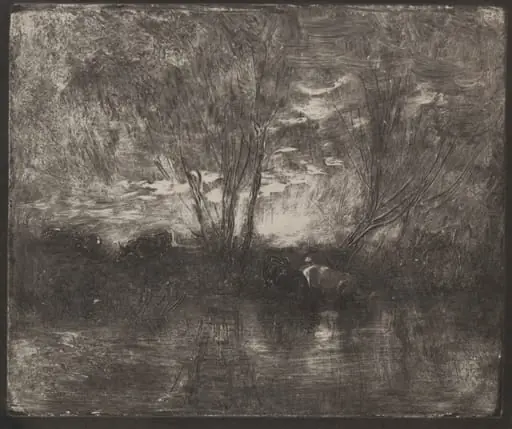 Cows at a Watering Place
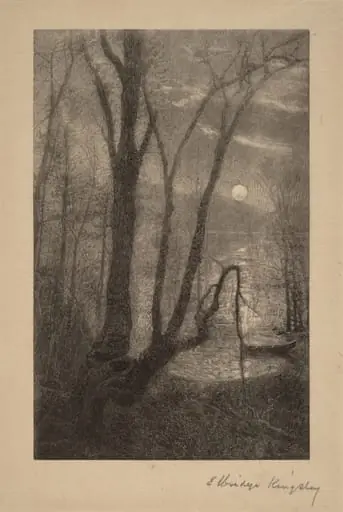 Summer by the Lakeside
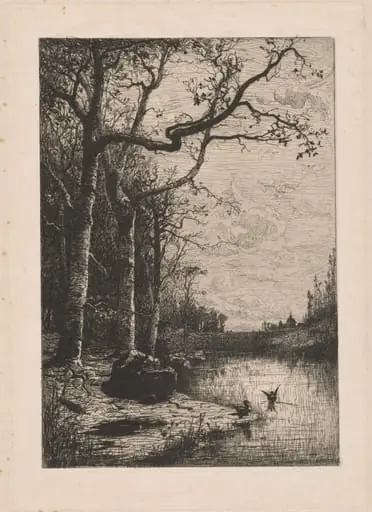 The Marshes of Burbanche (Marais de la Burbanche)
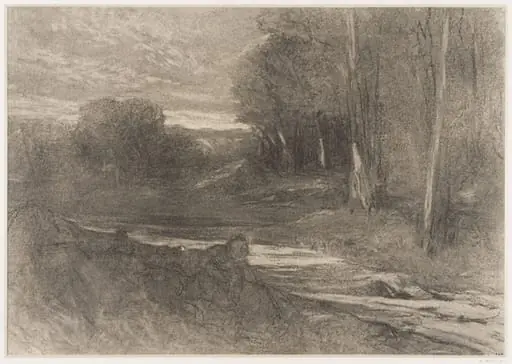 By the Waters of Babylon.
 The New Moon
 Crouching Man (L’Homme accroupi)
 Riverbank (Bord de la riviere)
 Wooded Landscape beside a River
 Deer in the Woods (Les Cerfs sous bois)