Artwork
The Protest
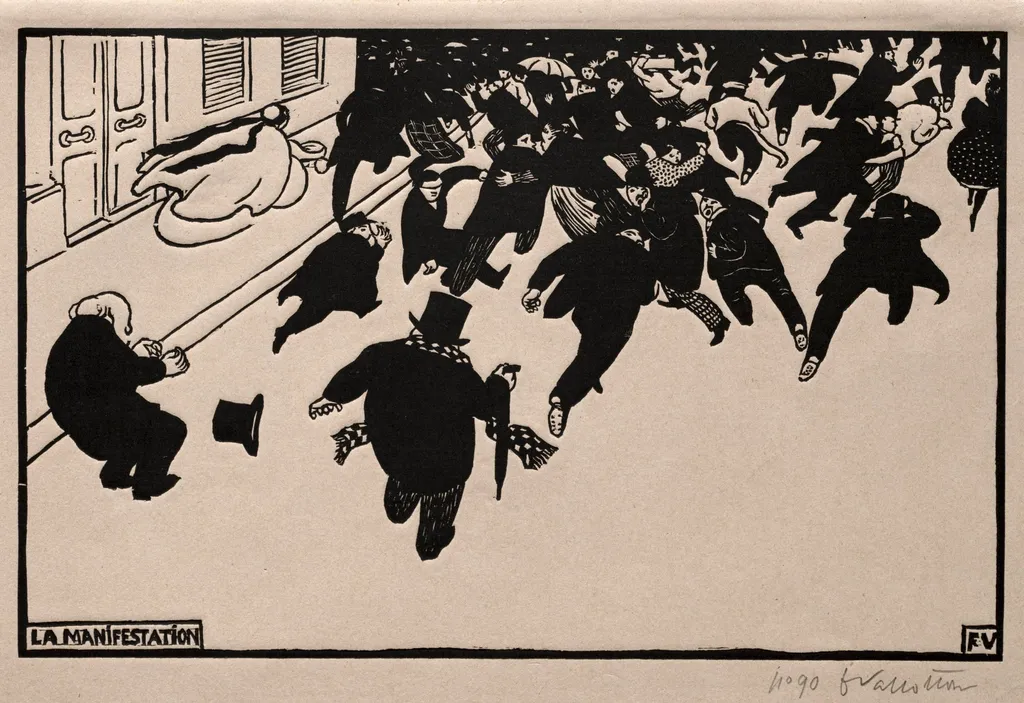
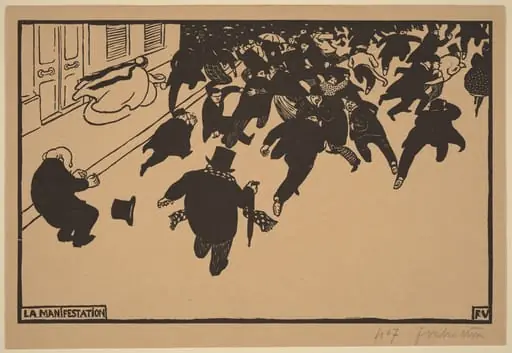
The Protest is a print by the Impressionist artist Félix Vallotton. It dates from 1893 and is held in the collection of the Cleveland Museum of Art.
About this work
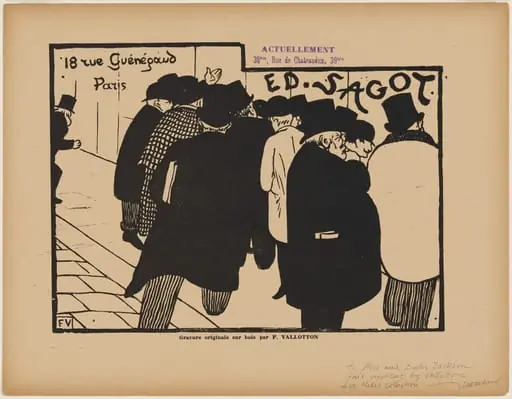
You see a crowd of people pushing forward, their faces blurred, while police in dark uniforms block them.
You see a crowd of people pushing forward, their faces blurred, while police in dark uniforms block them. The scene feels tight and tense, like a snapshot of chaos.
Vallotton made this during a time when Paris streets were full of protests. He used bold black shapes against white space to make the scene feel urgent. The empty corner at the bottom right is strange—it pulls your eye into the action.
Look up more works about France, 19th century to see how other artists showed these moments.
Overview
Félix Vallotton’s print *The Protest* captures a chaotic street clash, depicting a dense crowd surging forward while uniformed police form a barrier. The composition is dominated by stark black ink against the white paper, creating a sense of immediacy. A large empty space occupies the lower‑right third of the sheet, drawing the viewer’s eye toward the tumultuous center.
Subject & Meaning
The image reflects the frequent political demonstrations that roiled Paris in the 1890s. Vallotton presents the fleeing crowd with blurred faces, emphasizing collective panic rather than individual identity, while a few comic details—a man reaching for his hat, a rotund figure with an umbrella—soften the harshness of the police’s intervention.
Technique & Style
Inspired by Japanese colour woodcuts, Vallotton employs a tipped perspective and patterned surfaces, but reduces the palette to black and white. The contrast between dense ink blocks and the surrounding void heightens the visual tension, and the deliberate blank corner serves as a modernist compositional device that accentuates movement.
History & Provenance
Created during a period of frequent street riots in Paris, the print aligns with Vallotton’s broader interest in social issues of the late nineteenth century. It was produced as a woodcut, a medium through which the artist could rapidly disseminate his commentary on contemporary unrest.
Context
The work belongs to a wave of French artists who turned to urban disorder as subject matter, echoing the realism of the era while integrating aesthetic influences from Japanese prints. Vallotton’s approach combines documentary observation with a stylized, almost graphic, visual language.
Artist & collection
Artist
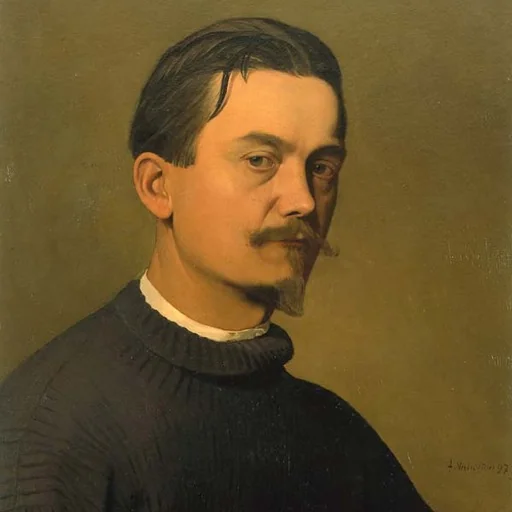
Félix Édouard Vallotton (French: ; December 28, 1865 – December 29, 1925) was a Swiss and French painter and printmaker associated with the group of artists known as Les Nabis.