Artwork
Au Violon (Off to the Jug)
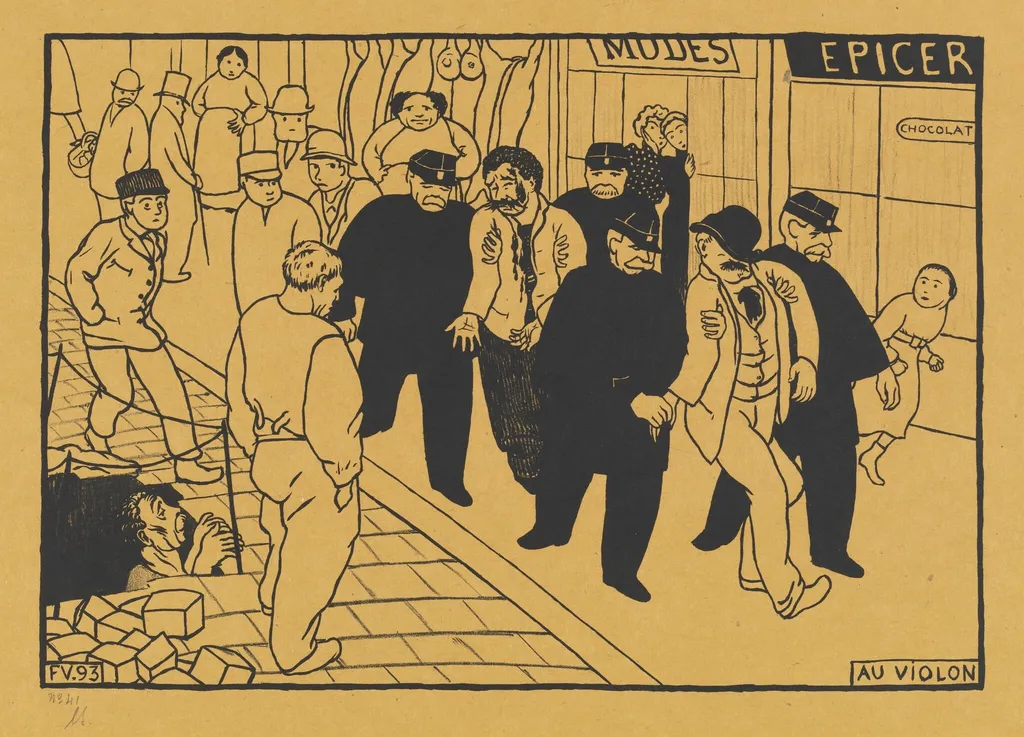
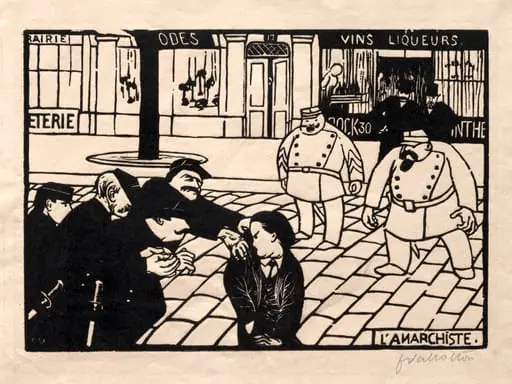
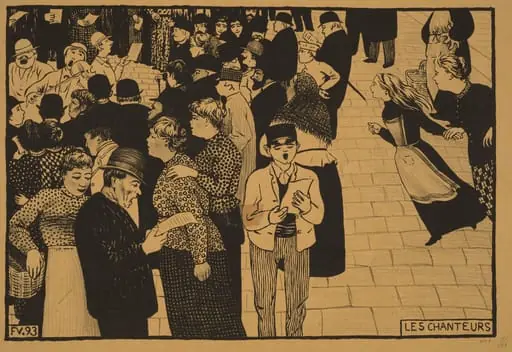
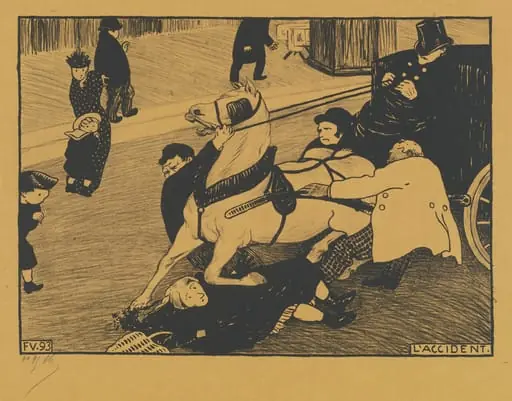
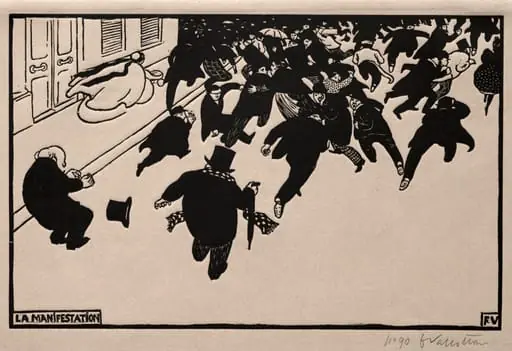
Au Violon (Off to the Jug) is an ink print by the Impressionist artist Félix Vallotton. It dates from 1893 and is held in the collection of the National Gallery of Art.
About this work
Overview
Unlike traditional prints, it embraces a raw, almost sketchlike quality, achieved through bold black lines and unmodulated color on a warm-toned paper.
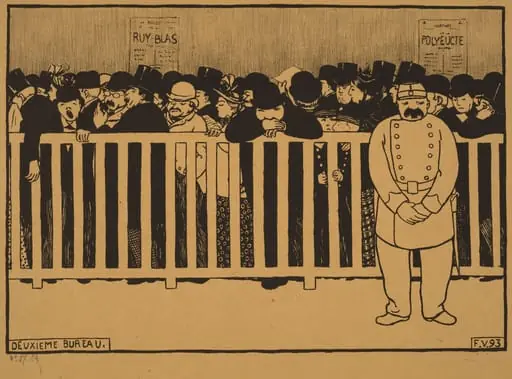
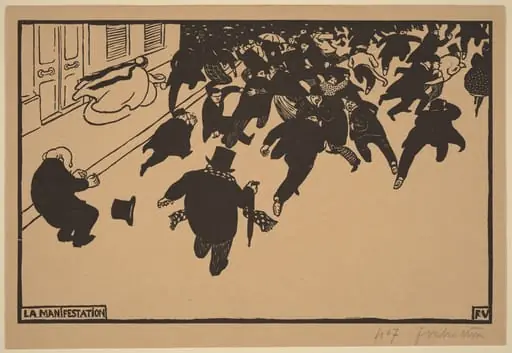
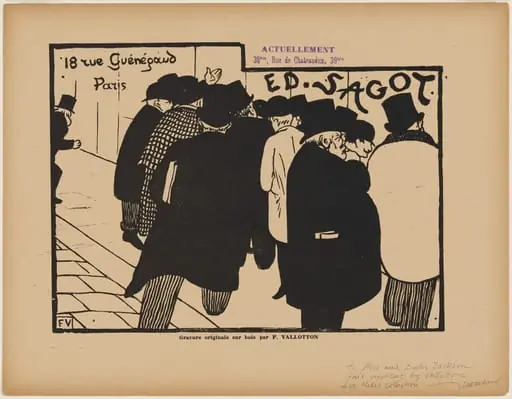
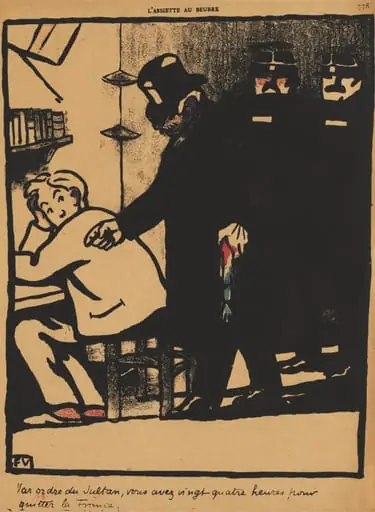
Created in 1893, *Au Violon (Off to the Jug)* is a lithograph on yellow wove paper by Swiss-French artist Félix Vallotton. Produced during his involvement with the Les Nabis, the work reflects the group’s interest in flattened forms and graphic clarity. Unlike traditional prints, it embraces a raw, almost sketchlike quality, achieved through bold black lines and unmodulated color on a warm-toned paper.
Subject & Meaning
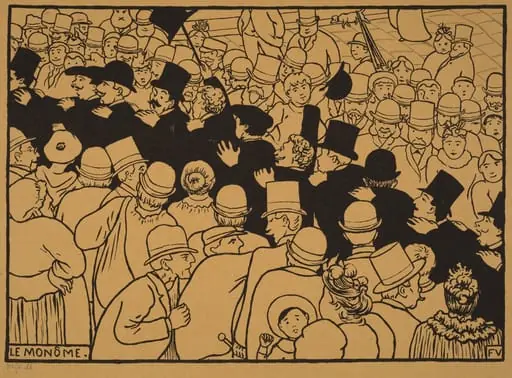
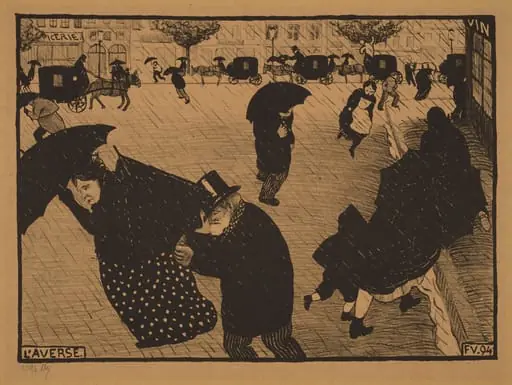
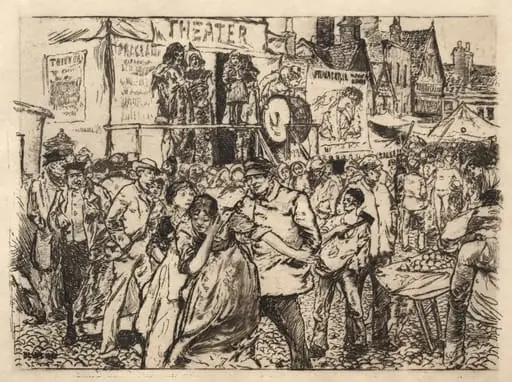
The scene captures a crowded interior, possibly a neighborhood shop or tavern, where figures are densely packed in a moment of informal gathering. A shirtless man stands at the center, holding hands with another, while children peer from behind adults and a woman clutches a child. Signs reading "Modes" and "Épicer" suggest a commercial space, hinting at the intersection of daily life and commerce in late 19th-century urban France.
Technique & Style
Vallotton employed lithography on zinc to produce sharp, linear contours and flat areas of tone. The absence of shading and the use of heavy outlines create a stylized, almost theatrical effect. The yellow paper enhances the contrast with black ink, lending the image a sense of immediacy and roughness, as if the scene were hastily recorded rather than meticulously composed.
History & Provenance
Made in 1893, the print emerged from Vallotton’s most active period within the Les Nabis, a collective of avant-garde artists exploring symbolic and decorative forms. While the work was not widely exhibited during his lifetime, it became part of broader interest in modern printmaking. Its survival in private and institutional collections reflects its role in documenting the era’s graphic innovations.
Context
In 1890s Paris, lithography was gaining traction as a medium for artists seeking alternatives to academic painting. Vallotton’s work aligned with a growing trend toward depicting ordinary life with psychological detachment. The crowded, unidealized interior echoes the social realism of the time, while its stylization distances it from naturalism, reflecting the Nabis’ interest in abstraction and symbolic structure.
Legacy
*Au Violon* exemplifies how printmaking became a vehicle for modernist experimentation beyond painting. Vallotton’s use of line and composition influenced later graphic artists and illustrators, particularly in the development of expressionist and satirical imagery. The work remains a key example of how everyday scenes could be transformed through formal rigor and emotional restraint.
Own this work as a print
Artist & collection
Artist
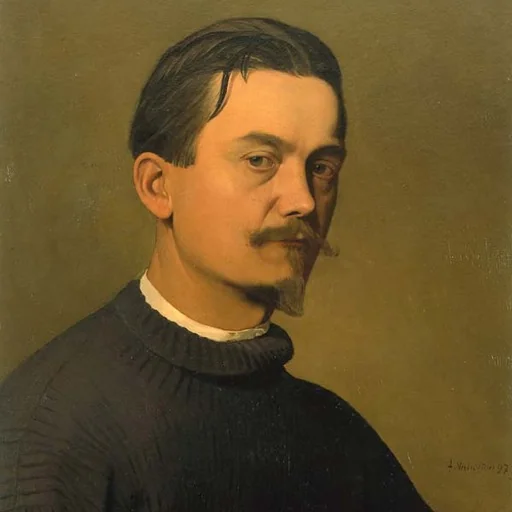
Félix Édouard Vallotton (French: ; December 28, 1865 – December 29, 1925) was a Swiss and French painter and printmaker associated with the group of artists known as Les Nabis.