Artwork
The Council of Trent with Saint Thomas Vanquishing the Heretics
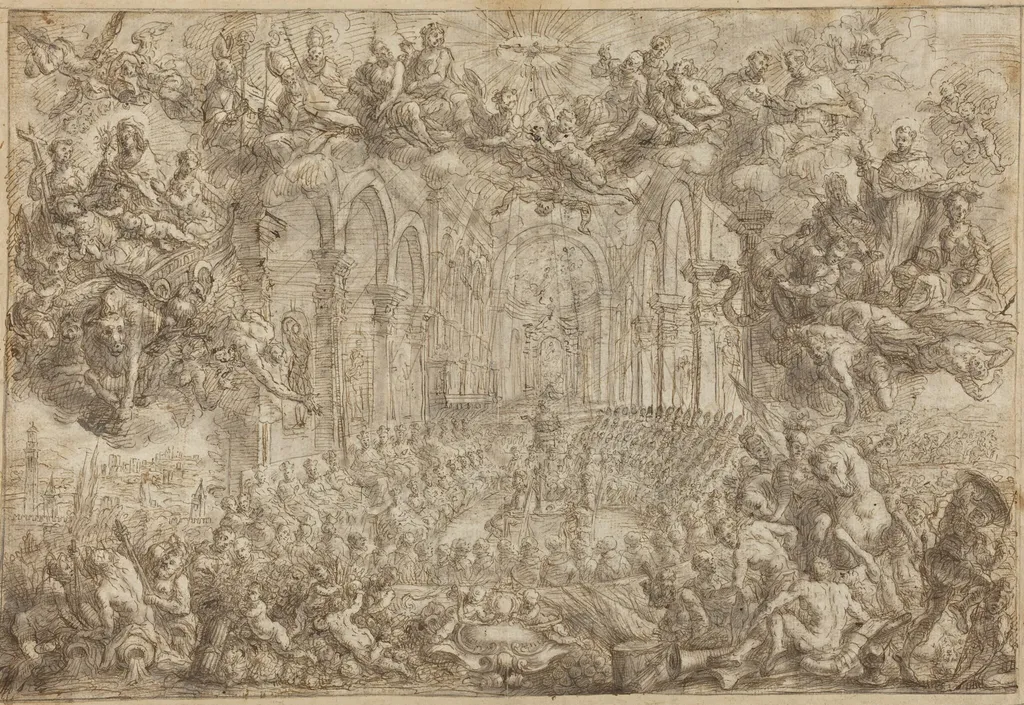
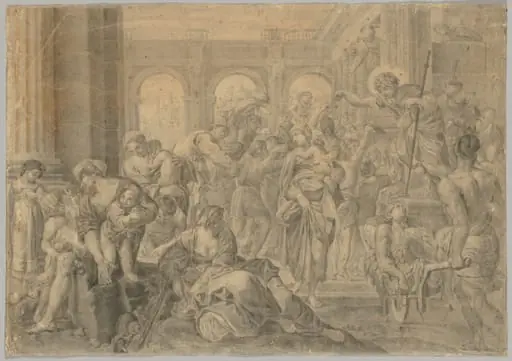
The Council of Trent with Saint Thomas Vanquishing the Heretics is an ink drawing by the Baroque artist Biagio Falcieri. It dates from 1680 and is held in the collection of the National Gallery of Art.
About this work
Overview
The work belongs to a tradition of religious drawings used to visualize theological debates, blending documentary intent with symbolic narrative.
This ink and wash drawing by Biagio Falcieri, dated around 1680, depicts a dramatic ecclesiastical gathering centered on the Council of Trent. Executed on laid paper with black chalk underdrawing, it captures a moment of doctrinal authority through dense figural composition. The work belongs to a tradition of religious drawings used to visualize theological debates, blending documentary intent with symbolic narrative.
Subject & Meaning
The scene portrays the Council of Trent as a moment of doctrinal consolidation, with Saint Thomas Aquinas depicted as a spiritual force confronting heresy. Figures are arranged to emphasize hierarchy and conviction, their gestures and gazes directing attention toward the central theological confrontation. The inclusion of the saint as an active agent reinforces the Counter-Reformation ideal of orthodoxy triumphing through intellectual and divine authority.
Technique & Style
Falcieri employed pen and ink with gray wash over black chalk to model volume and depth, creating tonal contrasts that define crowded spaces and individual postures. The linear precision of the ink outlines, combined with the soft gradations of wash, reflects Baroque tendencies toward dynamic movement and atmospheric density. The composition’s layered depth and energetic clustering align with contemporary Italian draftsmanship of the late 17th century.
History & Provenance
The drawing likely originated as a preparatory study or devotional illustration for a larger commission, possibly linked to ecclesiastical patrons in central Italy. Its survival suggests it was valued for its theological clarity and technical skill. No documented ownership prior to the 19th century is known, but its condition and medium indicate it was preserved within a private or religious collection rather than publicly displayed.
Context
Created in the decades following the Council of Trent’s conclusion, the drawing responds to the Catholic Church’s efforts to reaffirm doctrine amid Protestant challenges. Artists were commissioned to visualize key moments of reform, using imagery to educate and inspire fidelity. Falcieri’s work fits within a broader wave of Counter-Reformation visual propaganda, where drawing served both as study and as a tool of spiritual persuasion.
Legacy
Though not widely reproduced, the drawing exemplifies how religious institutions relied on draftsmanship to communicate complex theological narratives. Its survival offers insight into the role of preparatory works in Baroque ecclesiastical art, revealing how ideas of authority and orthodoxy were visually constructed. It remains a quiet but significant record of 17th-century Catholic intellectual culture.
Artist & collection


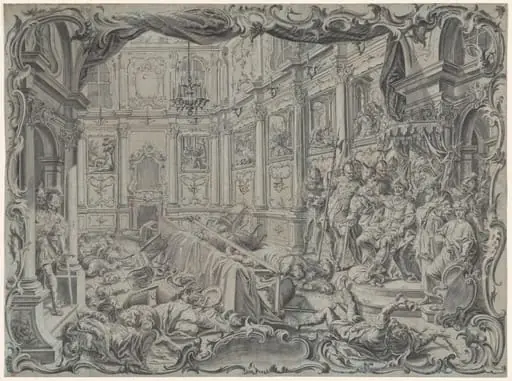 Absalom Orders the Murder of Amnon at a Feast in His Palace
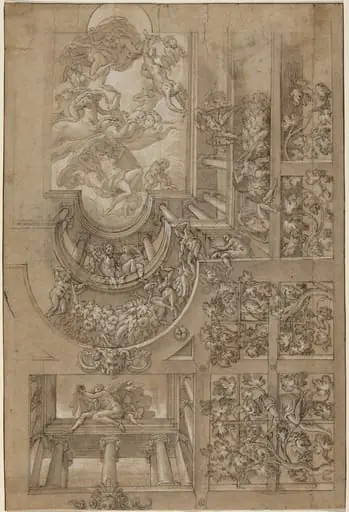 Illusionistic Ceiling with a Grape Arbor, Figures Poised on Galleries, and a Central Scene of Olympian Gods
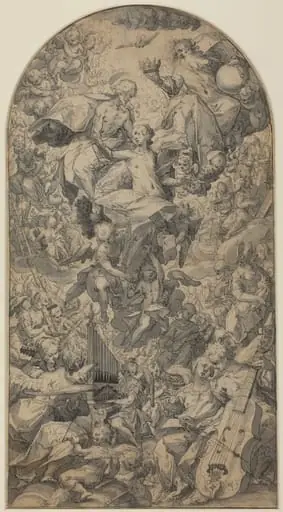 The Coronation of the Virgin with Angel Musicians and All Saints
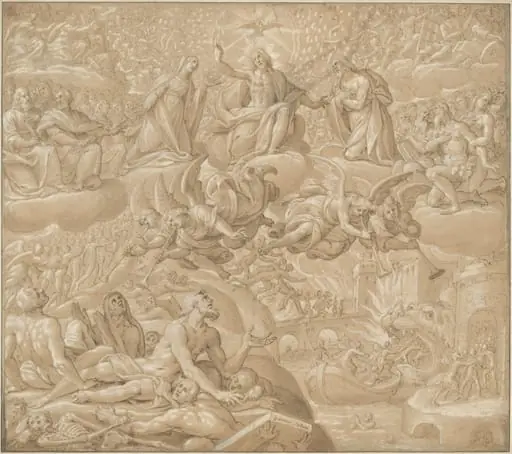 The Last Judgment
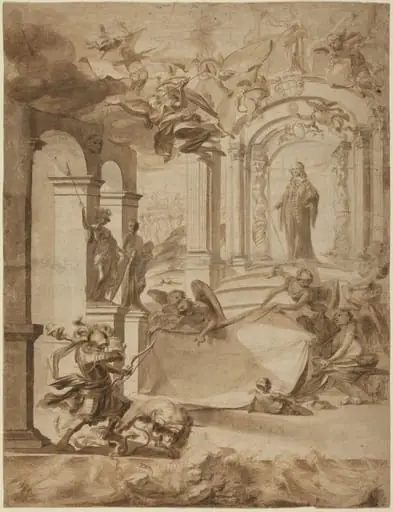 Allegory in Honor of a Gentleman
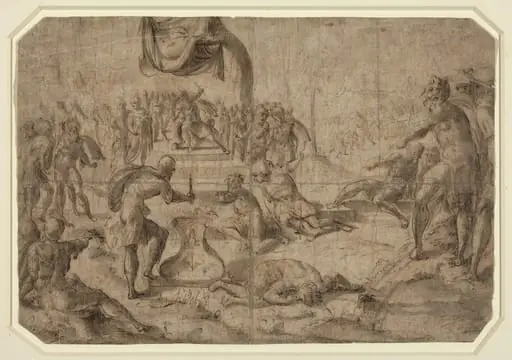 Sacrifice Scene (Gaius Mucius Scaevola?)
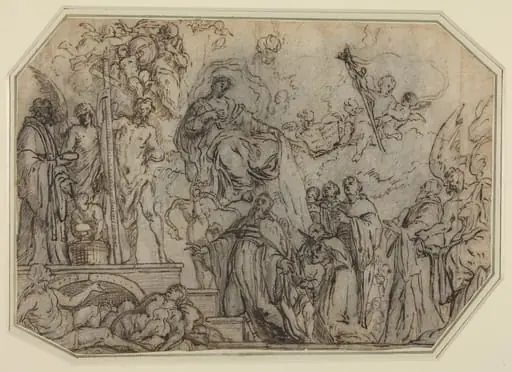 The Trinity and the Virgin Appearing to Ecclesiastics
 Preliminary design for the ceiling of the Upper Hall at Greenwich
 The Disputation of Saint Catherine of Alexandria
 A Roman Triumph
 Historical Scene
 Copy of Annibale Carracci's St. Roch Giving Alms