Artwork
Illusionistic Ceiling with a Grape Arbor, Figures Poised on Galleries, and a Central Scene of Olympian Gods
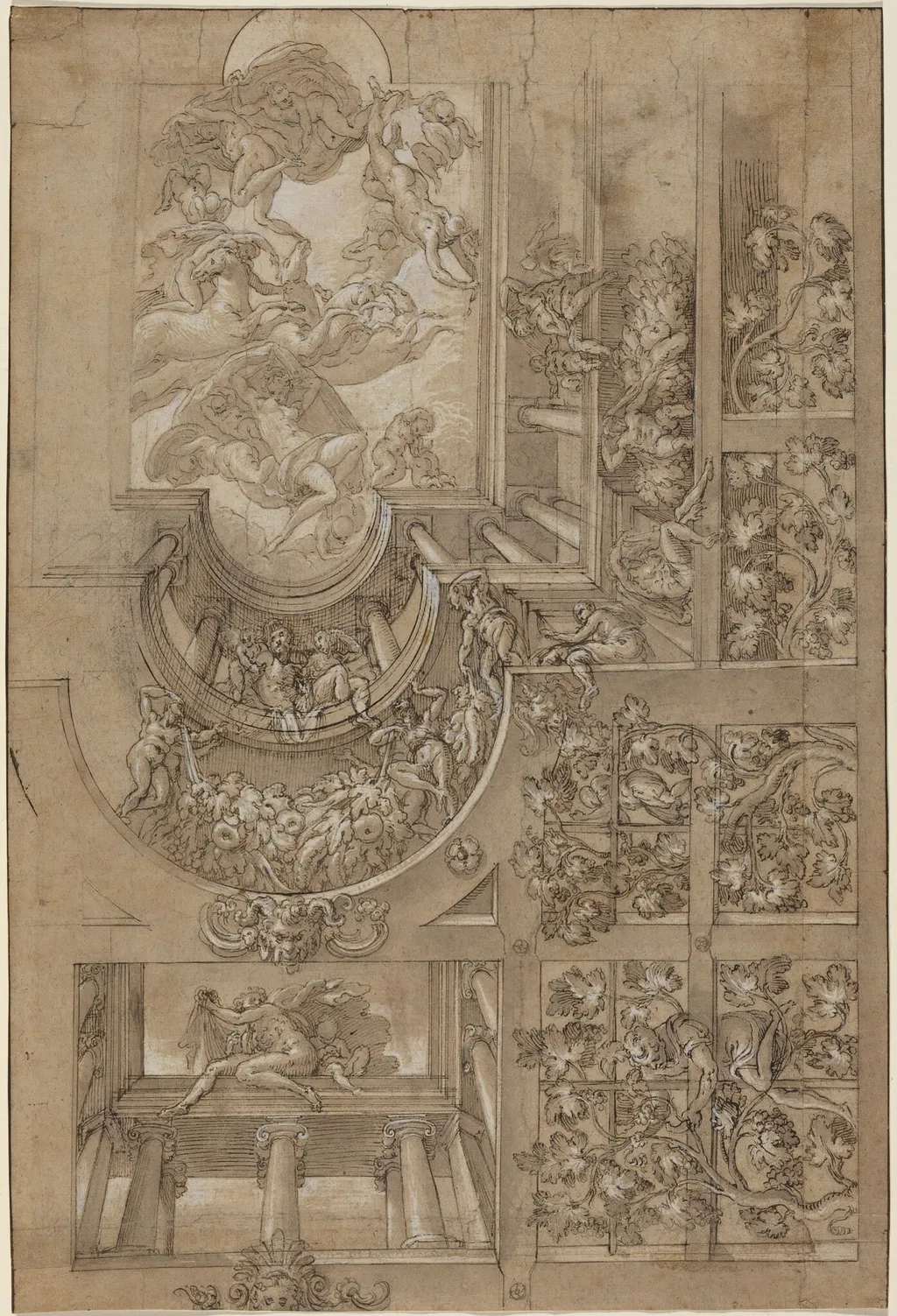
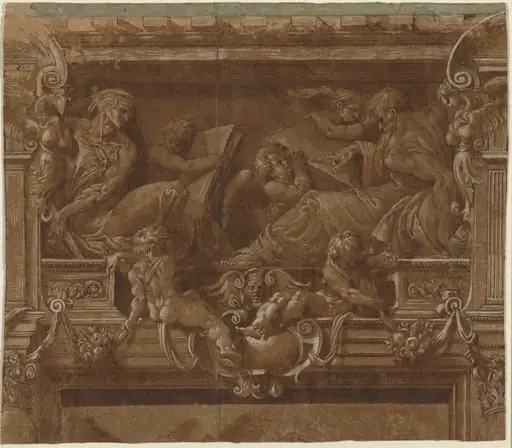
Illusionistic Ceiling with a Grape Arbor, Figures Poised on Galleries, and a Central Scene of Olympian Gods is an ink drawing by the Renaissance artist Italian 16th Century. It dates from 1585 and is held in the collection of the National Gallery of Art.
About this work
Overview
This ink drawing presents a fictional ceiling space, illusionistically constructed to appear as an architectural extension beyond the paper’s edge.
This ink drawing presents a fictional ceiling space, illusionistically constructed to appear as an architectural extension beyond the paper’s edge. The artist expanded the sheet at the right and bottom to accommodate the soaring composition. Using brown ink, wash, white highlights, and black chalk, the work simulates depth and volume, transforming a flat surface into a layered, airborne environment filled with figures and vegetation.
Subject & Meaning
At the center, a gathering of Olympian deities occupies a framed niche, suggesting a mythological scene suspended in midair. Surrounding them, a grape arbor and balconies with leaning figures evoke a festive or ceremonial setting. Smaller marginal panels contain architectural fragments and natural motifs—faces in foliage, staircases, floral patterns—hinting at a symbolic or allegorical narrative tied to abundance, divine presence, or the blurring of real and imagined space.
Technique & Style
The artist employed pen and brown ink with wash to model forms, using subtle gradations to suggest light and shadow. White highlights accentuate surfaces like grape clusters and fabric folds, while black chalk underdrawing guides the composition’s structure. Cross-hatching and fine linework define texture and dimensionality, turning two-dimensional paper into a convincing illusion of architectural space and three-dimensional figures.
History & Provenance
The drawing’s origins trace to the late Renaissance or early Baroque period, likely created as a preparatory study for a ceiling fresco or decorative scheme. Its enlarged format suggests it was intended as a presentation piece for a patron or architect. Though its exact commission remains unconfirmed, its technical precision and spatial ambition align with workshop practices in Italy during the 17th century.
Context
This work reflects the period’s fascination with illusionistic ceiling painting, a tradition rooted in Roman frescoes and revived in Renaissance architecture. Artists used such drawings to test spatial effects before executing large-scale murals. The inclusion of mythological figures and ornamental details echoes contemporary decorative programs in palaces and churches, where art aimed to elevate the viewer’s experience through visual enchantment.
Legacy
The drawing exemplifies how draftsmen mastered perspective and illusion without color or scale, influencing later ceiling designers and theatrical set painters. Its intricate marginalia anticipate the decorative excesses of Baroque interiors. Though not widely known today, it stands as a testament to the intellectual rigor and technical ingenuity of preparatory drawing in an era when architecture and myth converged in visual storytelling.
Artist & collection

Artist
A 16th-century Italian sculptor left us small bronze works in dark brown and gold.

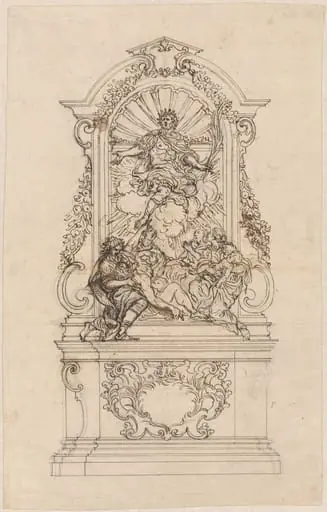 A Reliquary of Saint Sigismondo
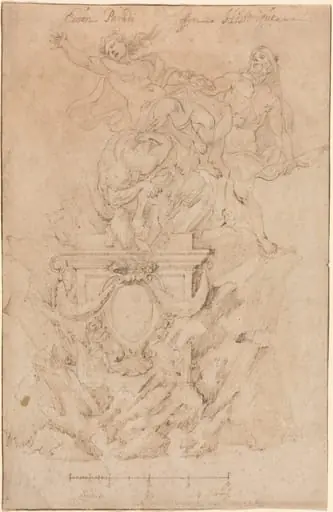 The Rescue of Deianeira
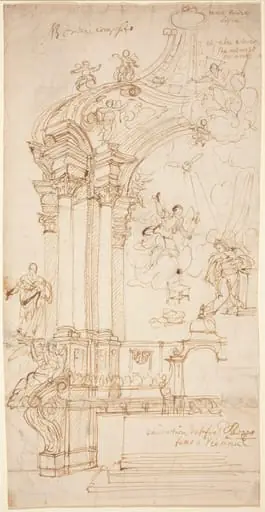 A Baldachin with a Painting of the Annunciation
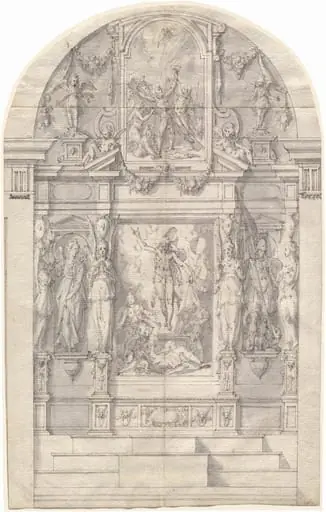 An Elaborate Altar with the Resurrection of Christ and the Martyrdom of Saint Andrew
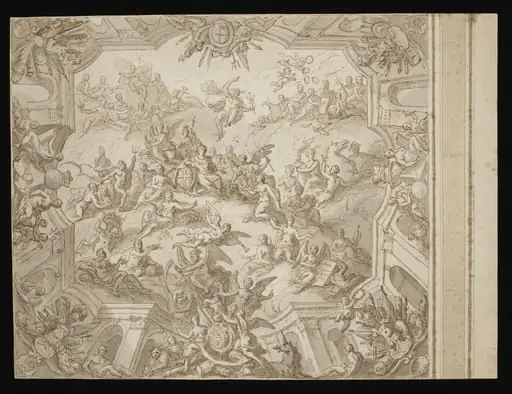 Preliminary design for the ceiling of the Upper Hall at Greenwich
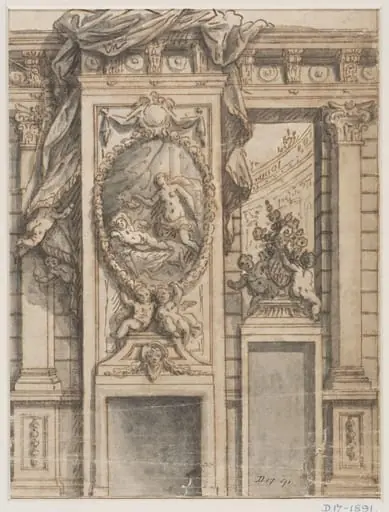 Design for wall decoration, possibly at Chatsworth, Derbyshire
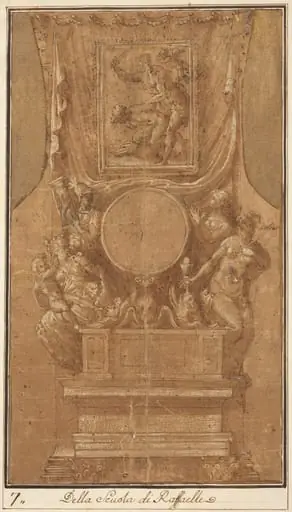 Design for an Altar
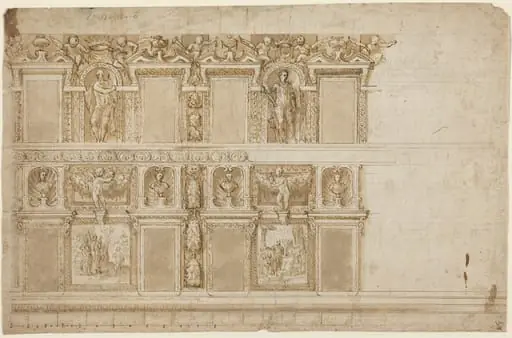 A Palatial Wall Ornamented with Sculptures and Paintings
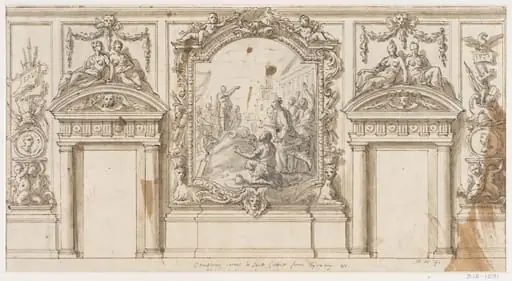 Early project design for the lower wall of the Great Hall at Moor Park, Hertfordshire