Artwork
H Beard Print Collection
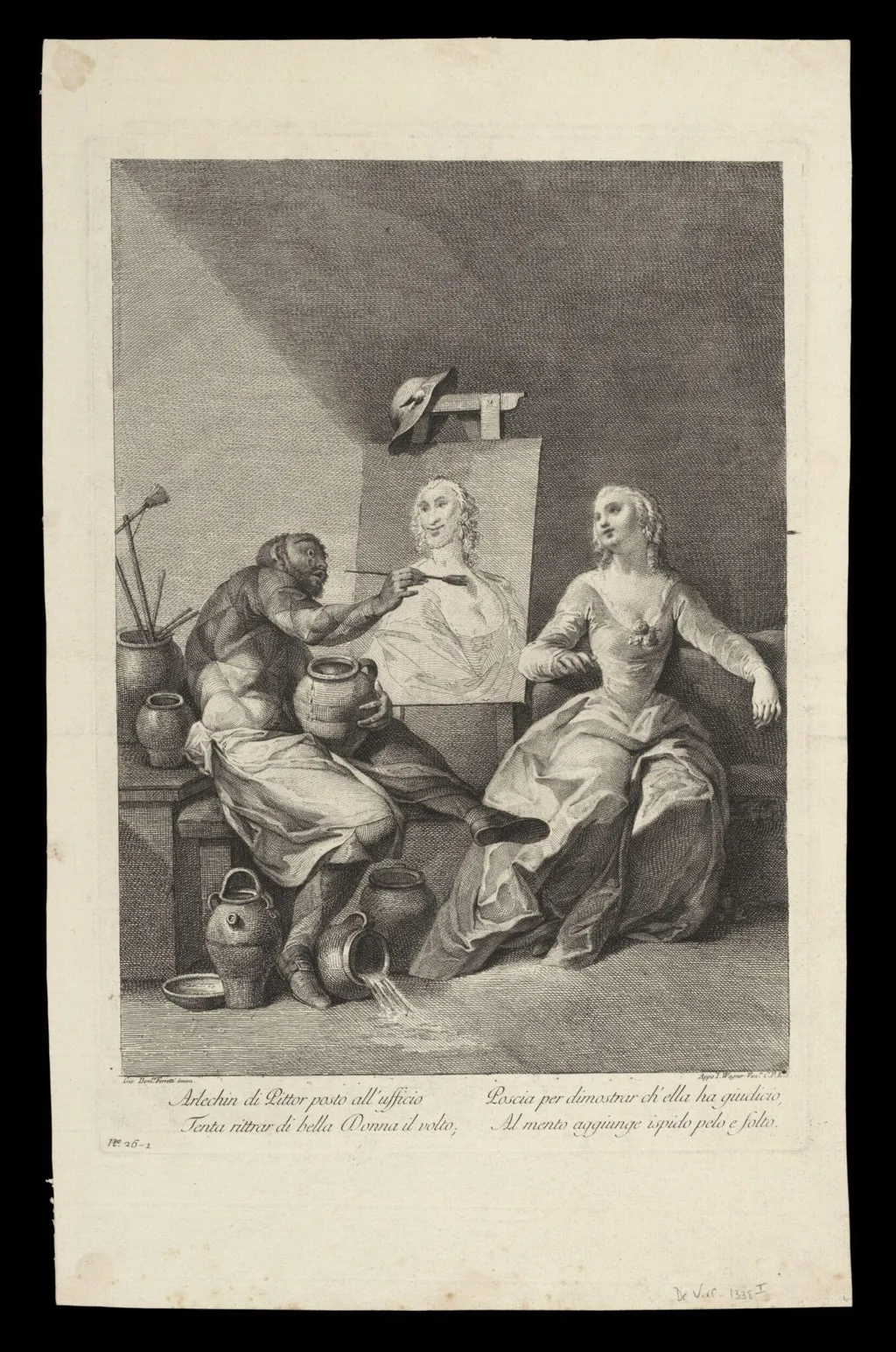
H Beard Print Collection is a print by the Romanticist artist Giovanni Domenico Ferretti. It dates from 1760 and is held in the collection of the Victoria and Albert Museum. This print is the first of four in the series 'Le 4 arlecchinate,' published in Venice by Joseph Wagner.
About this work
Overview
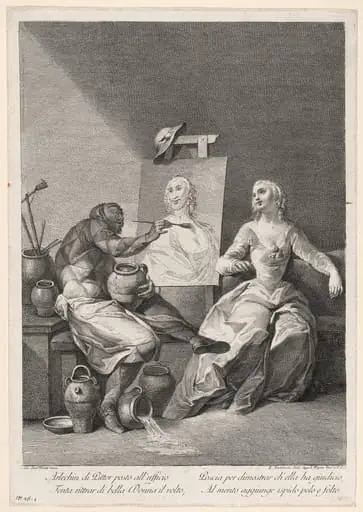
The image captures Harlequin in the act of sketching Columbine, who remains oblivious to the absurd detail he has added to her portrait.
This print is the first of four in the series 'Le 4 arlecchinate,' published in Venice by Joseph Wagner. It reproduces a composition by Giovanni Domenico Ferretti, depicting a scene from the commedia dell'arte tradition. The image captures Harlequin in the act of sketching Columbine, who remains oblivious to the absurd detail he has added to her portrait. The work blends theatrical humor with visual wit, characteristic of 18th-century Venetian print culture.
Subject & Meaning
The scene plays on the familiar dynamic between Harlequin and Columbine, stock figures from Italian comedy. Harlequin’s act of drawing Columbine with a beard introduces a deliberate, playful distortion—her unawareness heightens the irony. The joke hinges on the gap between perception and representation, turning art-making into a mischievous act. It reflects the genre’s love for visual puns and social satire, where appearance is both fragile and mutable.
Technique & Style
Ferretti’s composition is rendered with delicate linework and subtle tonal contrasts, typical of engraved reproductive prints of the period. The figures are rendered with graceful, theatrical gestures, and the interior drawing within the print mimics the sketchy quality of a quick charcoal outline. This layered visual device—art within art—creates a subtle trompe l'oeil effect, inviting the viewer to notice the discrepancy between the real and the depicted.
History & Provenance
Produced in Venice during the mid-18th century, the print was part of a commercial series issued by Joseph Wagner, a prominent publisher of graphic art. Wagner specialized in reproducing works by local artists for a broad audience, often drawing from popular theatrical themes. Ferretti’s original painting, now lost, was likely created for private patrons before being adapted into this print series, which circulated widely across Europe.
Context
The 'Harlequinades' emerged during a period when commedia dell'arte figures were widely celebrated in Venetian visual culture. Prints like this catered to a growing middle-class interest in theater and satire. The series capitalized on the public’s familiarity with these characters, using their established roles to explore themes of illusion, identity, and artistic authority. Such works blurred the line between entertainment and commentary on the nature of representation.
Legacy
Though Ferretti’s original paintings are no longer extant, his prints helped preserve the visual language of commedia dell'arte for later generations. The 'Harlequinades' series exemplifies how printmaking extended theatrical humor beyond the stage, making it accessible to a wider public. These works influenced later caricaturists and contributed to the evolution of satirical graphic art in Europe, particularly in the use of visual irony to critique social norms.
Artist & collection
Artist
This Florentine painter had a habit of signing his paintings with a tiny self-portrait hidden in the corner, like a secret handshake.