Artwork
Saint Luke Painting the Virgin
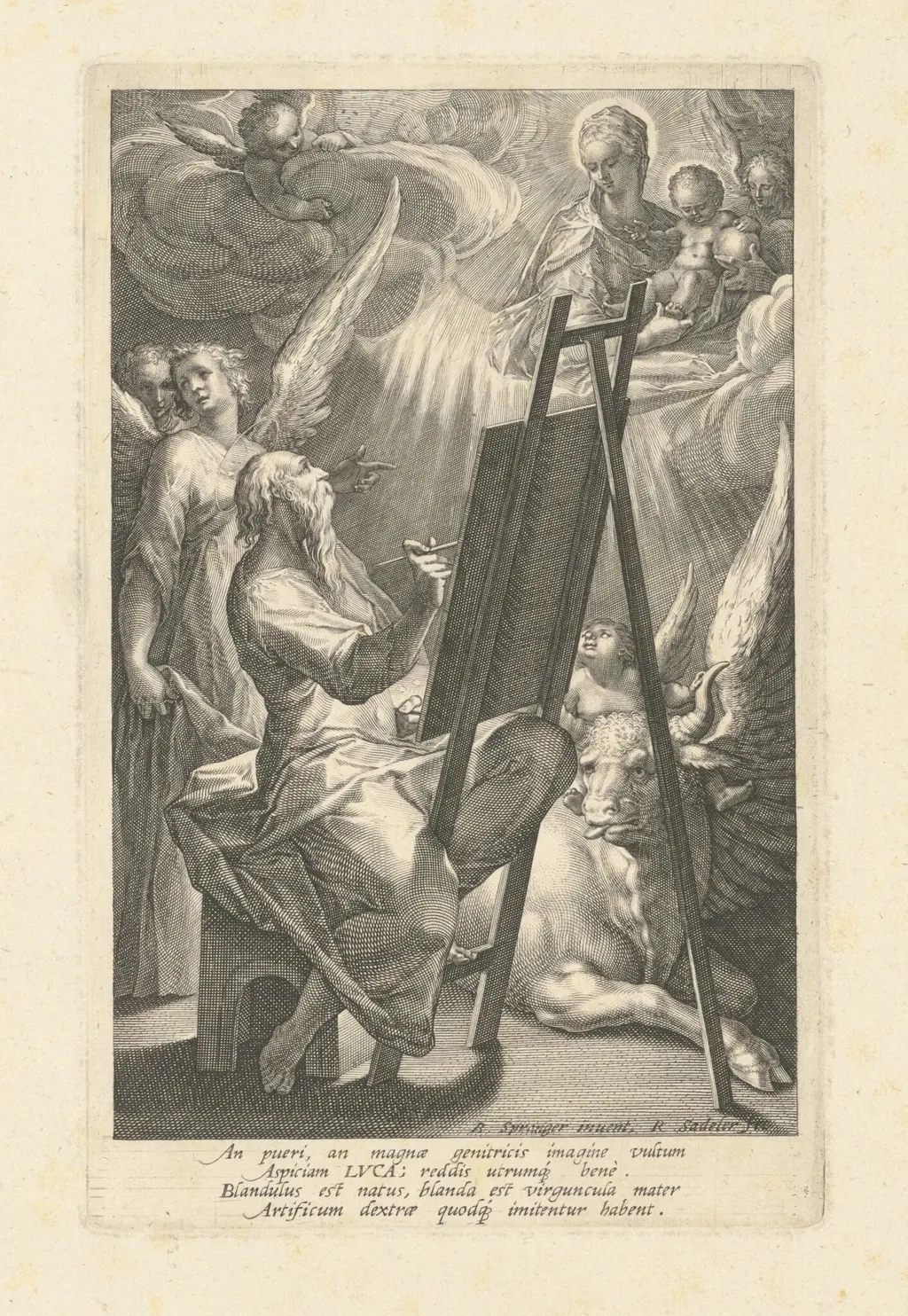
Saint Luke Painting the Virgin is an ink print by the Renaissance artist Raphael Sadeler I. It dates from 1584 and is held in the collection of the National Gallery of Art.
About this work
Overview
This engraving, dated around 1584, is the work of Raphael Sadeler I, a Flemish printmaker active in the late 16th century.
This engraving, dated around 1584, is the work of Raphael Sadeler I, a Flemish printmaker active in the late 16th century. Executed on laid paper using the engraving technique, it depicts a sacred scene in which Saint Luke, traditionally regarded as the first Christian painter, renders an image of the Virgin Mary. The composition is densely detailed, combining earthly and celestial elements within a single frame.
Subject & Meaning
The scene illustrates the legend of Saint Luke, a physician and evangelist, who is said to have painted the Virgin Mary from life. He is shown at work, capturing her likeness as she sits enthroned with the Christ Child in her arms. A second child, likely John the Baptist, sits nearby. Angels hover above, holding instruments of the Passion, reinforcing the theological significance of the Virgin’s role in salvation history.
Technique & Style
Sadeler employed fine, precise lines to render textures: the folds of fabric, the softness of skin, and the delicate wings of angels. The engraving’s clarity and controlled hatching create a sense of depth and luminosity, despite the monochrome medium. The composition is tightly organized, with figures arranged hierarchically, reflecting the Northern Renaissance tradition of combining naturalism with devotional symbolism.
History & Provenance
Raphael Sadeler I, part of a prominent family of engravers, produced this print during his time in Prague, where he worked for the imperial court. The image was likely intended for private devotion or as a model for artists. Surviving impressions suggest it was circulated among collectors and religious institutions in Central Europe, though its exact early ownership remains undocumented.
Context
In the late 16th century, prints of religious subjects were widely distributed to support Counter-Reformation piety. The theme of Saint Luke painting the Virgin resonated with Catholic teachings on the sanctity of images and the legitimacy of artistic representation in worship. Sadeler’s work aligns with a broader trend of Northern artists translating Italian iconography into detailed engravings for a devotional audience.
Legacy
Sadeler’s engraving contributed to the enduring visual tradition of Saint Luke as a sacred artist, influencing later depictions in both print and painting. While not widely known today, the work exemplifies the technical precision and devotional intent characteristic of late Renaissance printmaking. It remains a documented example of how religious narratives were disseminated through the print medium in early modern Europe.
Artist & collection

![An Artist's Studio [recto], by Frans Francken the Younger](https://artifactworldgallery.com/img/frans-francken-the-younger--an-artist-s-studio-recto--3de4d020bfd4cb8f-w320.webp)