Artwork
Mission San Juan Capistrano
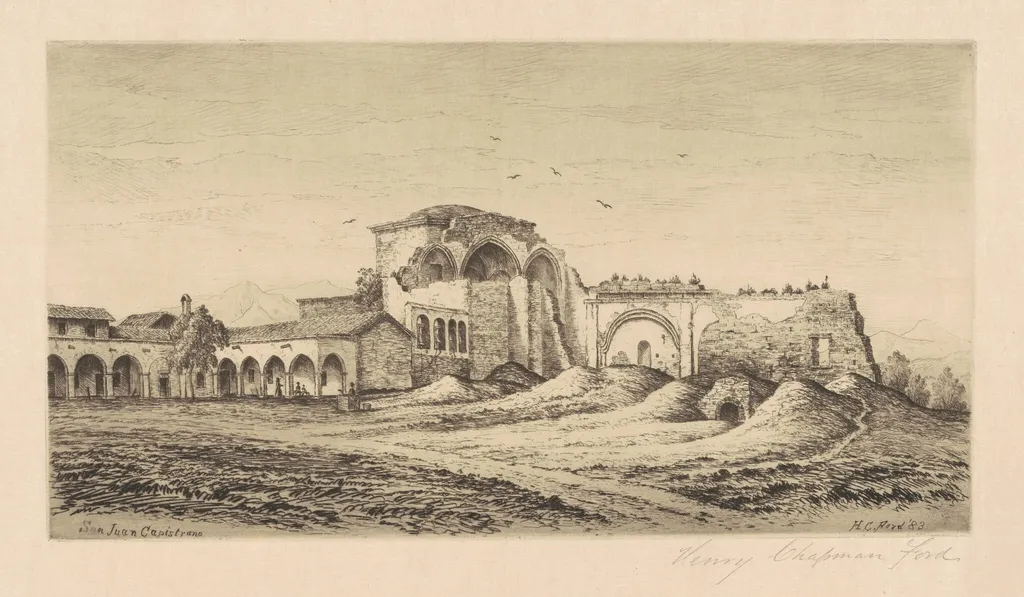
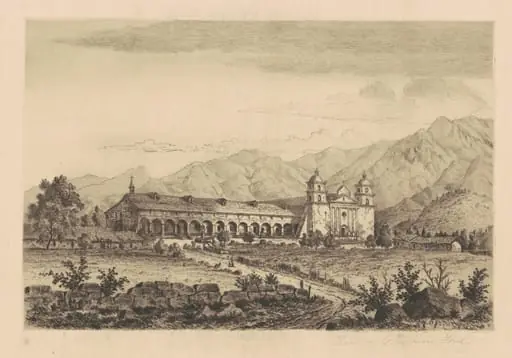
Mission San Juan Capistrano is an ink print by the Impressionist artist Henry Chapman Ford. It dates from 1883 and is held in the collection of the National Gallery of Art.
About this work
Overview
Ford’s technique highlights texture and atmosphere, aligning with 19th-century interest in documenting historical sites before they vanished.
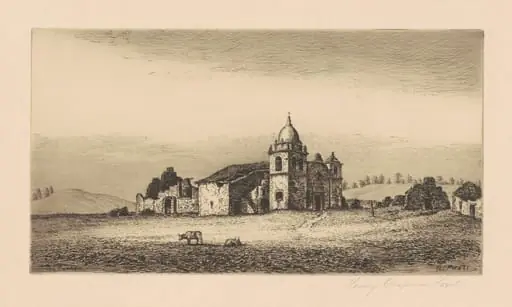
Created in 1883, this etching by Henry Chapman Ford depicts the ruins of Mission San Juan Capistrano in California. Rendered in black ink on laid paper, the work captures the mission’s decaying stone architecture with delicate linework. The composition emphasizes the passage of time through worn surfaces and quiet, sparse human presence. Ford’s technique highlights texture and atmosphere, aligning with 19th-century interest in documenting historical sites before they vanished.
Subject & Meaning
The scene centers on the mission’s chapel, its rounded arches and central tower standing amid crumbling walls and overgrown grounds. A covered walkway with smaller arches runs along the foreground, while a river traces the base of the image. Figures and birds add scale and life, but the dominant impression is one of abandonment. The work reflects a contemplative view of colonial heritage, acknowledging both spiritual legacy and physical decay.
Technique & Style
Ford employed etching to achieve fine, controlled lines that model light and shadow with subtle gradations. The acid-bitten plate allowed for intricate detail in the stonework, while the textured laid paper enhanced the sense of age and erosion. The absence of bold contrasts and the muted tonal range evoke a quiet, melancholic mood. The technique favors observation over drama, emphasizing the mission’s quiet endurance rather than its former grandeur.
History & Provenance
Ford created this print during a period of renewed interest in California’s Spanish missions, decades after their secularization. He traveled extensively through the region, sketching and documenting sites in decline. This etching was likely produced from on-site studies and later published as part of a broader effort to record architectural heritage. Its survival in institutional collections suggests early recognition of its documentary value.
Context
In the late 19th century, American artists and antiquarians began turning attention to the fading remnants of Spanish colonialism in the Southwest. Ford’s work emerged alongside similar efforts to preserve visual records of missions threatened by neglect or redevelopment. His focus on decay, rather than restoration, aligned with a growing cultural awareness of historical loss, even as romanticized narratives of the past still dominated public imagination.
Legacy
Ford’s etching remains a key visual record of Mission San Juan Capistrano in its 19th-century state, before major 20th-century restorations altered its appearance. It informs historical and architectural studies of the mission system and exemplifies the role of printmaking in early preservation efforts. The work’s quiet realism distinguishes it from idealized depictions, offering a grounded perspective on cultural memory and material decay.
Artist & collection

![Yediküle with a Muslim Cemetery, Constantinople, by Michel-François Préaulx [Préaux]](https://artifactworldgallery.com/img/michel-francois-preaulx-preaux--yedikule-with-a-muslim-cemetery-constantinople--c422bdec8e9c6ba8-w320.webp)