Artwork
The Three Graces
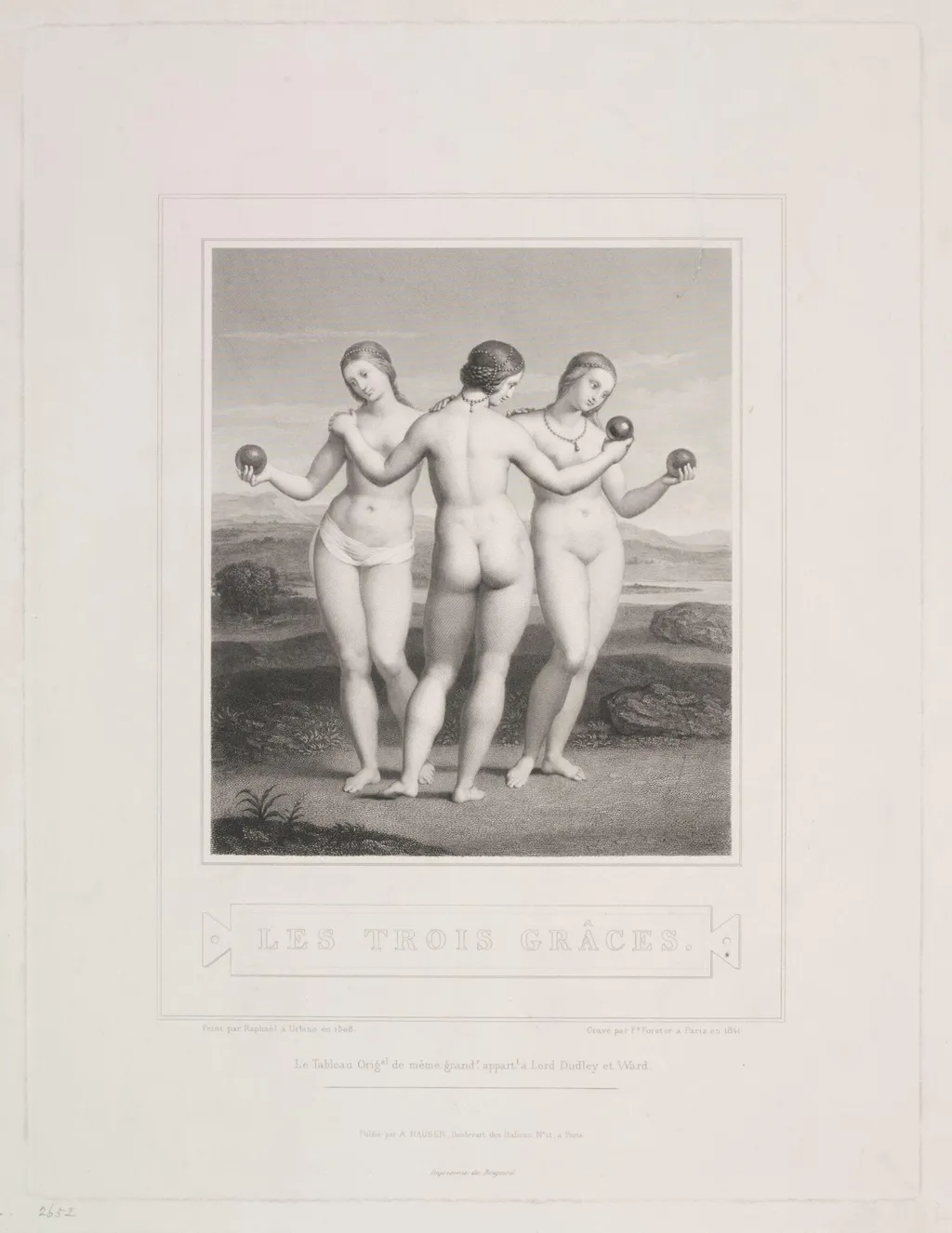
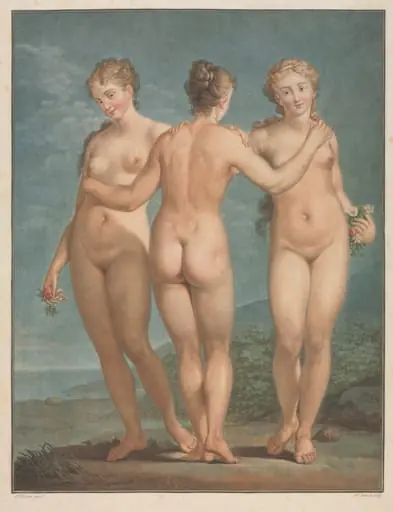
The Three Graces is a print by François Forster. It dates from 1850 and is held in the collection of the Victoria and Albert Museum. This 1850 print on paper, produced by A.
About this work
Overview
The image preserves the essential arrangement and elegance of the original Renaissance design while adapting it to the conventions of 19th-century printmaking.
This 1850 print on paper, produced by A. Hauser, is a reproductive work based on a drawing by François Forster, which in turn derives from a composition by Raphael. It depicts the classical trio of the Graces, rendered in line and tone, and was intended for wider dissemination through print culture. The image preserves the essential arrangement and elegance of the original Renaissance design while adapting it to the conventions of 19th-century printmaking.
Subject & Meaning
The three nude female figures represent the Graces from Greek mythology—Aglaea, Euphrosyne, and Thalia—embodying beauty, joy, and grace. Their intertwined postures and shared gestures suggest harmony and mutual support. Holding spherical objects, they may allude to celestial or symbolic unity. The composition reflects classical ideals of proportion and balance, reinforcing their role as personifications of aesthetic and moral virtue in Western art traditions.
Technique & Style
Executed as a line-based print, the work employs fine, controlled strokes to define form and contour, with subtle tonal variations suggesting volume without heavy shading. The figures are rendered with smooth, flowing lines that emphasize their graceful poses, while the background is minimally suggested with soft, distant hills and trees. The style is restrained and academic, prioritizing clarity and fidelity to the source over expressive flourish.
History & Provenance
The print was published in 1850 by A. Hauser, a known producer of reproductive engravings during the mid-19th century. It stems from a drawing by François Forster, who interpreted Raphael’s earlier composition, likely from a fresco or painting now lost or less accessible. Such prints were commonly collected by art enthusiasts and institutions, serving as educational tools and decorative objects in private and public collections.
Context
In the 19th century, there was renewed interest in classical themes as part of academic art training and bourgeois cultural taste. Reproductions of Renaissance compositions like Raphael’s Graces were widely circulated to meet demand for canonical imagery. This print reflects the era’s practice of revisiting antiquity through the lens of established masters, reinforcing artistic lineage and historical continuity in an age of industrial reproduction.
Legacy
As a reproductive print, this work contributed to the dissemination of Raphael’s compositional model beyond original paintings and into domestic and educational settings. Though not an original creation, it preserved and transmitted a classical ideal across generations. Copies like this one remain in museum collections today as evidence of how artistic traditions were maintained and shared through print media in the 19th century.
Artist & collection