Artwork
The Satyrs' Dance (Danse de satyres)
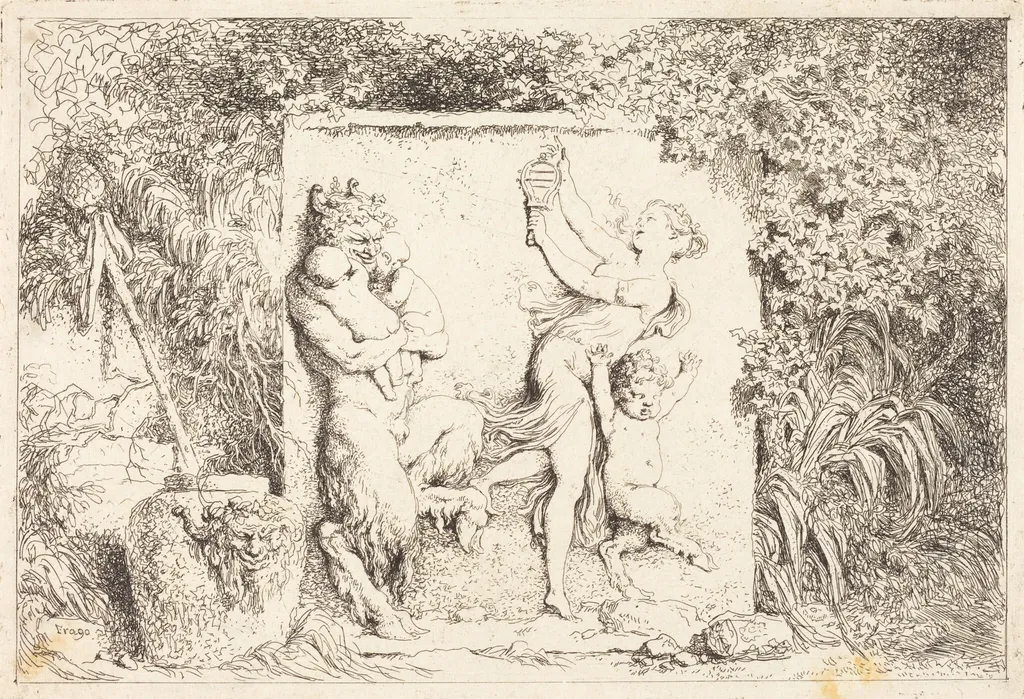
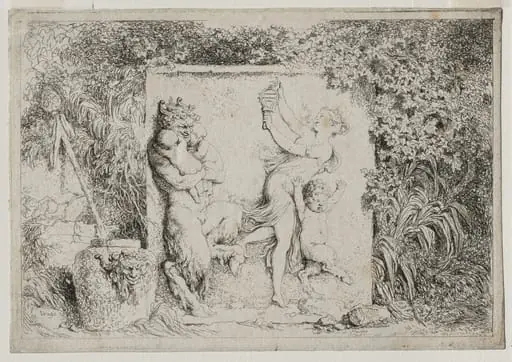
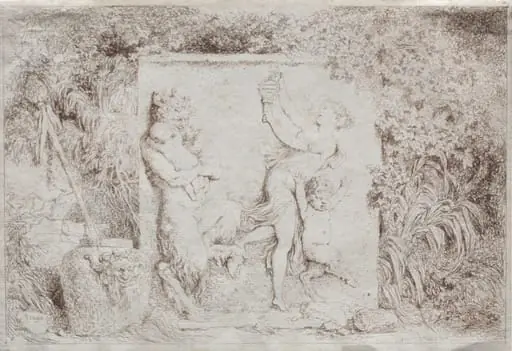
The Satyrs' Dance (Danse de satyres) is an ink print by the Romanticist artist Jean Honoré Fragonard. It dates from 1763 and is held in the collection of the National Gallery of Art. Created in 1763, The Satyrs' Dance is an etching by Jean-Honoré Fragonard that captures a pair of mythological forest spirits in motion.
About this work
Overview
Created in 1763, The Satyrs' Dance is an etching by Jean-Honoré Fragonard that captures a pair of mythological forest spirits in motion. Executed on paper, the work belongs to a series of experimental prints where Fragonard explored expressive line and texture. Unlike formal commissions, this piece reflects personal artistic inquiry, emphasizing spontaneity over precision.
Subject & Meaning
Two satyrs, half-human and half-animal, are shown in a rhythmic dance amid dense woodland. One beats a drum, the other strikes a stick, suggesting ritual or unrestrained celebration. Their wild forms and the tangled foliage evoke a realm beyond human order, channeling classical myths of nature’s untamed spirit. The scene conveys freedom and primal energy rather than narrative clarity.
Technique & Style
Fragonard employed etching to achieve fluid, gestural lines that mimic the motion of dance. By varying acid exposure and using loose, swirling strokes, he created areas of dense ink that blur into fuzzy textures—particularly in the satyrs’ fur and the foliage. This technique prioritizes atmosphere over detail, giving the scene a sense of immediacy and organic chaos.
History & Provenance
The print was made during Fragonard’s early career, a period when he was refining his graphic style outside official patronage. Few impressions survive, and most are held in institutional collections, including the Louvre and the British Museum. Its modest scale and private nature suggest it was likely produced for personal or collector circulation rather than public display.
Context
In mid-18th-century France, etching was gaining favor among artists seeking alternatives to academic painting. Fragonard’s work aligned with a broader interest in mythological subjects rendered with informality and emotional immediacy. This print reflects the influence of Rococo sensibility, where movement, fantasy, and naturalism merged in intimate, non-monumental formats.
Legacy
The Satyrs' Dance exemplifies Fragonard’s mastery of expressive line in printmaking and influenced later artists exploring spontaneous draftsmanship.
The Satyrs' Dance exemplifies Fragonard’s mastery of expressive line in printmaking and influenced later artists exploring spontaneous draftsmanship. Though not widely reproduced in his lifetime, it remains a key example of how etching could convey vitality and psychological depth beyond traditional narrative constraints. Its informal energy continues to inform studies of 18th-century graphic art.
Own this work as a print
Artist & collection

Artist
Jean-Honoré Fragonard was born on 5 April 1732 in Grasse, the son of a glover, and moved with his family to Paris in 1738.