Artwork
Saint John the Evangelist
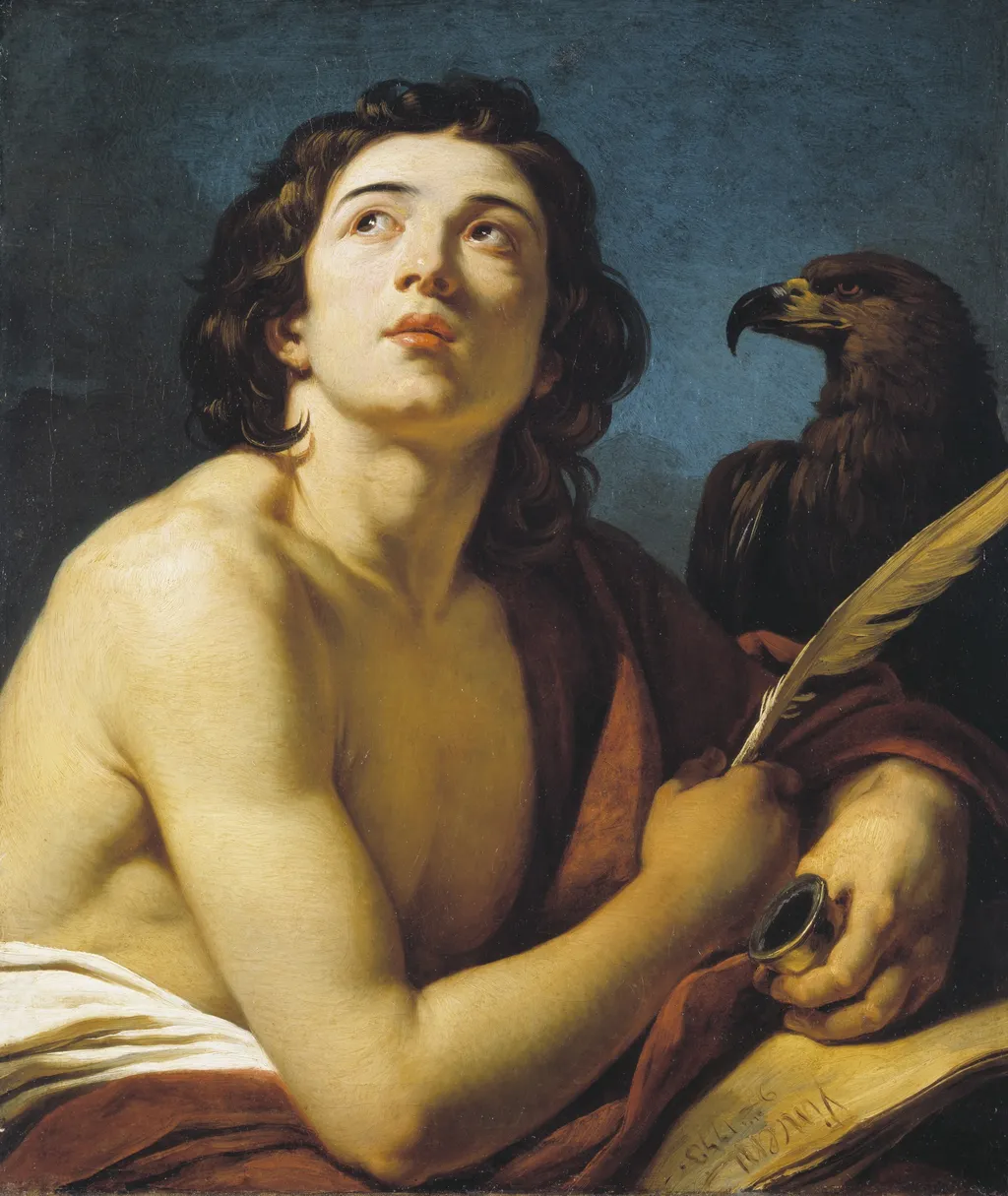
Saint John the Evangelist is an oil painting by the French Romanticist artist François-André Vincent. It dates from 1797 and is held in the collection of the Detroit Institute of Arts.
About this work
Overview
François‑André Vincent’s oil painting Saint John the Evangelist, completed in 1797, depicts the apostle in a moment of quiet contemplation. The work is part of the collection of the Detroit Institute of Arts, where it is displayed among other late‑18th‑century French religious pieces.
Subject & Meaning
The figure is a youthful John, rendered with long dark hair and a red mantle draped over his left shoulder. He holds a quill pen and an open book, symbols of his role as author of the Gospel. A large bird, likely an eagle—a traditional attribute of John—perches nearby, its head turned toward the saint, reinforcing his prophetic identity.
Technique & Style
Vincent employs a restrained palette, setting the saint against a deep blue‑gray backdrop that isolates the figure and heightens the sense of introspection. The smooth handling of oil paint renders delicate flesh tones and the sheen of the cloth, while the bird’s feathers are treated with finer, more textured brushwork, creating a subtle contrast between the human and animal elements.
History & Provenance
Painted at the height of Vincent’s career, the canvas entered the Detroit Institute of Arts’ holdings in the early 20th century through a private donation. Its acquisition reflects the museum’s interest in expanding its representation of French Neoclassical religious art from the Revolutionary period.
Context
Created shortly after the French Revolution, the painting reflects a renewed interest in religious subjects within a secularizing society. Vincent’s portrayal aligns with Neoclassical ideals of clarity and moral virtue, presenting Saint John not as a dramatic martyr but as a contemplative scholar, echoing Enlightenment values of reason and learning.
Own this work as a print
Artist & collection