Artwork
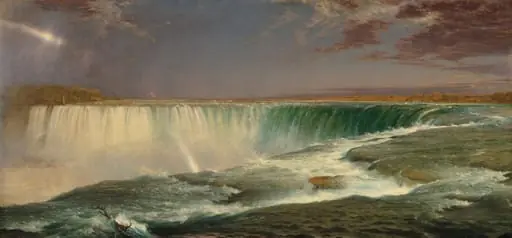
Niagara Falls, from the American Side
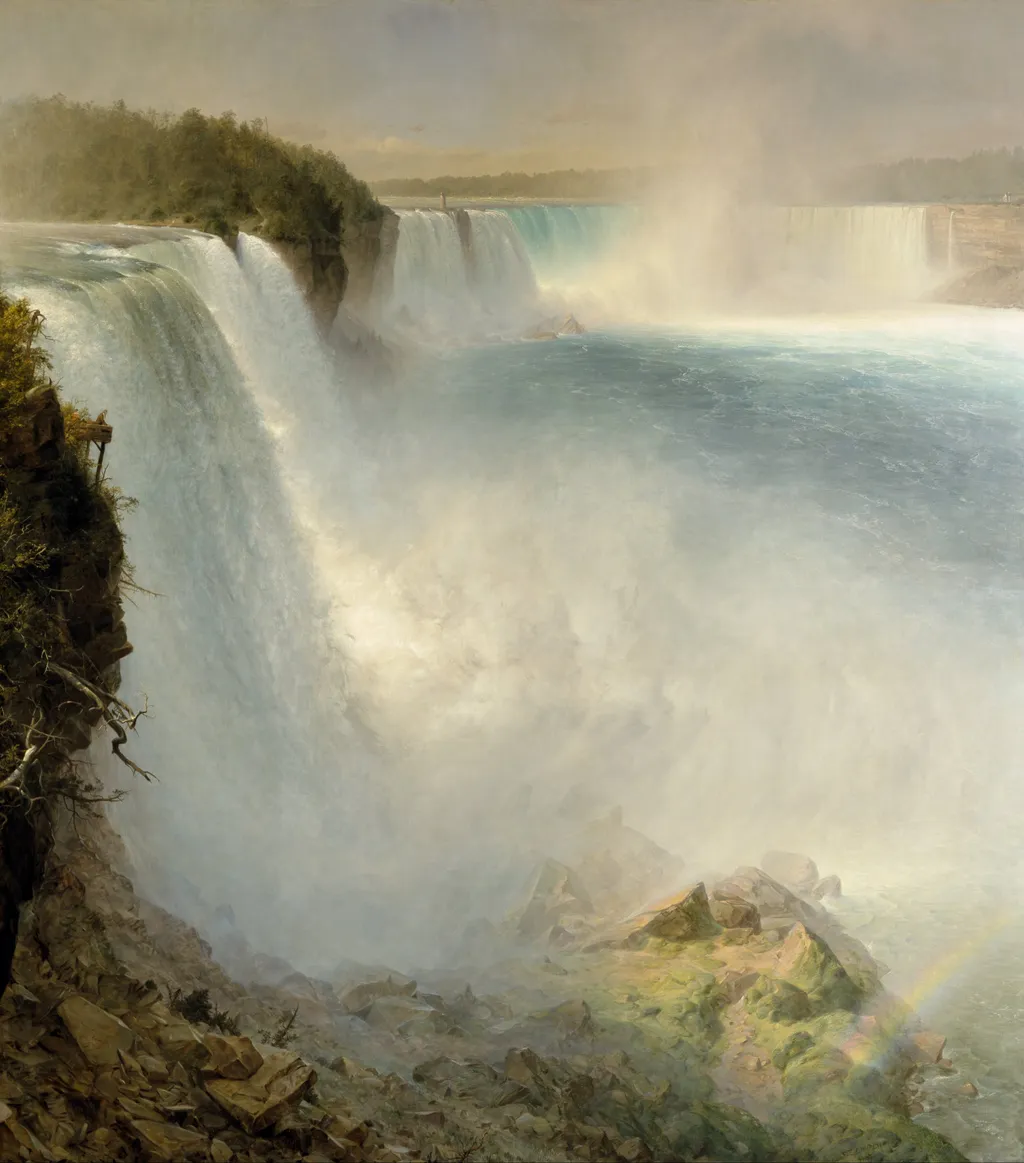
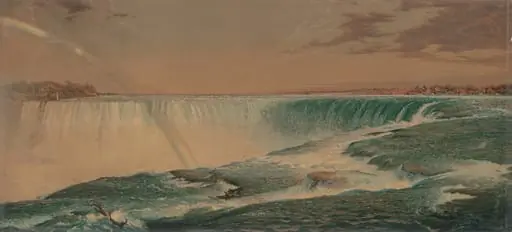
Niagara Falls, from the American Side is an oil painting by the Hudson River School artist Frederic Edwin Church. It dates from 1867 and is held in the collection of the Scottish National Gallery.
About this work
Overview
Painted in 1867, Niagara Falls, from the American Side is the largest work by Frederic Edwin Church, an American landscape artist associated with the Hudson River School. Executed in oil, the painting synthesizes direct observation from sketches made at the falls with reference to a sepia photograph, reflecting Church’s methodical approach to capturing natural grandeur.
Subject & Meaning
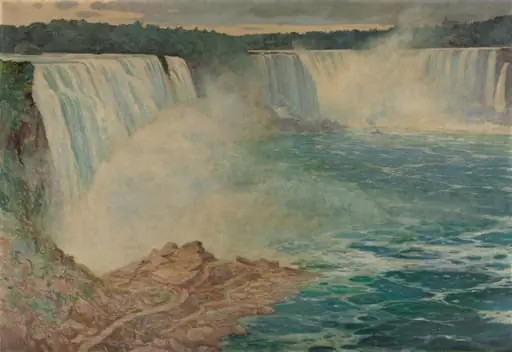
The painting presents the full scale of Niagara Falls as viewed from the American shore, emphasizing the raw power and scale of the cascading water. Rather than dramatizing the scene, Church renders it with quiet precision, inviting contemplation of nature’s immensity rather than its spectacle. The absence of human figures underscores the sublime indifference of the landscape.
Technique & Style
Church employed fine brushwork and layered glazes to achieve luminous effects in the mist and water, capturing subtle shifts in light and atmosphere. His attention to geological detail in the rock formations and vegetation reflects the Hudson River School’s commitment to scientific observation. The composition’s horizontal format enhances the sense of expansive, uninterrupted natural force.
History & Provenance
Completed in 1867, the painting was acquired by the Scottish National Gallery in 1870, following its exhibition in London. Its acquisition by a British institution reflected international recognition of Church’s work during a period when American landscape painting was gaining global attention, despite its roots in distinctly national themes.
Context
As a central figure in the Hudson River School, Church extended the movement’s ideals by pursuing increasingly monumental subjects. His focus on Niagara Falls aligned with mid-19th-century American interests in natural wonders as symbols of national identity and divine order, even as industrialization reshaped the landscape.
Legacy
The painting remains a defining example of 19th-century American landscape art, illustrating how technical precision and emotional restraint could convey awe. It influenced later artists seeking to represent nature with both accuracy and reverence, and continues to serve as a reference for the intersection of science, aesthetics, and perception in landscape painting.
Own this work as a print
Artist & collection

Artist
Frederic Edwin Church was an American landscape painter born in Hartford, Connecticut.