Artwork
Samuel Anointing David
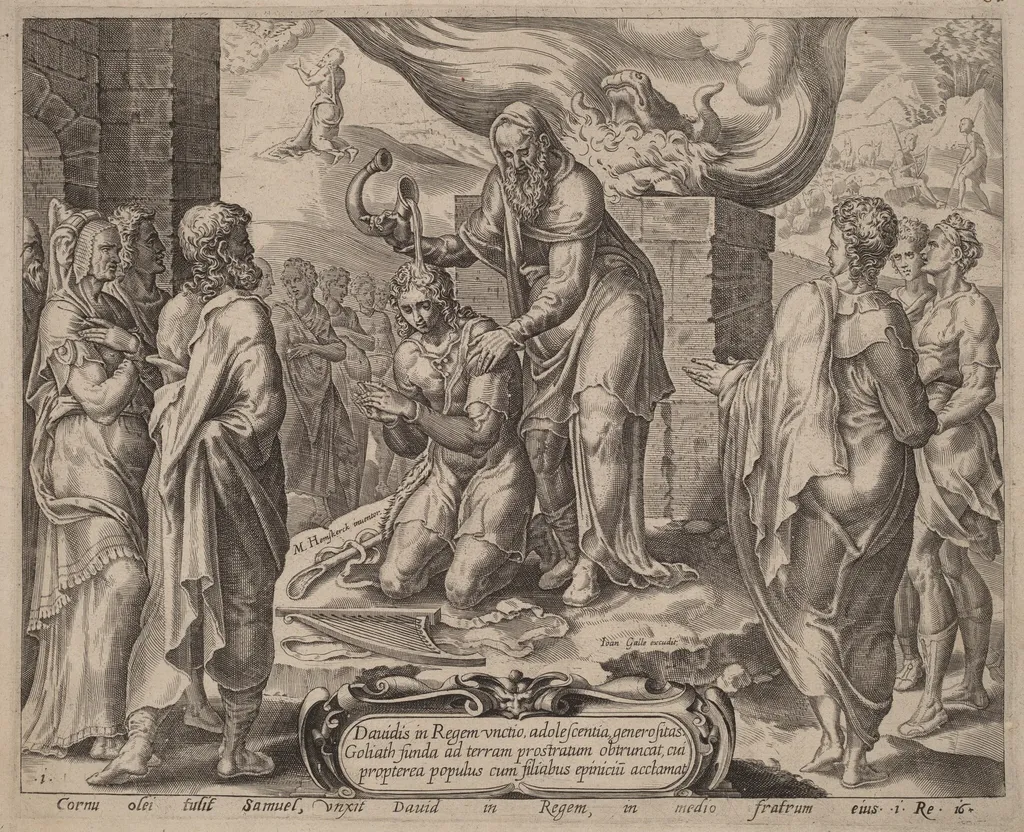
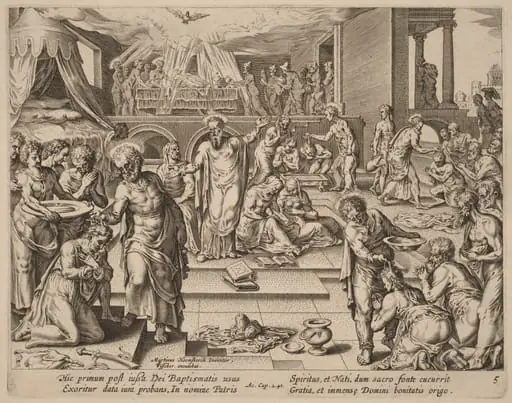
Samuel Anointing David is an ink print by the Renaissance artist Joannes Galle. It dates from 1556 and is held in the collection of the National Gallery of Art.
About this work
Overview
Samuel Anointing David is a mid‑sixteenth‑century engraving executed by the Flemish printmaker Joannes Galle around 1556.
Samuel Anointing David is a mid‑sixteenth‑century engraving executed by the Flemish printmaker Joannes Galle around 1556. The monochrome image presents a densely populated composition in which a kneeling, robed figure receives a ceremonial touch from a second figure holding a horn, while a crowd of onlookers surrounds them. Latin inscription at the bottom identifies the biblical narrative of the prophet Samuel anointing the future king David.
Subject & Meaning
The print visualises the Old Testament episode in which the prophet Samuel, acting on divine command, anoints the young shepherd David as Israel’s future monarch. The central act of anointing is emphasized by the gestures of the participants—Samuel’s hand on David’s head and the horn, a symbol of authority, held by the attendant. The surrounding witnesses, some gesturing upward, underscore the communal recognition of divine selection.
Technique & Style
Galle employs fine, cross‑hatching and delicate line work to model the figures, creating a sense of volume and spatial recession. The interplay of light and shadow, achieved through varied line density, renders the crowd’s drapery and the swirling clouds in the background with subtle three‑dimensionality. The composition balances intricate detail with a clear focal point, characteristic of Northern Renaissance printmaking.
History & Provenance
Created circa 1556, the engraving belongs to a period when Galle was active in Antwerp, a major hub for the production of reproductive prints. Though specific ownership records are scarce, copies of the image appear in several 16th‑century print collections, indicating its circulation among collectors interested in biblical subjects and the work of prominent Flemish engravers.
Context
The work reflects the broader Renaissance interest in biblical narratives as moral exempla and as subjects for artistic study. Engravings such as this served both devotional purposes and the dissemination of scriptural stories to a literate audience, aided by the inclusion of a Latin caption that clarified the scene for educated viewers.
Artist & collection