Artwork
The Ox Cart (Le char a boeufs)
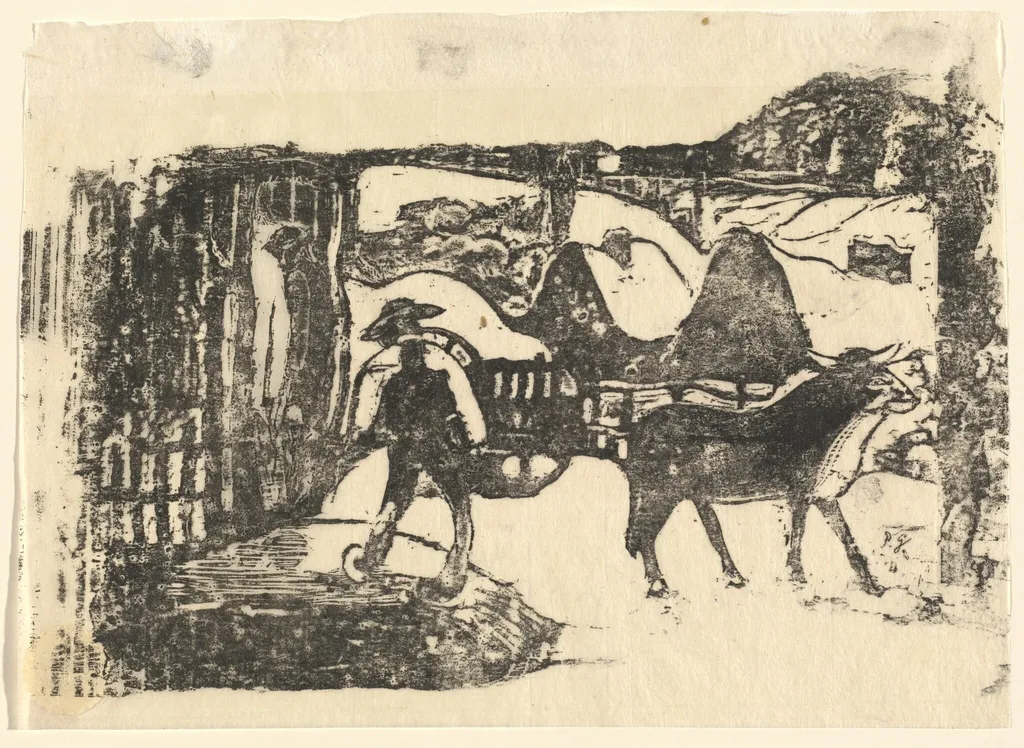
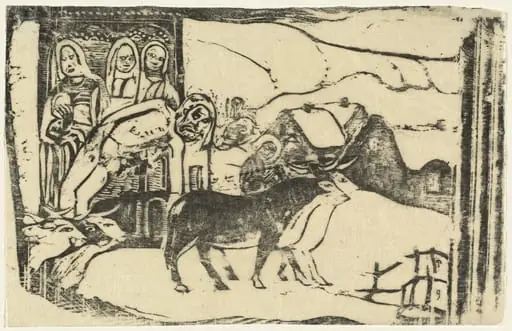
The Ox Cart (Le char a boeufs) is an ink print by the Impressionist artist Paul Gauguin. It dates from 1898 and is held in the collection of the National Gallery of Art. Created in 1898, *The Ox Cart (Le char à bœufs)* is a woodcut print executed on Japanese paper.
About this work
Overview
Created in 1898, *The Ox Cart (Le char à bœufs)* is a woodcut print executed on Japanese paper. The work belongs to the later period of Paul Gauguin’s career, when he was exploring printmaking alongside painting and sculpture. Its composition presents a stark, nocturnal landscape dominated by a heavily laden cart and the figures that draw it.
Subject & Meaning
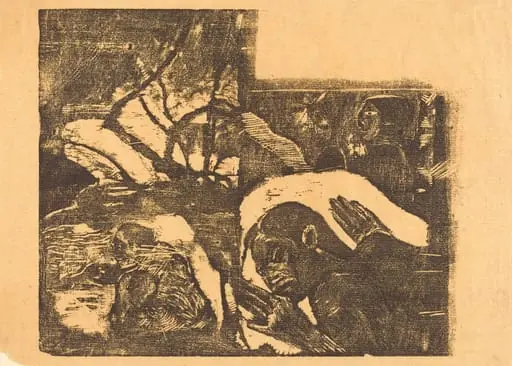
The image depicts two laborers hauling a cumbersome cart filled with timber through a tangled forest, with a faint structure visible in the background.
The image depicts two laborers hauling a cumbersome cart filled with timber through a tangled forest, with a faint structure visible in the background. The figures are rendered without distinct facial features, emphasizing their role as archetypal workers rather than individualized portraits, and reinforcing the work’s symbolic focus on toil and the relationship between humanity and the natural world.
Technique & Style
Gauguin employed the traditional woodcut process: a design was carved into a wooden block, ink was applied to the raised surfaces, and the block was pressed onto Japanese paper. This method yields bold, uneven lines and a textured surface, characteristics evident in the print’s rough outlines and stark contrasts, aligning with Gauguin’s Synthetist interest in simplifying forms and emphasizing symbolic content.
History & Provenance
The print was produced during Gauguin’s stay in the South Pacific, a period marked by prolific experimentation with print media. It was issued as part of a limited series of woodcuts that the artist distributed among his circle of collectors and fellow artists, contributing to his reputation as an innovator in early modern printmaking.
Context
At the turn of the twentieth century, European artists were increasingly drawn to non‑Western materials and techniques, including Japanese paper and woodblock printing. Gauguin’s adoption of these methods reflects the broader cross‑cultural exchanges of the era and his personal quest to break from Impressionist conventions toward a more abstract, symbolic visual language.
Artist & collection
Artist
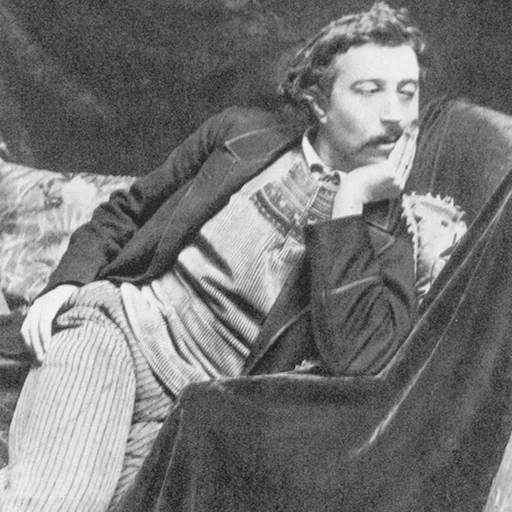
Eugène Henri Paul Gauguin (; French: ; 7 June 1848 – 8 May 1903) was a French painter, sculptor, printmaker, ceramist, and writer, whose work has been primarily associated with the Post-Impressionist and Symbolist movements.

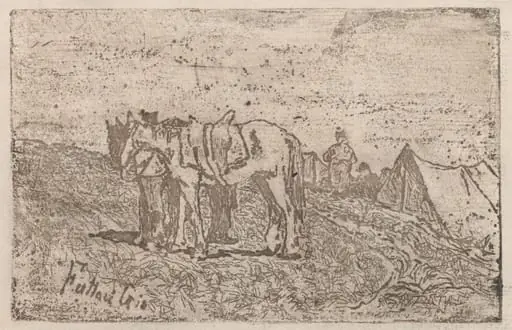 a) On Maneuvers (recto); b) On Maneuvers (verso) (Alle Manovre)
 Wayside Shrine in Brittany (Le calvaire Breton)
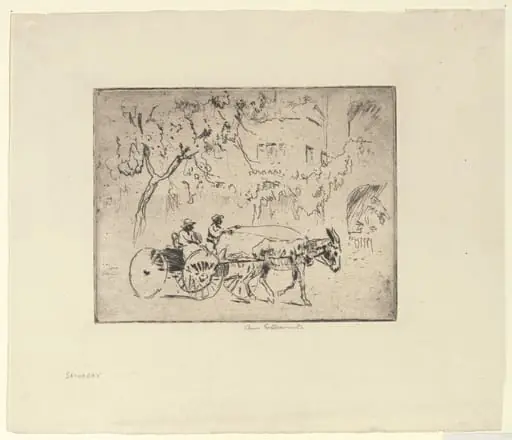 Untitled
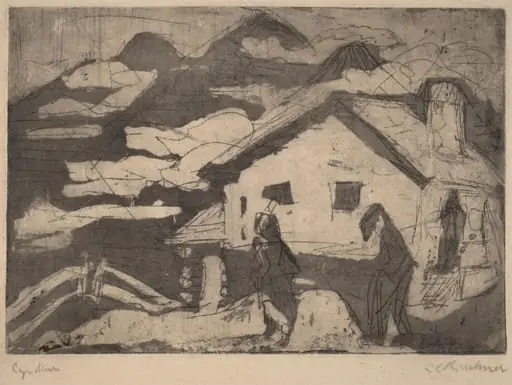 Alpine Huts in Fog
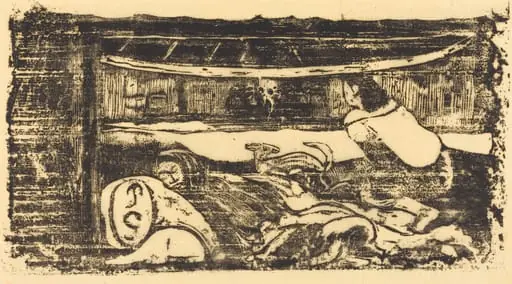 Interior of a Hut (Interieur de case)
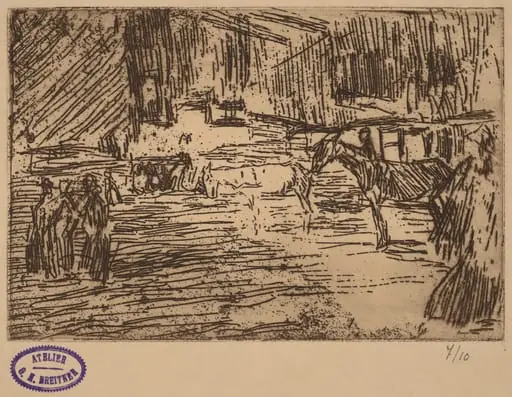 Scene with Horses Standing in Stream
 Port Scene (Hafenbild)
 The Farm on the Hill
 Our Hill from Dumstown, Ohio
 a) Artillery on Mission (recto); b) Artillery on Mission (verso) (Artiglieria da campagna)
 A Maori Woman in a Forest; Manao Tupapau (She is Haunted by a Spirit)
 Oxen Yoked to a Cart (Maremma) (Bovi al carro (Maremma))