Artwork
In the Park, Light
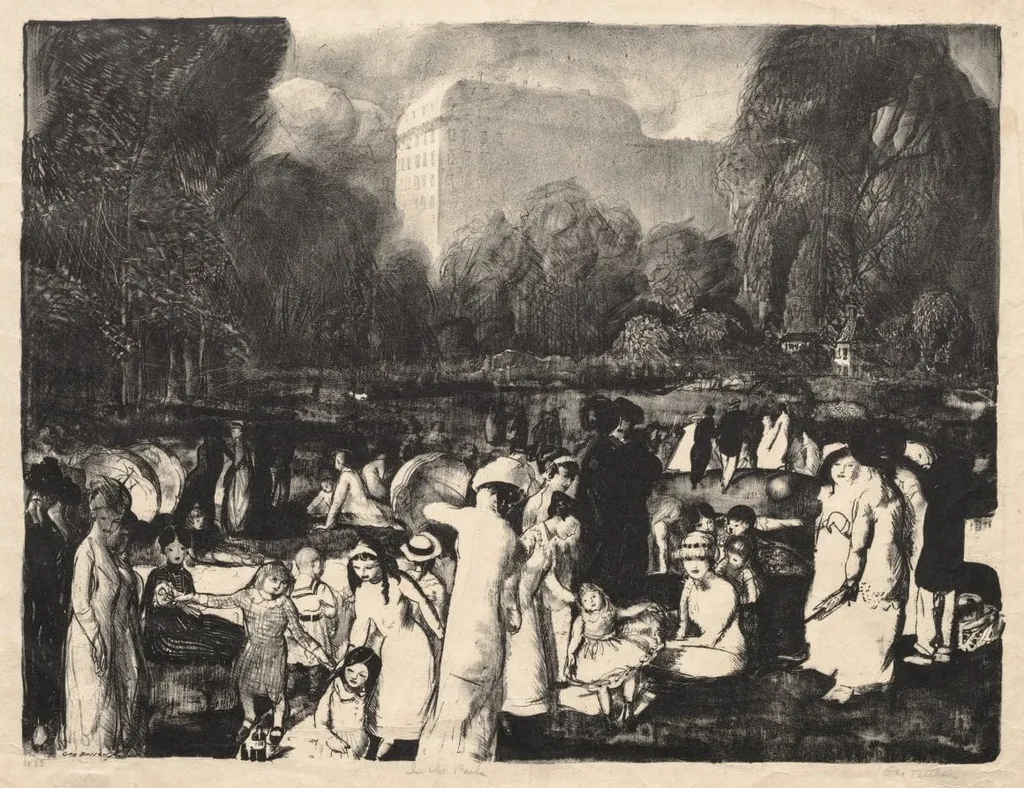
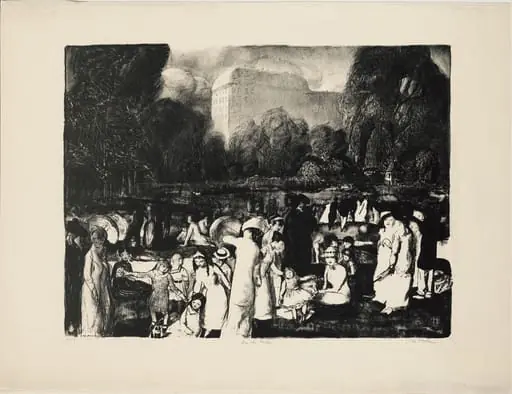
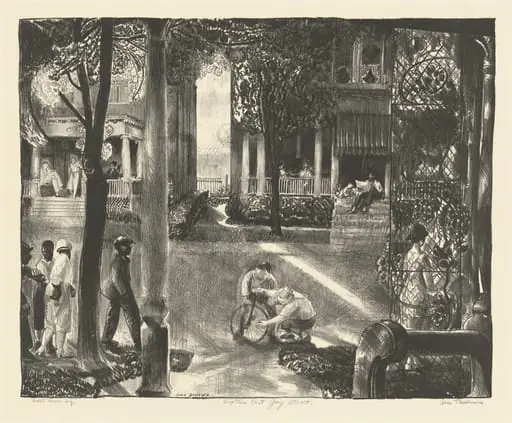
In the Park, Light is a print by George Bellows. It dates from 1916 and is held in the collection of the Cleveland Museum of Art.
About this work
Overview
The work belongs to Bellows’s broader exploration of everyday American life and reflects his interest in transient, unposed scenes.
Created in 1916, *In the Park, Light* is a black-and-white print by American artist George Bellows. It captures a moment in a public urban green space during daylight, rendered with energetic linework and high contrast. The work belongs to Bellows’s broader exploration of everyday American life and reflects his interest in transient, unposed scenes. It is held in the collection of The Cleveland Museum of Art.
Subject & Meaning
The scene depicts a diverse group of people engaged in ordinary park activities—walking, sitting, conversing, and playing. Umbrellas suggest a changeable day, while the presence of children and adults conveys a sense of communal rhythm. No single narrative dominates; instead, the composition emphasizes the quiet anonymity and shared space of urban leisure, reflecting early 20th-century city life without sentimentality.
Technique & Style
Bellows employed bold, gestural lines and strong chiaroscuro to define form and movement. The print’s high contrast between light and shadow gives the scene immediacy and depth, mimicking the spontaneity of a sketch. Textural variety is achieved through varied line weight and hatching, suggesting foliage, fabric, and architecture with minimal detail. The effect is dynamic, evoking motion rather than polished realism.
History & Provenance
Executed in 1916, the print emerged during Bellows’s most active period as a printmaker, when he frequently explored urban themes through lithography. It entered The Cleveland Museum of Art’s collection through established acquisition channels, likely as part of a broader effort to document American graphic art of the era. Its preservation reflects institutional recognition of Bellows’s contribution to early modern printmaking.
Context
Bellows created this work amid the rise of American realism and the Ashcan School’s focus on unidealized city life. Urban parks were increasingly seen as democratic spaces, and Bellows’s depiction aligns with contemporary social observations. The print’s immediacy echoes the influence of photography and journalistic illustration, positioning it within a broader cultural shift toward capturing fleeting, authentic moments.
Legacy
Though less widely known than Bellows’s paintings, *In the Park, Light* exemplifies his skill in translating urban energy into graphic form. It contributed to the legitimacy of printmaking as a serious medium for social observation in early 20th-century America. The work remains a reference point for studies of American realism and the intersection of art and everyday experience.
Artist & collection
Artist
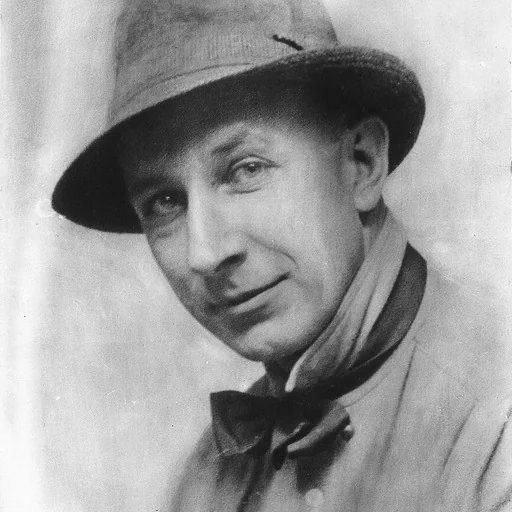
George Wesley Bellows (August 12 or August 19, 1882 – January 8, 1925) was an American realist painter, known for his bold depictions of urban life in New York City.