Artwork
Sir Francis Bacon
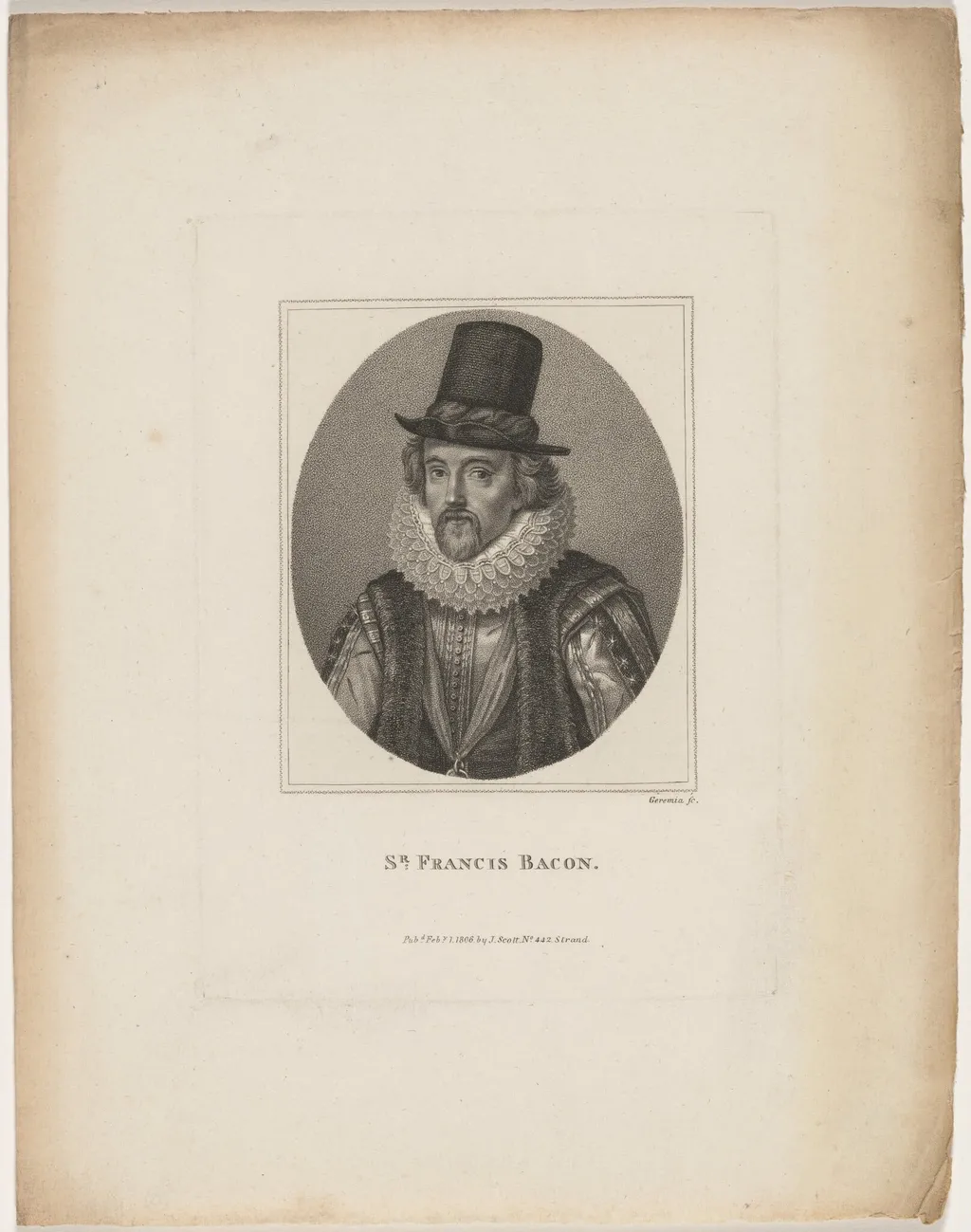
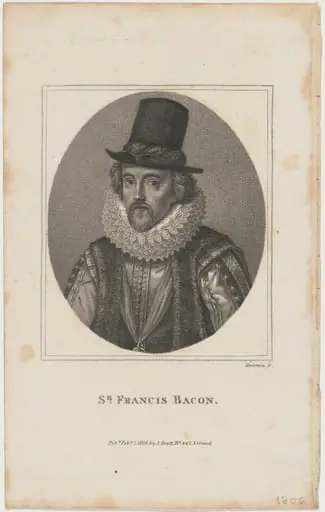
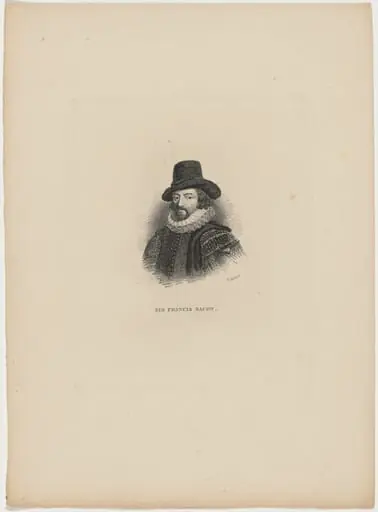
Sir Francis Bacon is an ink print by the Romanticist artist Innocenzo Geremia. It dates from 1806 and is held in the collection of the National Gallery of Art.
About this work
Overview
The work belongs to the tradition of posthumous portraiture, aiming to convey intellectual gravitas through restrained visual language.
This black-and-white print, created in 1806 by Innocenzo Geremia, depicts Sir Francis Bacon as a formal portrait. Executed in the technique of engraving, the image relies on incised lines on a metal plate to produce fine, precise detail. The composition is contained within an oval frame, emphasizing the subject’s presence against a neutral background. The work belongs to the tradition of posthumous portraiture, aiming to convey intellectual gravitas through restrained visual language.
Subject & Meaning
The portrait represents Sir Francis Bacon, the 16th-century English philosopher and statesman, known for his contributions to empirical science and the scientific method. The depiction emphasizes dignity and contemplation: his serious expression, elevated hat, and ornate collar suggest scholarly authority. The absence of symbolic objects or setting directs focus to the individual’s demeanor, reinforcing his legacy as a thinker rather than a political figure.
Technique & Style
Geremia employed engraving, a method involving incising lines into a copper plate with a burin. The fine, controlled strokes capture texture in the fabric, the sheen of the hat, and the softness of the ruffled collar. The monochrome palette and linear precision reflect 18th-century print conventions, prioritizing clarity and detail over expressive brushwork. The result is a disciplined, almost archival image, typical of scholarly portraiture of the period.
History & Provenance
Created in 1806, the engraving emerged during a revival of interest in early modern thinkers, particularly in Britain. Geremia, an Italian artist active in London, likely produced it for a broader audience seeking visual representations of historical figures. No documented early ownership is recorded, but its existence suggests it was part of a series or publication aimed at educating the public on intellectual heritage.
Context
In the early 19th century, engraved portraits of philosophers and scientists were commonly circulated in books, journals, and private collections. This print aligns with a cultural trend that elevated Bacon as a foundational figure of modern science. The formal, restrained style mirrors contemporary ideals of rationality and order, contrasting with the emotional intensity of Romantic art then gaining prominence.
Legacy
Though not widely reproduced today, the engraving remains a representative example of how Enlightenment-era figures were visually codified in the 19th century. It contributes to the visual archive of Bacon’s public image, influencing later depictions in textbooks and historical works. Its enduring value lies in its fidelity to the conventions of its time, offering insight into how intellectual legacy was materialized through print.
Artist & collection