Artwork
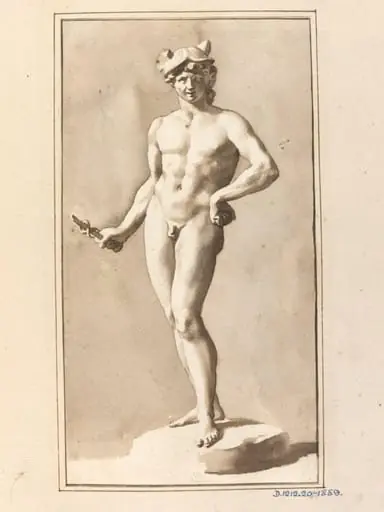
Mercurio di Giambologna
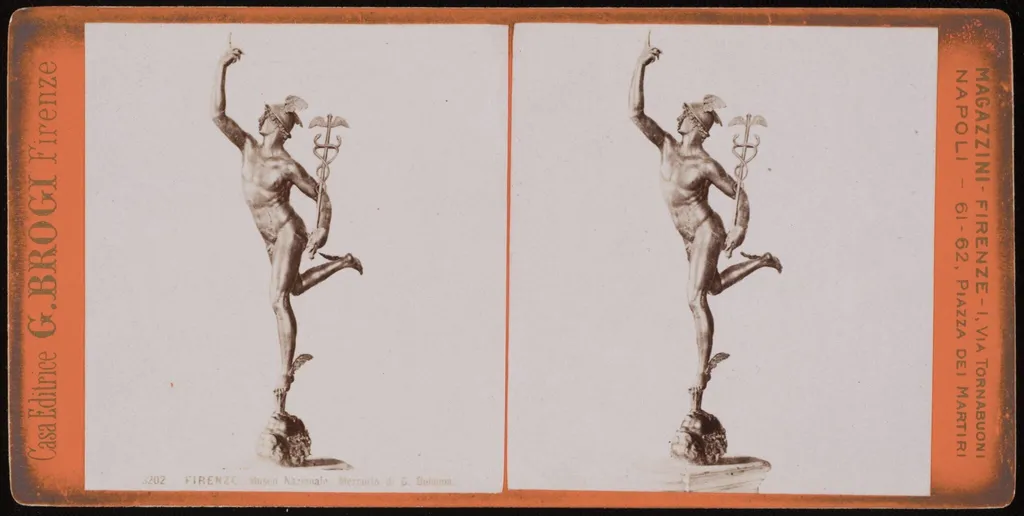
Mercurio di Giambologna is a photographic photography by the Impressionist artist Giacomo Brogi. It dates from 1880 and is held in the collection of the Victoria and Albert Museum.
About this work
Overview
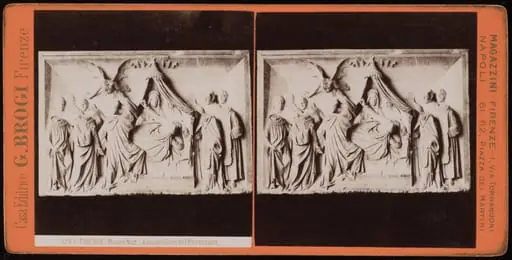
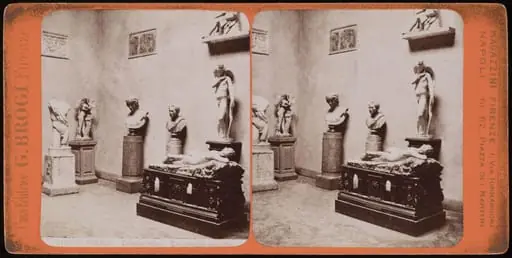
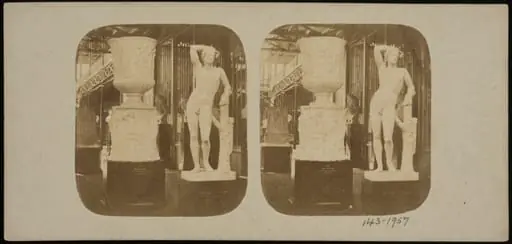
A black-and-white stereoscopic photograph from 1880, taken by Giacomo Brogi, captures Giambologna’s bronze statue of Mercury in Florence.
A black-and-white stereoscopic photograph from 1880, taken by Giacomo Brogi, captures Giambologna’s bronze statue of Mercury in Florence. The image presents the sculpture as part of a broader collection of artworks, framed by the photographic conventions of the period. Faded borders and printed text along the mount identify the photographer and location, reflecting the era’s practice of documenting art for scholarly and commercial circulation.
Subject & Meaning
The sculpture depicts Mercury, the Roman messenger god, caught in motion with one leg raised and a caduceus—two entwined snakes atop a staff—held in his hand. The pose suggests swift movement, aligning with his mythological role. Though the caduceus is often associated with medicine today, in this context it symbolizes divine communication and commerce, consistent with Mercury’s ancient attributes.
Technique & Style
Giambologna’s Mercury is rendered with dynamic tension, muscles subtly defined and hair styled in a close, wavy cap that enhances the sense of motion. The figure stands on a rough, naturalistic base, contrasting with the polished bronze surface. The photograph captures these details in monochrome, emphasizing form and texture over color, typical of 19th-century photographic documentation of sculpture.
History & Provenance
The photograph was produced by Giacomo Brogi, a Florentine photographer known for documenting artworks in the city during the late 19th century. The printed address on the mount links it to his studio, suggesting it was sold as a commercial or educational item. Its survival in collections today reflects its role in disseminating images of Renaissance sculpture before widespread museum photography.
Context
In the 1880s, stereoscopic photography was widely used to bring art into private homes and classrooms. Brogi’s images of Florentine sculptures, including Mercury, served as visual references for students and collectors. This photograph is part of a broader effort to catalog and preserve the appearance of artworks during a period of increasing interest in Italy’s artistic heritage.
Legacy
The photograph preserves Mercury’s appearance at a time when the sculpture was displayed in its original setting, before modern conservation practices altered its presentation. As a historical document, it offers insight into how Renaissance art was viewed and reproduced in the late 19th century, bridging the gap between original creation and later interpretation.
Artist & collection
Artist