Artwork
Discobulus, by Myron
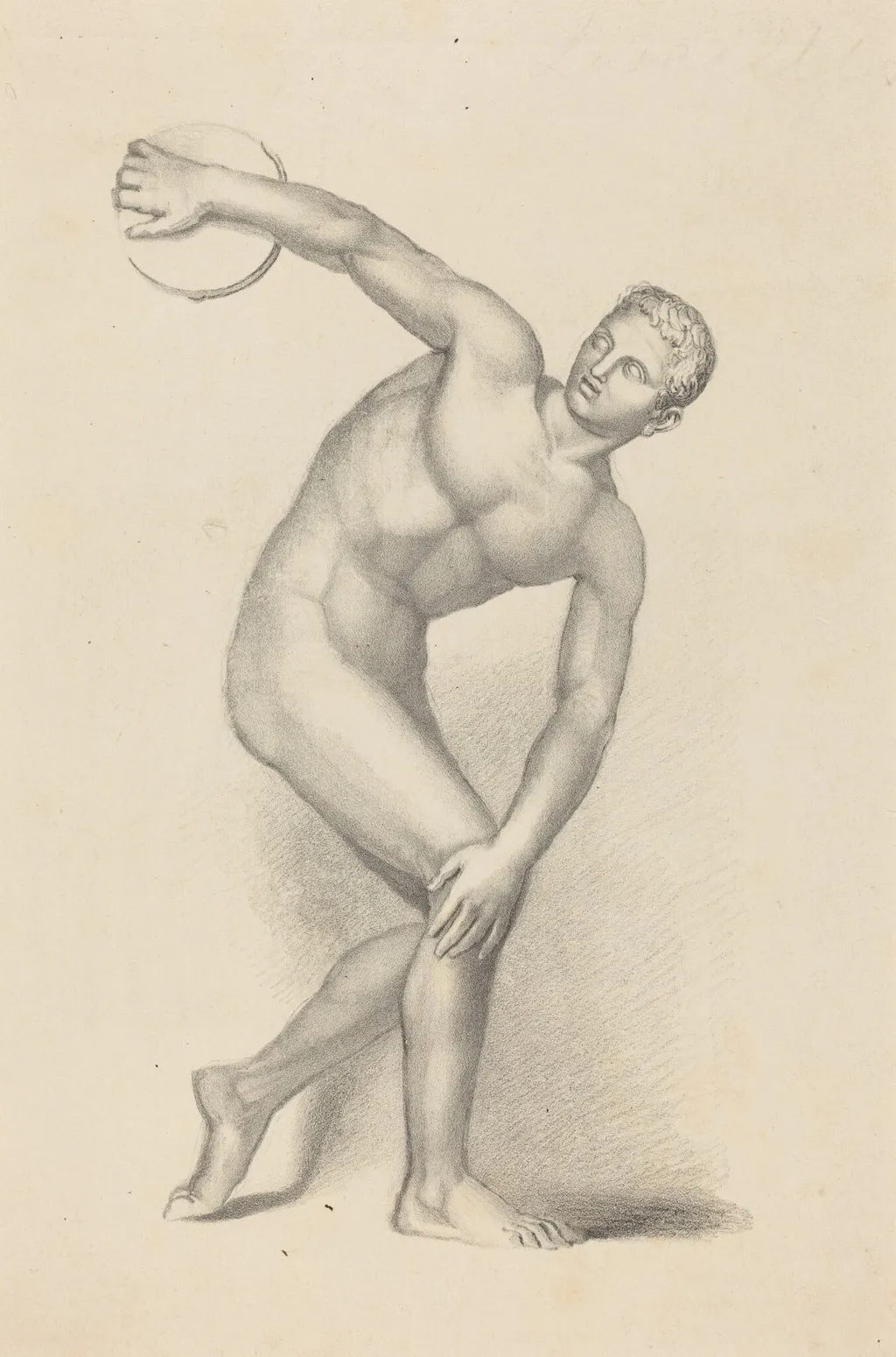
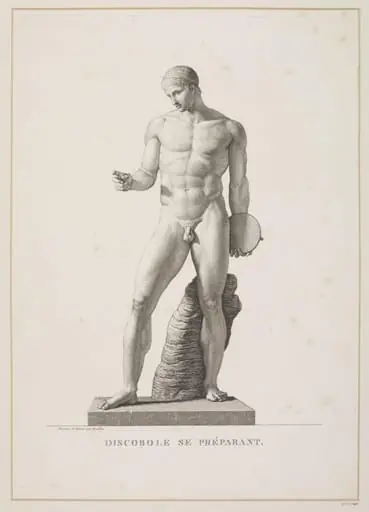
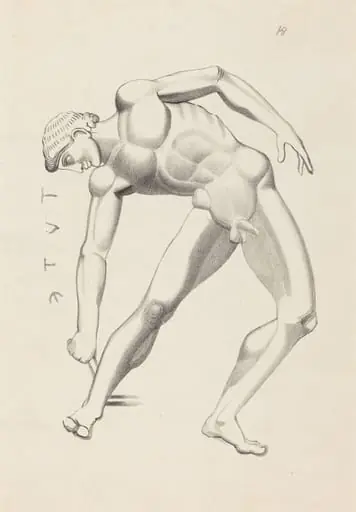
Discobulus, by Myron is an ink print by the Romanticist artist James William Giles. It dates from 1829 and is held in the collection of the National Gallery of Art.
About this work
Overview
James William Giles’s 1829 lithographic proof, titled *Discobulus, by Myron*, presents a solitary athlete in the act of hurling a discus. Rendered in stark, confident lines, the composition isolates the figure against a plain background, emphasizing the tension of the pose and the sculptural quality of the body.
Subject & Meaning
The image depicts a well‑trained male figure caught in the decisive moment of a discus throw, his torso twisted, one arm drawn back, the other poised to release. The pose echoes the classical Greek statue attributed to Myron, embodying ideals of physical perfection and the dynamism of athletic competition.
Technique & Style
Executed as a lithographic proof before the addition of lettering, the work relies on bold, simplified contours to delineate musculature and movement. The early‑19th‑century aesthetic favors a neoclassical restraint, using minimal shading to convey volume while maintaining a graphic clarity characteristic of the medium’s early experiments.
History & Provenance
Created in 1829, the print reflects the period’s fascination with antiquity, when British artists frequently revisited ancient motifs. Giles, a Scottish landscape and figure draughtsman, produced this work as part of his studies of classical forms; the proof stage indicates it was intended for a larger edition, though the final printed version remains undocumented.
Artist & collection


![The Borghese Gladiator, front view [plate 26], by François Perrier](https://artifactworldgallery.com/img/francois-perrier--the-borghese-gladiator-front-view-plate-26--5b649a5fe8c2f305-w320.webp)
![The Borghese Gladiator, side view, turned to right [plate 28], by François Perrier](https://artifactworldgallery.com/img/francois-perrier--the-borghese-gladiator-side-view-turned-to-right-plate-28--d519e69b0c94bb6a-w320.webp)
![A Nude Fighting Man, side view, turned to left [plate 27], by François Perrier](https://artifactworldgallery.com/img/francois-perrier--a-nude-fighting-man-side-view-turned-to-left-plate-27--39122f796b85b2fb-w320.webp)