Artwork
The Risen Christ Adored by Saints and Angels
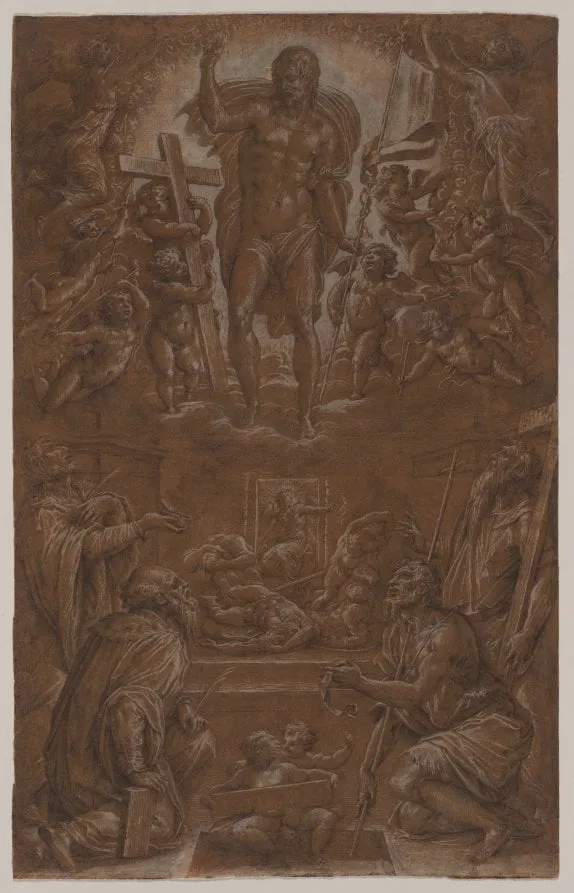
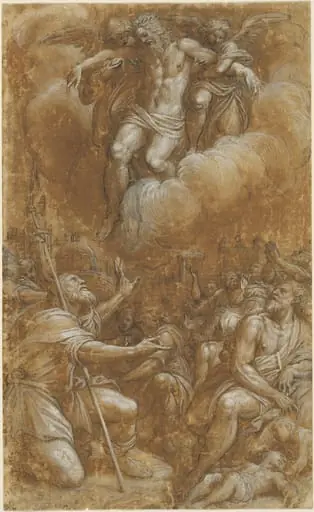
The Risen Christ Adored by Saints and Angels is a drawing by the Renaissance artist Giorgio Vasari. It dates from 1567 and is held in the collection of the Cleveland Museum of Art.
About this work
Vasari made this as a *modello*—a polished drawing to show a church before painting the real altarpiece.
You see a muscular Christ floating above saints and angels, all packed into a tight, glowing cloud.
Vasari made this as a *modello*—a polished drawing to show a church before painting the real altarpiece. He copied Michelangelo’s Christ from the *Last Judgment*, but flipped the pose. The saints below look up in awe, but their faces are softer, less dramatic.
If you like this, check out the *subject: italy, 16th century* for more altarpieces like it.
Overview
This drawing by Giorgio Vasari was created as a modello—a refined preparatory study—for an intended altarpiece in Florence. It served to present the proposed composition to church patrons before the final painting was executed. The work reflects Vasari’s deep engagement with Michelangelo’s artistic language, particularly in its treatment of the human form and celestial arrangement.
Subject & Meaning
The scene depicts the Risen Christ ascending amid a host of angels, surrounded by kneeling saints who gaze upward in reverence. The composition conveys divine triumph and spiritual awe, aligning with Counter-Reformation ideals of sacred spectacle. Christ’s presence dominates the upper register, while the saints below anchor the scene in human devotion, their expressions more restrained than dramatic.
Technique & Style
Vasari rendered the figures in precise pen and ink with subtle washes, achieving a luminous, sculptural quality. The bodies are modeled with careful attention to anatomy, echoing Michelangelo’s muscular forms. Though the pose of Christ is adapted from the Last Judgment, Vasari reversed its orientation, demonstrating both homage and independent reimagining within the constraints of devotional iconography.
History & Provenance
Created in the mid-16th century, the drawing was intended for a Florentine church commission, though the final altarpiece was never completed. As a modello, it remained in Vasari’s circle and later entered institutional collections. Its survival offers rare insight into the preparatory processes of Renaissance artists working under ecclesiastical patronage.
Context
In mid-1500s Florence, religious art was shaped by the Council of Trent’s emphasis on clarity and emotional resonance. Vasari’s drawing responds to this climate by combining classical idealism with devotional intensity. His reliance on Michelangelo’s imagery reflects the latter’s towering influence, even as Vasari sought to adapt it for new liturgical purposes.
Legacy
The drawing stands as a testament to Vasari’s role as both artist and chronicler of Renaissance practice. While not as widely known as Michelangelo’s works, it illustrates how artistic ideas were transmitted, modified, and repurposed across generations. It remains a key document in understanding the mechanics of artistic influence in 16th-century Italy.
Artist & collection
Artist
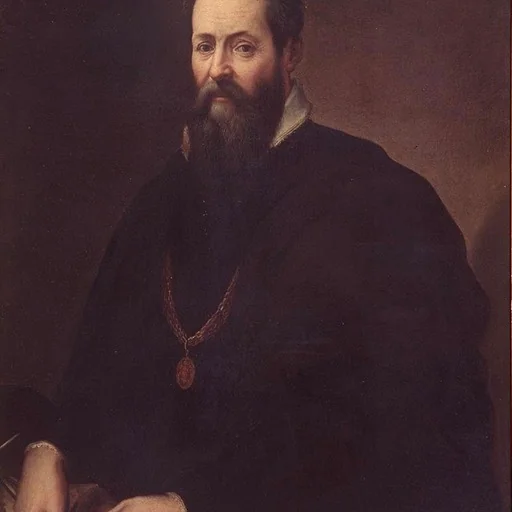
Giorgio Vasari (30 July 1511 – 27 June 1574) was an Italian Renaissance painter, architect, art historian, and biographer known for his work Lives of the Most Excellent Painters, Sculptors, and Architects, considered…