Artwork
The Prisons: A Perspective of Colonnades with Zig-Zag Staircase
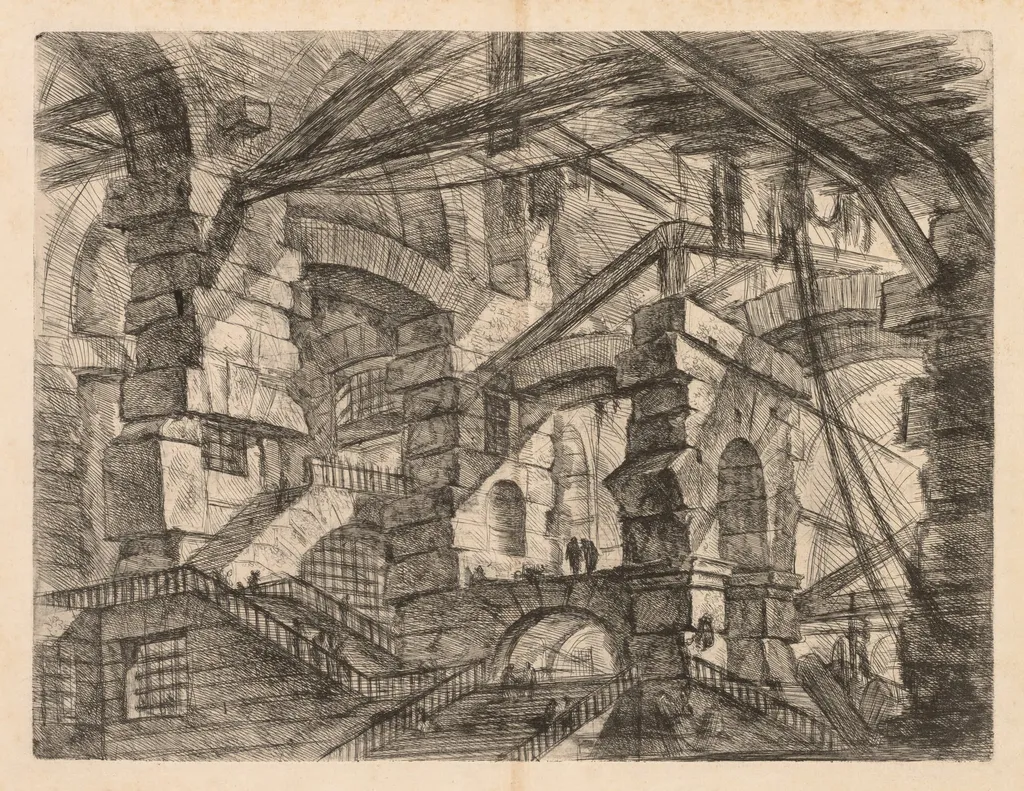
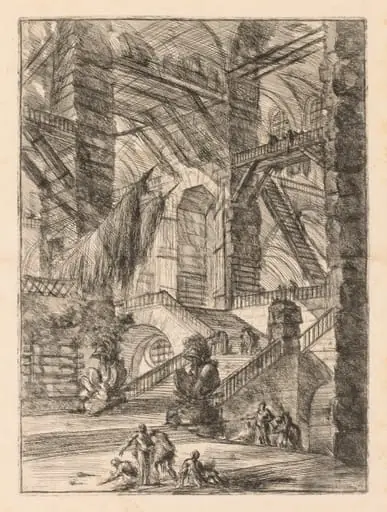
The Prisons: A Perspective of Colonnades with Zig-Zag Staircase is a print by the Baroque artist Giovanni Battista Piranesi. It dates from 1748 and is held in the collection of the Cleveland Museum of Art.
About this work
Overview
The work belongs to The Cleveland Museum of Art’s print collection and exemplifies Piranesi’s fascination with monumental, unrealized architecture.
Created in 1748 by Giovanni Battista Piranesi, this etching is part of a series known as Le Carceri d'Invenzione, or 'Imaginary Prisons.' It depicts an expansive, labyrinthine architectural space composed of towering colonnades, vaulted ceilings, and winding staircases. The composition is rendered in monochrome, emphasizing structural complexity over narrative detail. The work belongs to The Cleveland Museum of Art’s print collection and exemplifies Piranesi’s fascination with monumental, unrealized architecture.
Subject & Meaning
The scene presents no identifiable function or occupation; it is an invented space, neither prison nor palace, but a psychological landscape of confinement and scale. The diminutive human figures underscore the overwhelming dominance of architecture, evoking themes of isolation, disorientation, and the sublime. Piranesi’s vision suggests a metaphysical environment, where structure becomes a metaphor for the mind’s inner labyrinth rather than a literal detention space.
Technique & Style
Piranesi employed etching with meticulous line work to render intricate architectural details and dramatic chiaroscuro. Deep shadows contrast sharply with illuminated surfaces, enhancing the illusion of depth and volume. The precision of the lines captures the texture of stone, the curvature of arches, and the angularity of staircases. The style blends Renaissance perspective with Baroque theatricality, resulting in an atmosphere that is both mathematically ordered and emotionally charged.
History & Provenance
The print was produced during Piranesi’s early years in Rome, where he studied ancient ruins and developed his distinctive architectural fantasies. Originally published in 1749 as part of a set of sixteen plates, it was later revised and expanded in 1761. The Cleveland Museum of Art acquired the print through established collections of European prints, preserving its place within the broader legacy of 18th-century printmaking.
Context
Piranesi’s work emerged amid a European revival of interest in classical antiquity and architectural theory. While contemporaries like Borromini and Palladio inspired his forms, he departed from historical accuracy to explore imaginative extremes. His prints responded to Enlightenment debates on space and perception, offering visual meditations on power, order, and the limits of human comprehension within built environments.
Legacy
The Prisons series influenced Romantic and Gothic artists, including William Blake and Francisco Goya, who adopted its eerie grandeur and psychological tension. Later architects and filmmakers drew from its surreal spatial logic. Though not intended as literal blueprints, the etchings became enduring symbols of architectural imagination, shaping how later generations envisioned the emotional potential of built form.
Artist & collection

Artist
Giovanni Battista (or Giambattista) Piranesi (Italian pronunciation: ; also known as simply Piranesi; 4 October 1720 – 9 November 1778) was an Italian classical archaeologist, architect, and artist, famous for his…

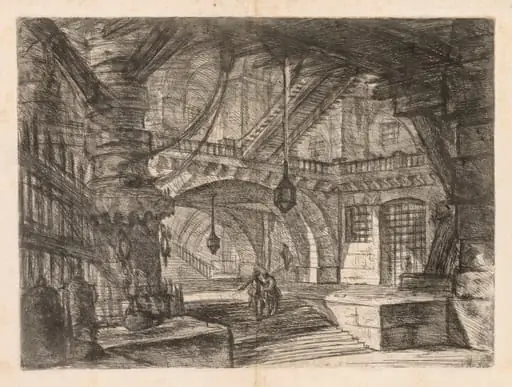 The Prisons: A Wide Hall with Lanterns
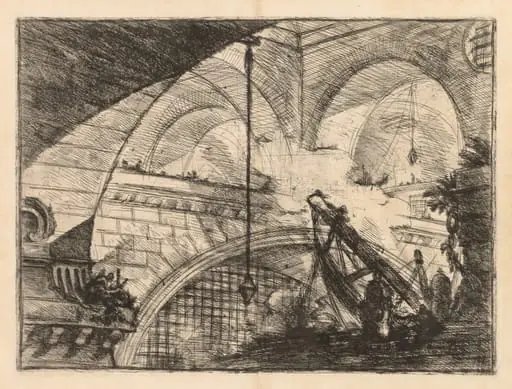 The Prisons: A Series of Galleries with Crane-Like Erection of Beams
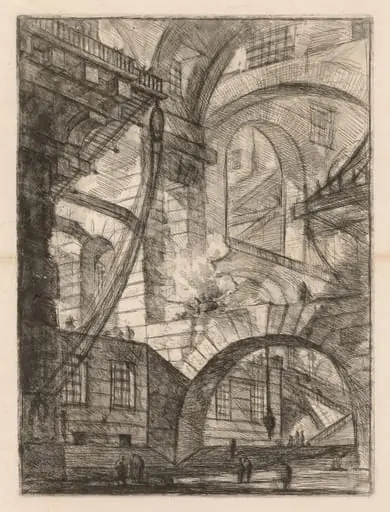 The Prisons: A Perspective of Arches with a Smoking Fire
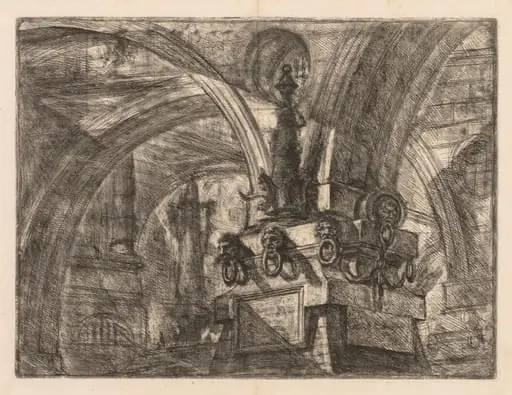 The Prisons: Round Arches Springing from a Square Column
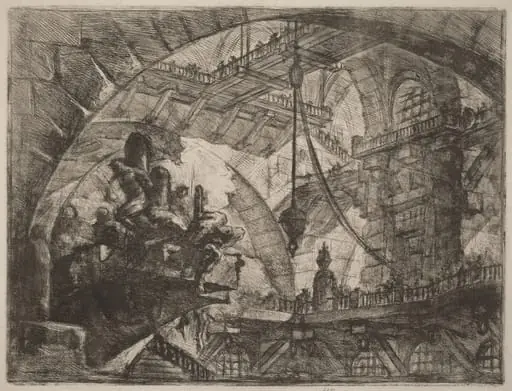 Prisoners on a Projecting Platform
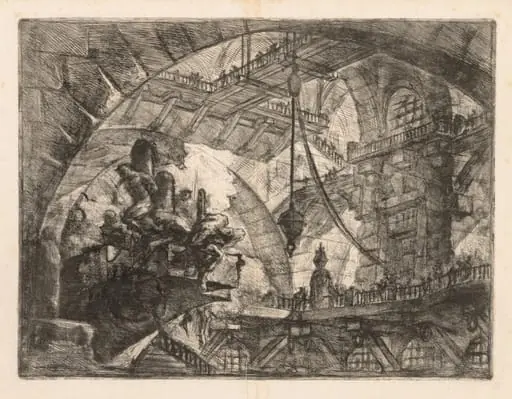 Prisoners on a Projecting Platform, Plate 10
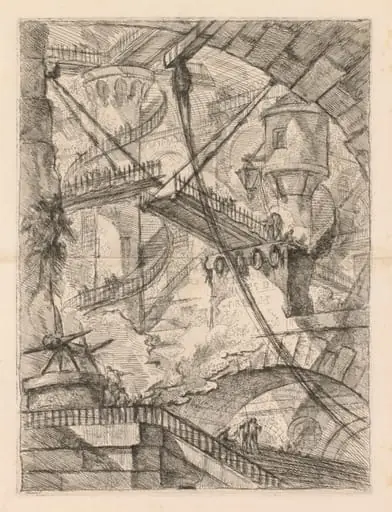 The Prisons: An Immense Interior with a Drawbridge
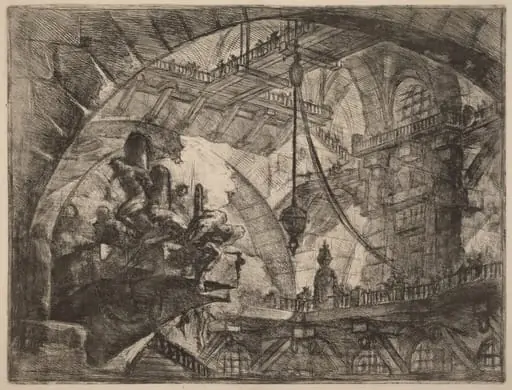 Prisoners on a Projecting Platform
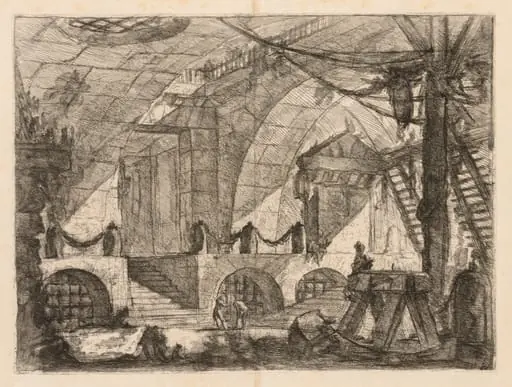 The Prisons: An Arched Chamber with Posts and Chains
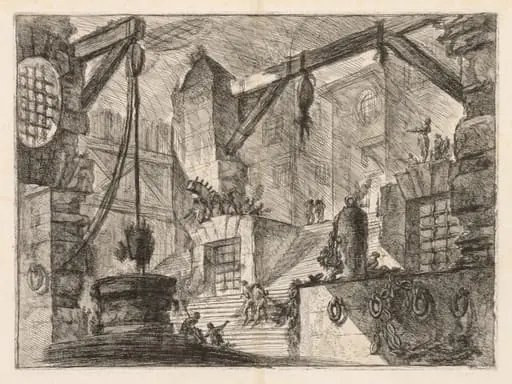 The Prisons: Colonnaded Interior with a Broad Stair
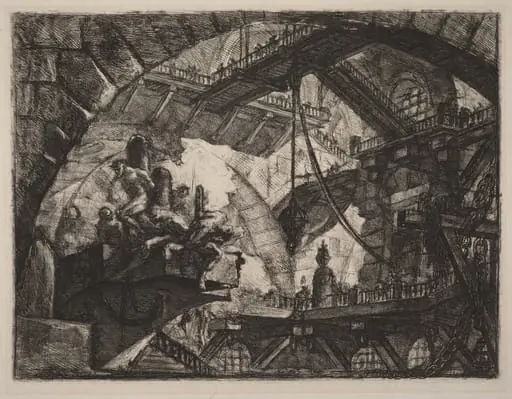 Prisoners on a Projecting Platform
 The Prisons: A Vast Interior with Trophies