Artwork
Charlotte of Bourbon
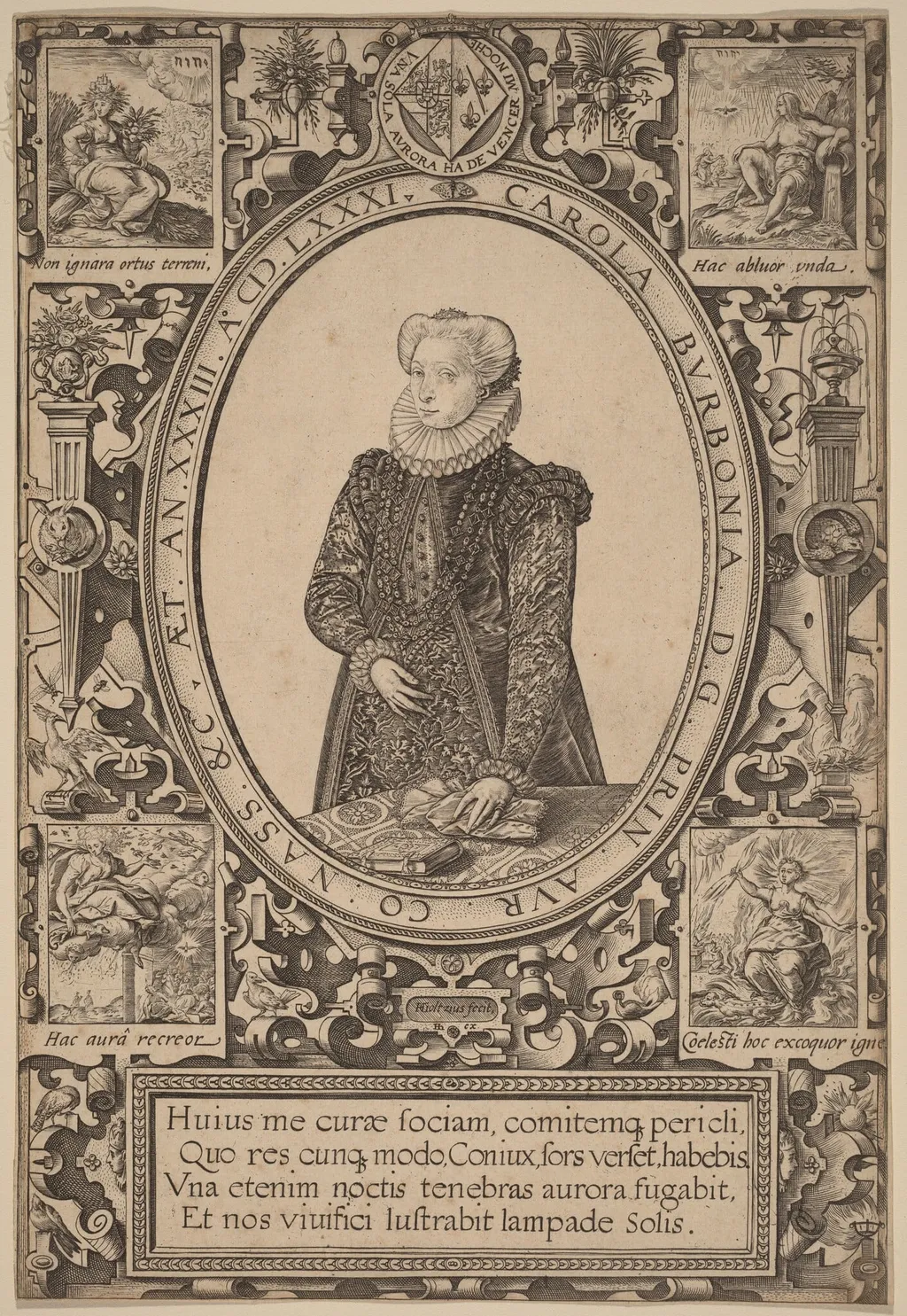
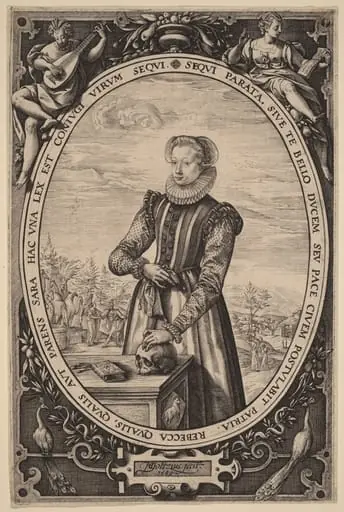
Charlotte of Bourbon is an ink print by the Renaissance artist Hendrik Goltzius. It dates from 1581 and is held in the collection of the National Gallery of Art.
About this work
Overview
The piece exemplifies his technical command and the refined aesthetic of Northern Mannerism, a style marked by elaborate detail and intellectual complexity.
Created in 1581 by Hendrick Goltzius, this engraving depicts Charlotte of Bourbon, a noblewoman and former nun. Goltzius, a Dutch artist of German origin, was renowned for his precision in engraving and his ability to craft original compositions rather than replicate existing works. The piece exemplifies his technical command and the refined aesthetic of Northern Mannerism, a style marked by elaborate detail and intellectual complexity.
Subject & Meaning
Charlotte of Bourbon, once a nun who left religious life to marry William the Silent, is portrayed with quiet dignity. Her formal attire and the presence of a book suggest literacy and social standing. The surrounding ornate frame, filled with small allegorical scenes and inscriptions, likely references her transition from convent to court, embedding her personal narrative within a symbolic context common in elite portraiture of the era.
Technique & Style
Goltzius employed fine, controlled lines to render texture and volume, showcasing his mastery of the burin. The dress’s intricate folds, the book’s surface, and the frame’s miniature vignettes are rendered with exceptional clarity. The composition is tightly structured, with the figure centered against a densely decorated border—a hallmark of Northern Mannerism that prioritizes visual richness over spatial depth.
History & Provenance
The engraving was produced during Goltzius’s early career in Haarlem, when he was establishing himself as a leading printmaker. It was likely commissioned by or for members of the Dutch nobility, possibly to commemorate Charlotte’s marriage to William the Silent. The work circulated among collectors and artists, contributing to Goltzius’s reputation across Europe as a virtuoso of the medium.
Context
In late 16th-century the Netherlands, portraiture often merged personal identity with political or moral symbolism. Engravings like this served both as private keepsakes and public statements of status. The elaborate frame, filled with mythological and religious imagery, reflects the humanist culture of the time, where visual codes conveyed complex narratives about virtue, lineage, and transformation.
Legacy
Goltzius’s engraving of Charlotte of Bourbon influenced later generations of printmakers through its technical ambition and symbolic density. While not widely reproduced in popular culture, it remains a key example of how Northern Mannerist artists elevated portraiture into layered, intellectual artifacts. The work continues to be studied for its fusion of personal history and artistic innovation.
Artist & collection
Artist
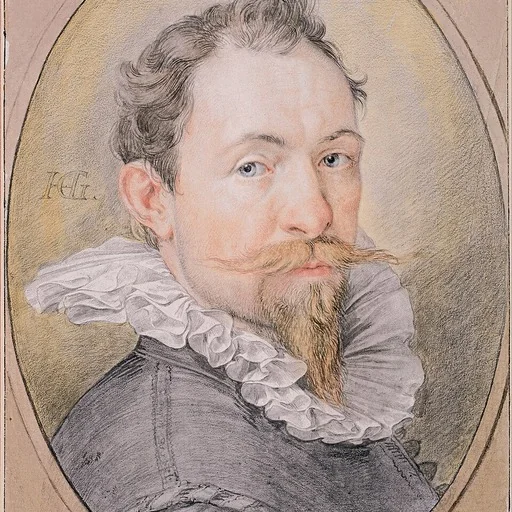
Hendrick Goltzius (German: , Dutch: ; né Goltz; January or February 1558 – 1 January 1617) was a German-born Dutch printmaker, draftsman, and painter.

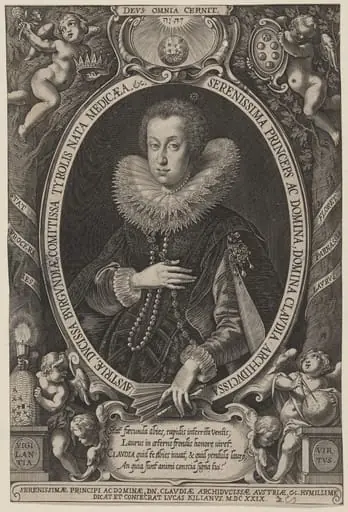 Claudia de Medici, Wife of Leopold of Austrian Tyrol
 Josina Hamels
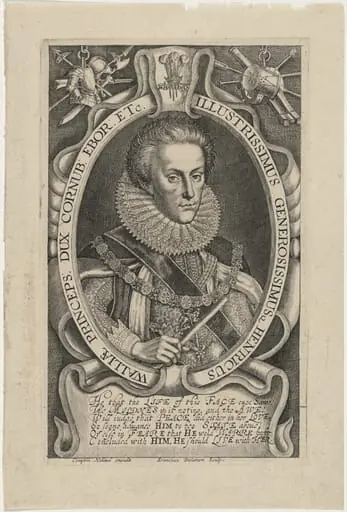 Henrici VIII Angliae, Franciae et Hiberniam Rex (King Henry VIII)
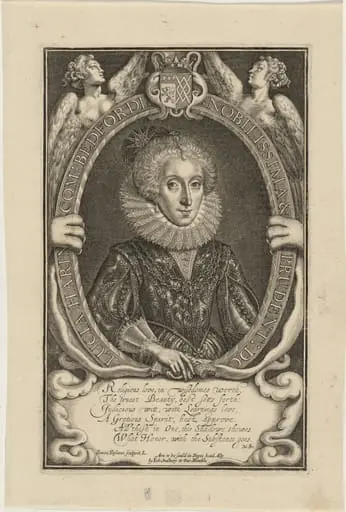 Lucia Harrington, Countess of Bedford
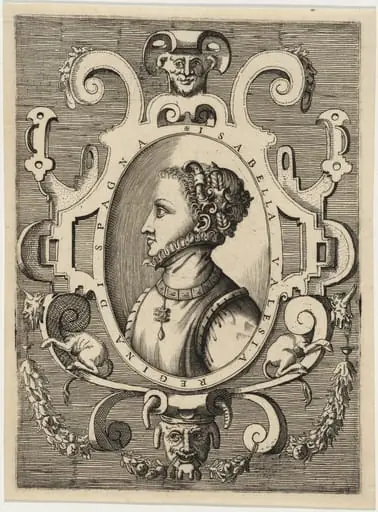 Isabella, Wife of Philip IV of Spain
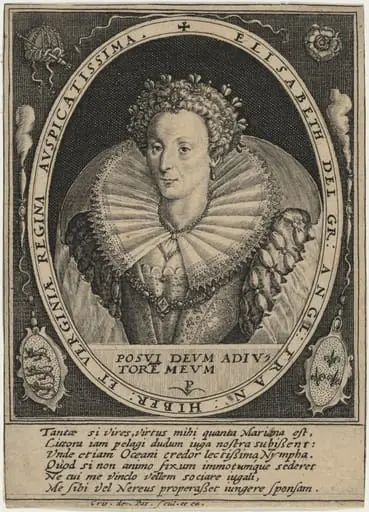 Elizabeth, Queen of England
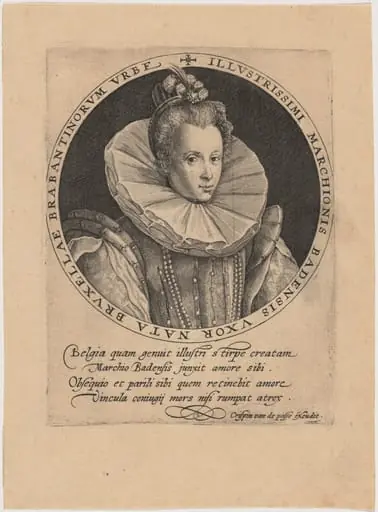 Elizabeth van Pallandt, Countess of Culemborg, Wife of Jacob, Margrave of Baden
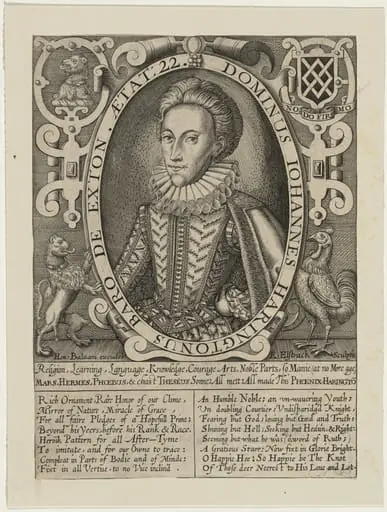 John, Lord Harrington of Exton
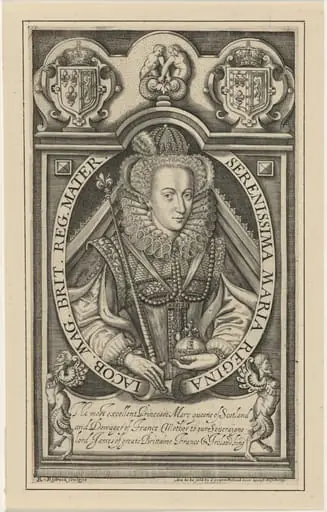 Mary, Queen of Scots
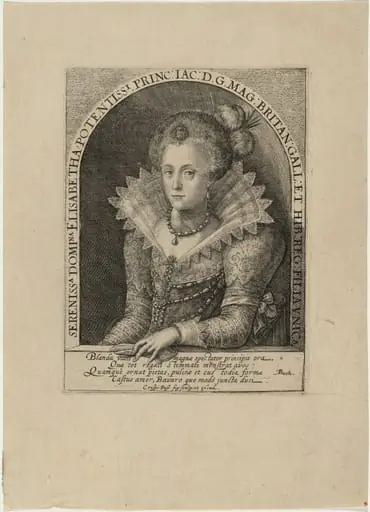 Elizabeth, Princess, Wife of the Elector Palatine Frederick V, King of Bohemia