Artwork
Icarus
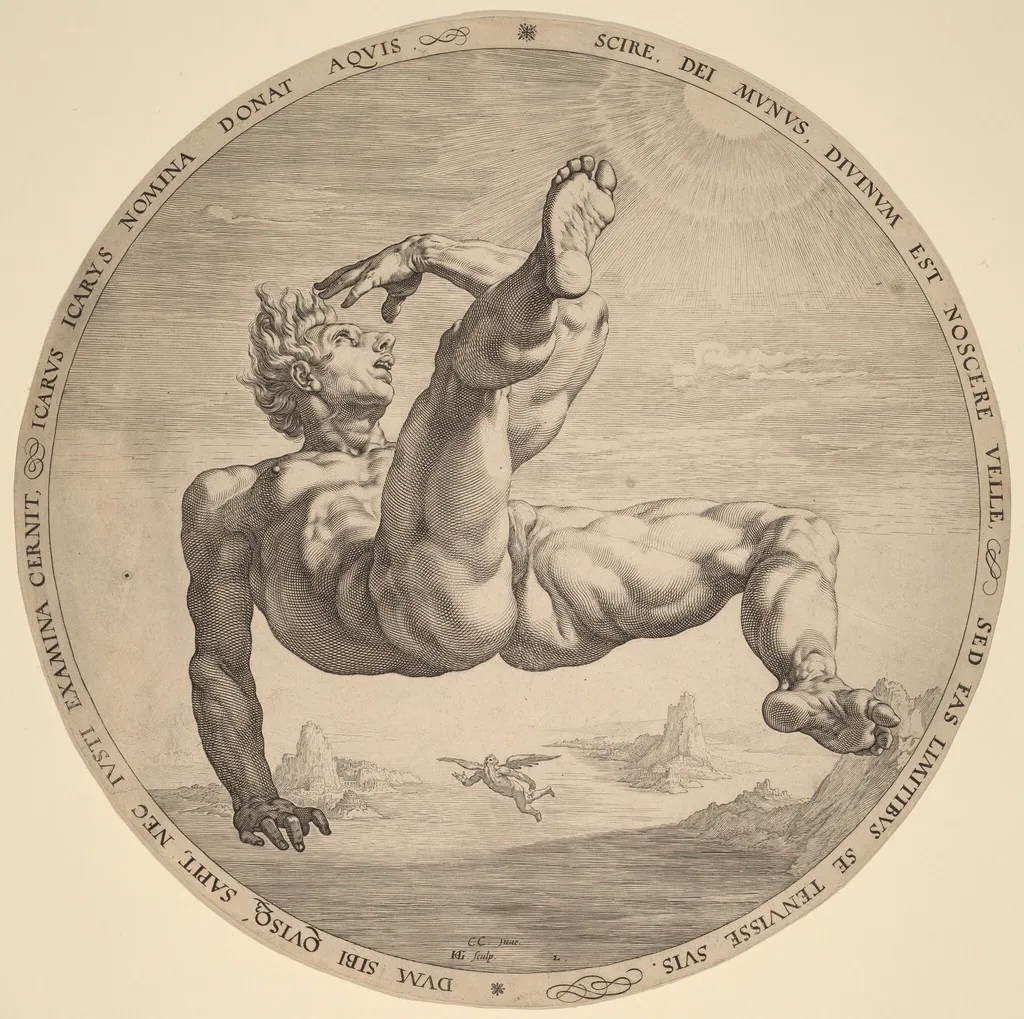
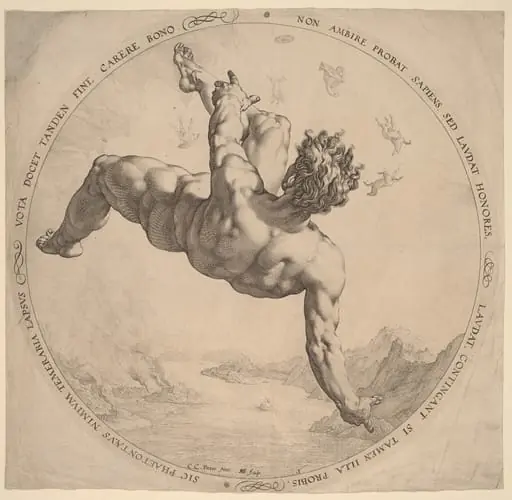
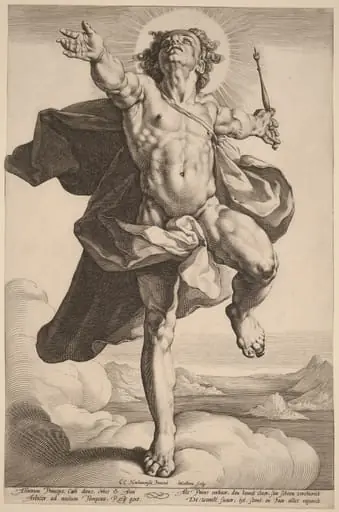
Icarus is an ink print by the Renaissance artist Hendrik Goltzius. It dates from 1588 and is held in the collection of the National Gallery of Art.
About this work
Overview
As one of the most skilled printmakers of his time, Goltzius elevated engraving through precise line work and complex compositions.
Created in 1588, *Icarus* is an engraving on laid paper by Hendrick Goltzius, a German-born artist active in the Netherlands. As one of the most skilled printmakers of his time, Goltzius elevated engraving through precise line work and complex compositions. This piece belongs to the Northern Mannerist tradition, emphasizing dramatic movement and technical virtuosity over naturalism. The image captures a moment of mythic collapse with intense physicality.
Subject & Meaning
The engraving illustrates the myth of Icarus, who defied limits by flying too near the sun, causing his wax wings to melt. Goltzius depicts the instant of his fall: body twisted mid-air, arms outstretched, hair swept by wind, sinking toward turbulent seas. The small winged figure above suggests divine observation or judgment. The Latin inscription encircling the scene reinforces the moral weight of hubris, grounding the image in classical warning.
Technique & Style
Goltzius employed fine, controlled lines to model the human form with sculptural intensity, emphasizing musculature and dynamic torsion. The engraving’s intricate cross-hatching renders texture in skin, water, and rock with remarkable subtlety. The composition is tightly framed, focusing attention on Icarus’s contorted body while the background recedes into chaotic waves and distant cliffs. The Latin border functions as both decorative frame and narrative anchor.
History & Provenance
Produced during Goltzius’s mature period in Haarlem, the print was part of a broader engagement with classical myths and humanist themes. It circulated widely among collectors and artists across Europe, admired for its technical ambition. No early ownership records are documented, but its survival in multiple institutional collections attests to its enduring reputation among connoisseurs of Northern printmaking.
Context
In late 16th-century Northern Europe, engraving was a respected medium for intellectual and artistic expression. Goltzius’s work responded to Italian Mannerist ideals while asserting Dutch technical prowess. His depictions of mythological subjects often served as vehicles for moral reflection, aligning with humanist education. The detailed rendering of the human body reflected contemporary interest in anatomy and movement, informed by both classical sculpture and dissection studies.
Legacy
Goltzius’s *Icarus* influenced generations of printmakers through its fusion of anatomical precision and emotional tension. Its emphasis on the body in extreme motion became a benchmark for expressive engraving. Though later artistic movements shifted toward broader strokes and tonal effects, this work remains a reference point for the potential of line to convey both physical and psychological drama.
Artist & collection
Artist
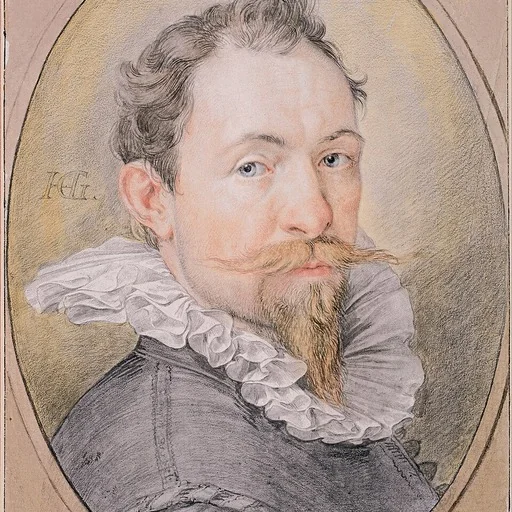
Hendrick Goltzius (German: , Dutch: ; né Goltz; January or February 1558 – 1 January 1617) was a German-born Dutch printmaker, draftsman, and painter.

![The Borghese Gladiator, back view [plate 29], by François Perrier](https://artifactworldgallery.com/img/francois-perrier--the-borghese-gladiator-back-view-plate-29--e76fdd1927ce2d52-w320.webp)
![A Nude Fighting Man, side view, turned to left [plate 27], by François Perrier](https://artifactworldgallery.com/img/francois-perrier--a-nude-fighting-man-side-view-turned-to-left-plate-27--39122f796b85b2fb-w320.webp)
![The Borghese Gladiator, side view, turned to right [plate 28], by François Perrier](https://artifactworldgallery.com/img/francois-perrier--the-borghese-gladiator-side-view-turned-to-right-plate-28--d519e69b0c94bb6a-w320.webp)