Artwork
Academy
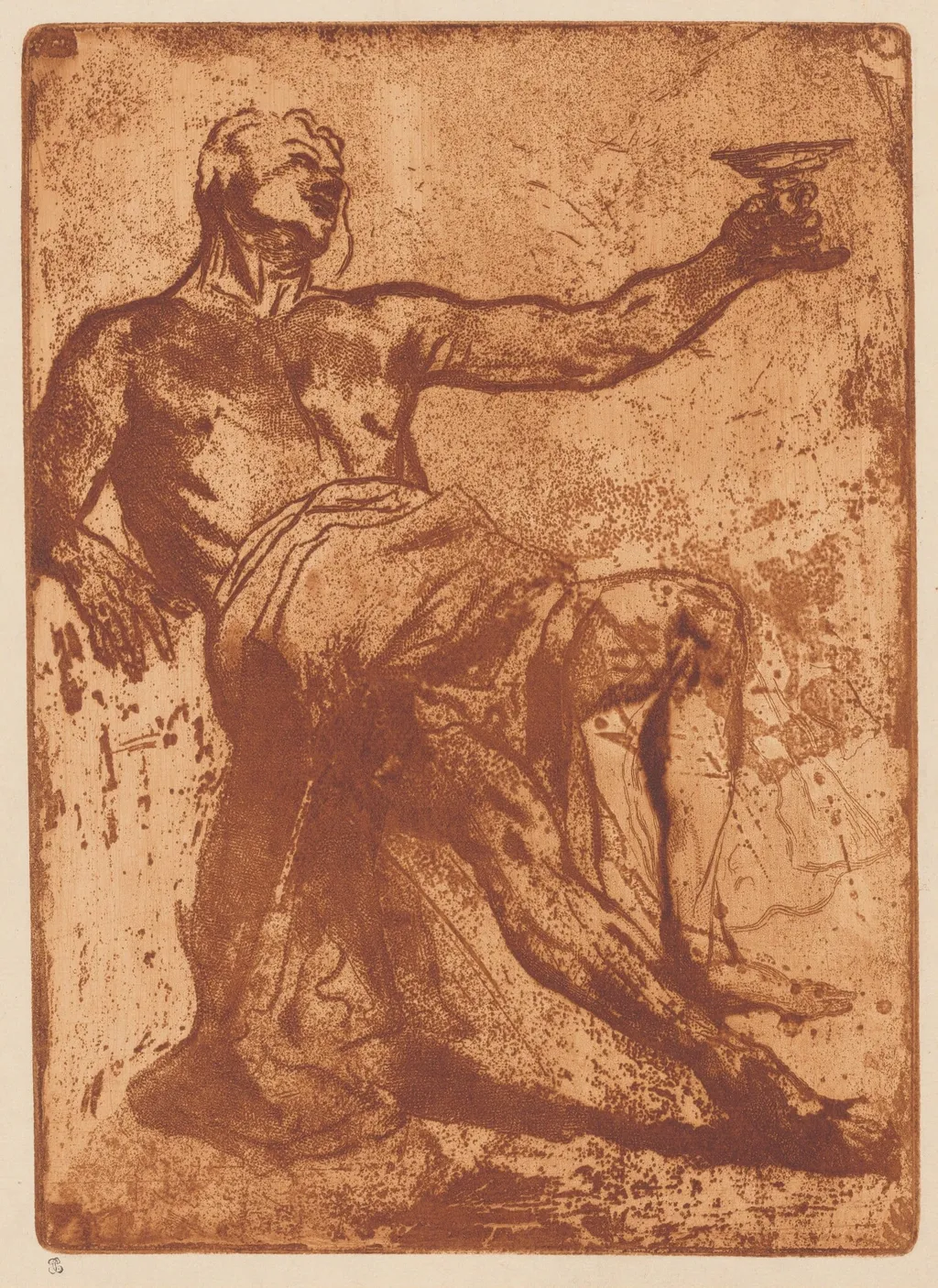
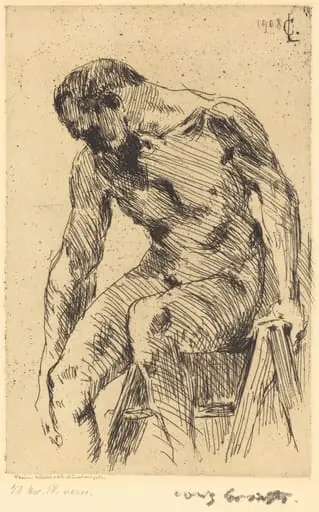
Academy is an ink print by the Impressionist artist Jules de Goncourt. It dates from 1864 and is held in the collection of the National Gallery of Art.
About this work
Overview
Created by Jules de Goncourt, it belongs to a series of experimental prints that prioritize tactile immediacy over polished finish.
Academy is a softground etching with roulette work, printed in red-brown ink on laid paper, dated around 1864. Created by Jules de Goncourt, it belongs to a series of experimental prints that prioritize tactile immediacy over polished finish. The work’s rough texture and limited palette reflect the artist’s interest in capturing spontaneous, almost sketch-like forms through printmaking techniques rarely used in this way at the time.
Subject & Meaning
The scene depicts a nude male figure seated on a rocky outcrop, holding a small vessel, while a reclining woman lies nearby, her face turned away. Neither figure is identified, and their relationship remains ambiguous. The composition avoids narrative clarity, instead evoking a moment of quiet solitude. The lack of idealization and the raw physicality suggest a deliberate departure from academic conventions of the human form.
Technique & Style
De Goncourt employed softground etching to capture the texture of drawn lines and added roulette work to create stippled, granular effects. The red-brown ink enhances the sense of immediacy, while uneven ink application and visible plate marks reinforce the print’s unfinished character. The style mimics the energy of a rapid drawing, prioritizing expressive mark-making over precision, challenging traditional printmaking ideals of clarity and refinement.
History & Provenance
Created during a period when Jules de Goncourt was deeply engaged with printmaking, Academy was likely made in his private studio rather than for commercial publication. It was not widely exhibited in his lifetime and remained largely within private collections until later 20th-century reassessments of 19th-century print experimentation. Its survival reflects its status as an artist’s personal exploration rather than a public statement.
Context
In the 1860s, French artists began rejecting rigid academic norms in favor of more personal, experimental approaches. De Goncourt, influenced by his literary circle and interest in naturalism, turned to printmaking as a medium for unfiltered expression. Academy aligns with broader shifts toward capturing transient moments and embracing imperfection, paralleling developments in contemporary drawing and early Impressionist practices.
Legacy
Though not widely known during his lifetime, Academy is now recognized as an early example of printmaking used to subvert academic ideals. Its emphasis on texture, spontaneity, and emotional ambiguity influenced later artists exploring the expressive potential of etching. The work stands as a quiet but significant step in the evolution of modern printmaking, valuing process over polish.
Artist & collection


![Seated Satyr Leaning Backward [recto], by Jean-Baptiste Deshays](https://artifactworldgallery.com/img/jean-baptiste-deshays--seated-satyr-leaning-backward-recto--46579a155129856e-w320.webp)