Artwork
Parra Sinensis (Pheasant-Tailed Jacana)
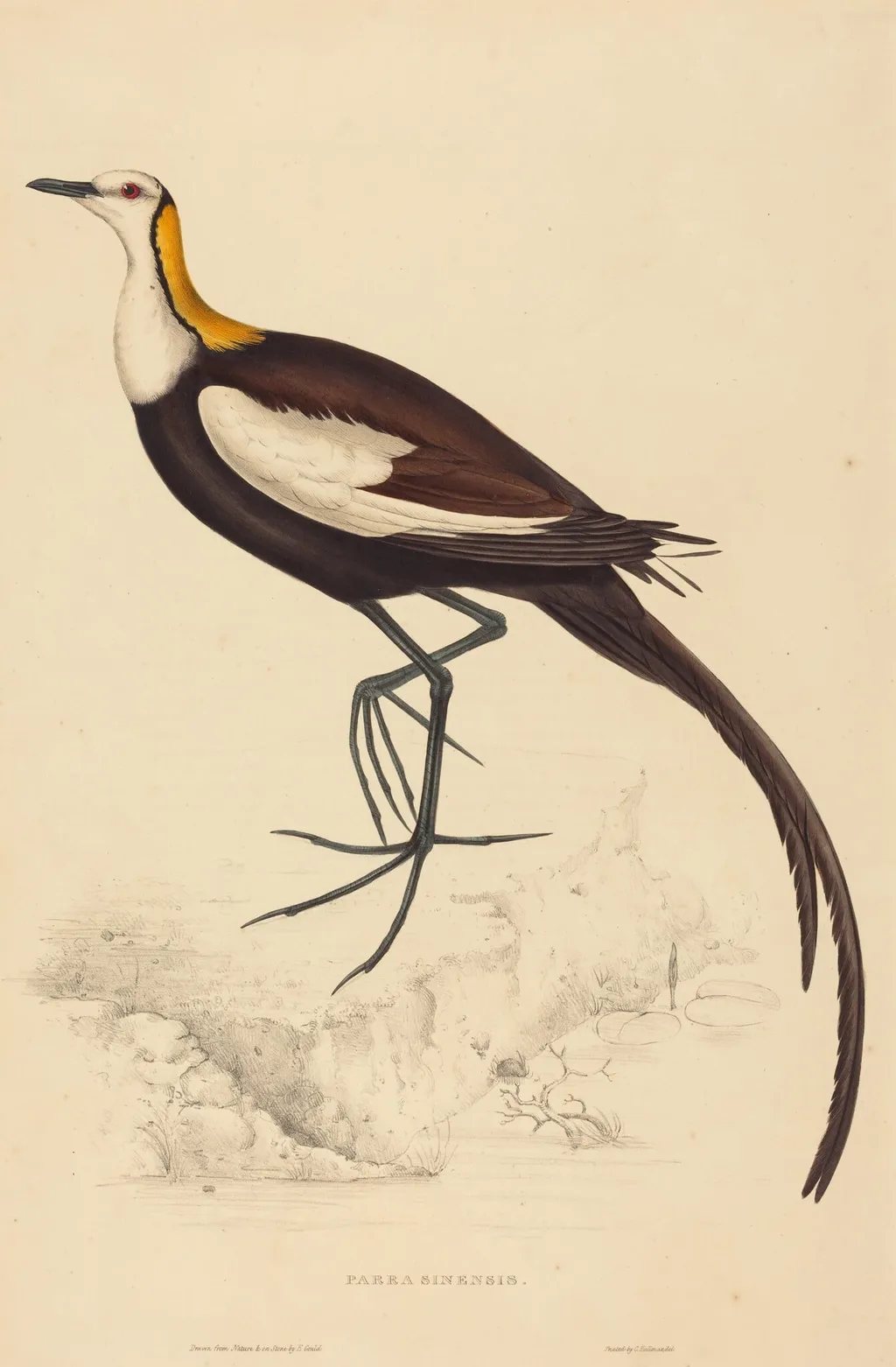
Parra Sinensis (Pheasant-Tailed Jacana) is an ink print by the Romanticist artist Elizabeth Gould. It dates from 1822 and is held in the collection of the National Gallery of Art.
About this work
Overview
Created in 1822 by Elizabeth Gould, this hand-colored lithograph depicts the Pheasant-Tailed Jacana, a wading bird native to Asian wetlands.
Created in 1822 by Elizabeth Gould, this hand-colored lithograph depicts the Pheasant-Tailed Jacana, a wading bird native to Asian wetlands. The image presents the bird in isolation on a plain surface, emphasizing its form through precise linework and subtle tonal shading. A smaller supplementary sketch beneath illustrates the species in its natural habitat, offering context beyond the isolated portrait.
Subject & Meaning
The bird, known for its ability to walk across floating vegetation, is rendered with anatomical accuracy, reflecting scientific interest in avian diversity during the early 19th century. Its elongated tail feathers, pale head, and yellow facial patch are carefully noted, suggesting documentation for natural history rather than decorative intent. The Latin name, Parra Sinensis, anchors the image in taxonomic classification of the era.
Technique & Style
The print was produced using lithography, a method allowing fine detail and tonal gradation. Hand-coloring was applied with water-based pigments to enhance naturalistic features, such as the bird’s white breast and yellow facial skin. The background is left unadorned, directing focus to the subject’s form, while the smaller habitat sketch below provides ecological context without visual clutter.
History & Provenance
This print originated from Elizabeth Gould’s work illustrating ornithological texts alongside her husband John Gould, a prominent publisher of bird studies. Though unsigned, it aligns with her known output from the early 1820s. The image likely appeared in a private or institutional collection of natural history illustrations, circulated among scientists and collectors before being archived.
Context
During the 1820s, European naturalists were systematically cataloging species from Asia and other colonial regions. Elizabeth Gould’s illustrations contributed to this effort, combining artistic precision with scientific rigor. The inclusion of both isolated and contextual views reflects evolving practices in biological illustration, where accuracy and ecological setting were increasingly valued together.
Legacy
Elizabeth Gould’s work laid groundwork for later ornithological publications, influencing how birds were visually documented in scientific literature. Though not widely exhibited in her lifetime, her prints remain referenced in historical studies of natural history art. This lithograph endures as a quiet example of 19th-century scientific observation, valued for its clarity and restraint.
Artist & collection