Artwork
Four Birds
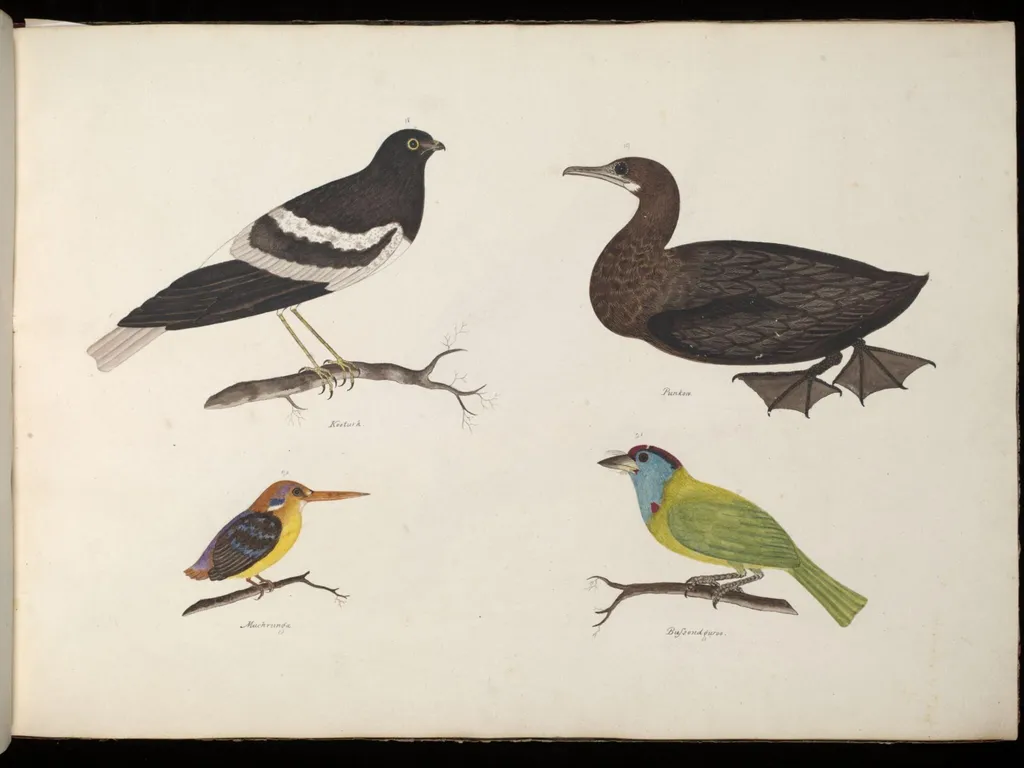
Four Birds is a paint painting by the Romanticist artist Unknown. It dates from 1826 and is held in the collection of the Victoria and Albert Museum.
About this work
Overview
Each sheet presents a single subject with meticulous attention to detail, reflecting a tradition of scientific illustration in British colonial India.
Created in 1826, Four Birds is one of twelve painted folios bound into a volume with marbled covers. Each sheet presents a single subject with meticulous attention to detail, reflecting a tradition of scientific illustration in British colonial India. The work belongs to a private collection assembled by Lord Amherst, then Governor General, and his family, who cultivated an interest in natural history during their time in the subcontinent.
Subject & Meaning
The painting depicts four bird species native to South Asia: the Pied harrier, Little cormorant, Three-toed kingfisher, and Blue-throated barbet. Rather than serving as decorative art, the composition functions as a visual record, capturing distinct anatomical features for study. The birds are arranged without background or context, emphasizing form and plumage over habitat, aligning with the era’s empirical approach to natural classification.
Technique & Style
The artist rendered each bird with precise brushwork, highlighting individual feathers, beak structure, and eye color. Soft modeling defines volume, while thin, delicate branches anchor the subjects without distraction. Color is applied with restraint, favoring accuracy over embellishment. The lack of landscape or atmospheric elements directs focus entirely to the birds’ physical characteristics, characteristic of scientific documentation of the period.
History & Provenance
The folio was produced during Lord Amherst’s tenure as Governor General of India (1823–1828), a period marked by increased documentation of regional flora and fauna. It was likely created by an Indian artist working under European patronage, a common practice in colonial natural history projects. The volume remained within the Amherst family before entering institutional collections, preserving its original binding and sequence.
Context
This painting emerged amid a broader British effort to catalog India’s biodiversity, supported by colonial administrators and naturalists. Similar works were produced for institutions like the East India Company and private collectors. Unlike European ornithological texts, these Indian-made illustrations often blended local artistic conventions with Western observational standards, resulting in a unique hybrid style grounded in direct observation.
Legacy
The folio survives as part of a rare, intact set of natural history illustrations from early 19th-century India. It contributes to understanding how scientific knowledge was visually constructed under colonial conditions. Today, such works are studied not only for their biological accuracy but also as cultural artifacts reflecting the intersection of art, empire, and natural science.
Artist & collection

 Domestic Scene
 Giacomo and Cardinal Marco, investing Andrea, Abbot of San Zeno, with his Benefice
 The Nymph of Fontainebleau
 Portrait of a Woman
 Madonna and Child with Saints in the Enclosed Garden
 Venus and Minerva
 Family Group of Four on Sofa
 Wall painting from Room H of the Villa of P. Fannius Synistor at Boscoreale
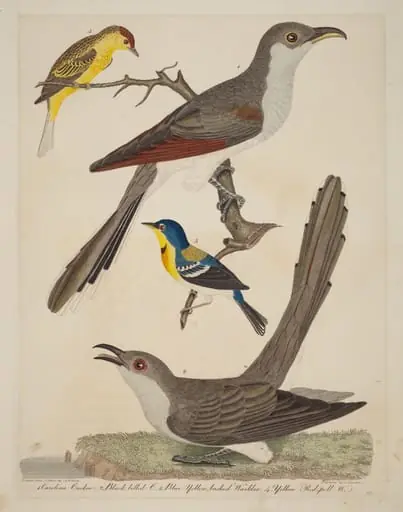 Carolina Cuckoo, Black-billed Cuckoo, Blue Yellow-backed Warbler, and Yellow Red-poll Warbler
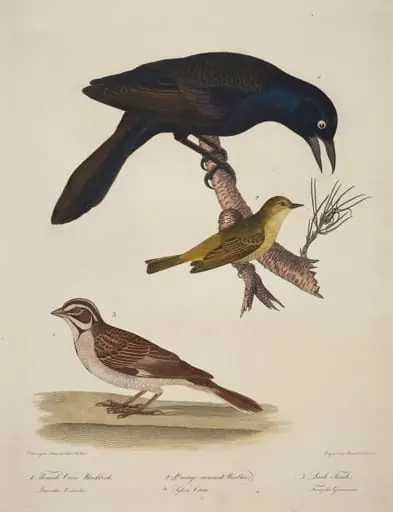 Female Crow Blackbird, Orange-Crowned Warbler, Lark Finch
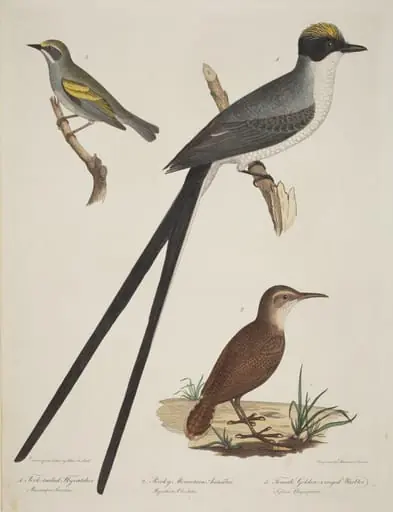 Fork-tailed Flycatcher, Rocky Mountain Anteater, and Female Golden-winged Warbler
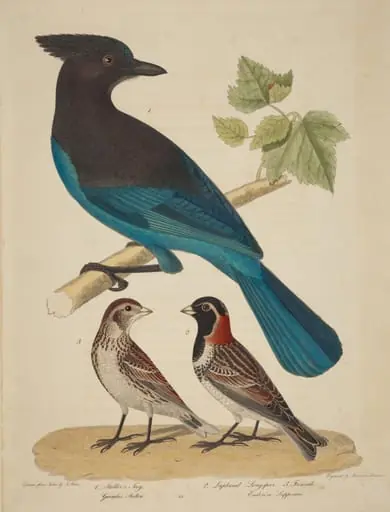 Stellar's Jay, Lapland Longspur and Female
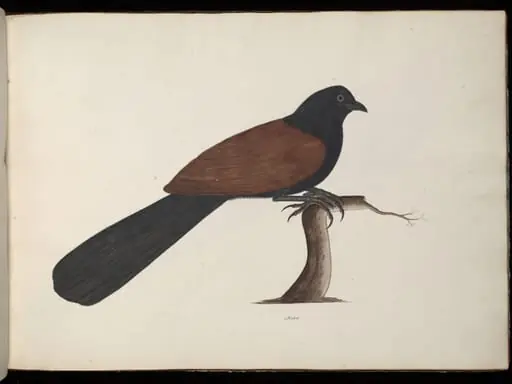 Conucal or crow pheasant
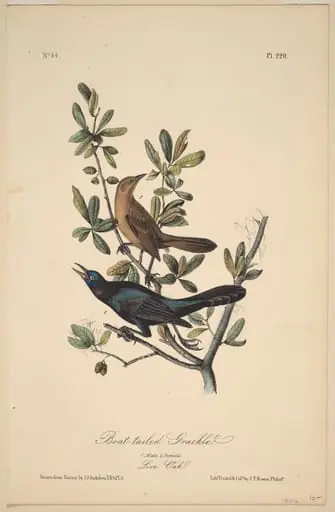 Boat-Tailed Grackle
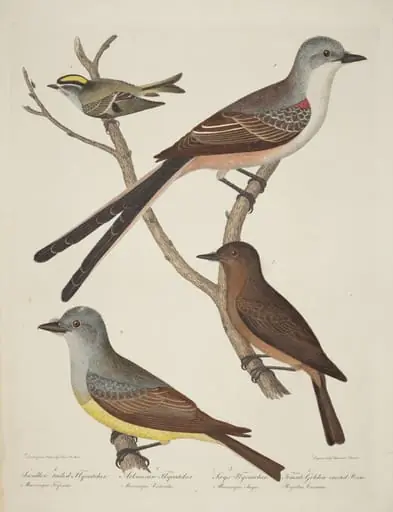 Swallow-tailed Flycatcher, Arkansas Flycatcher, Say's Flycatcher, and Female Golden-crested Wren
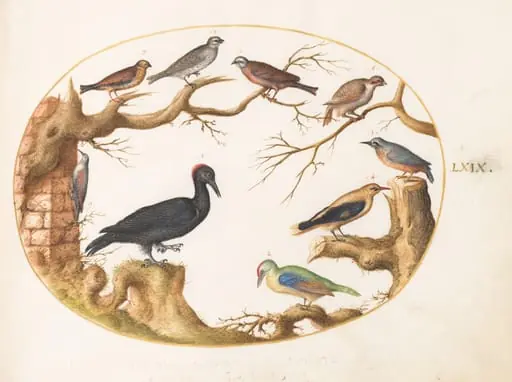 Plate 69: Black Woodpecker, European Green Woodpecker, Nuthatch, and Other Birds
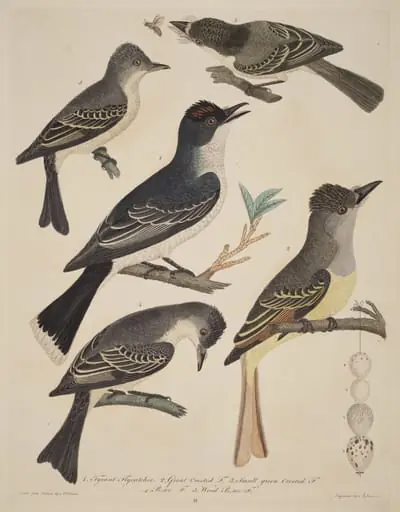 Five Birds with Their Eggs and an Insect