Artwork
Dibersion de España (Spanish Entertainment)
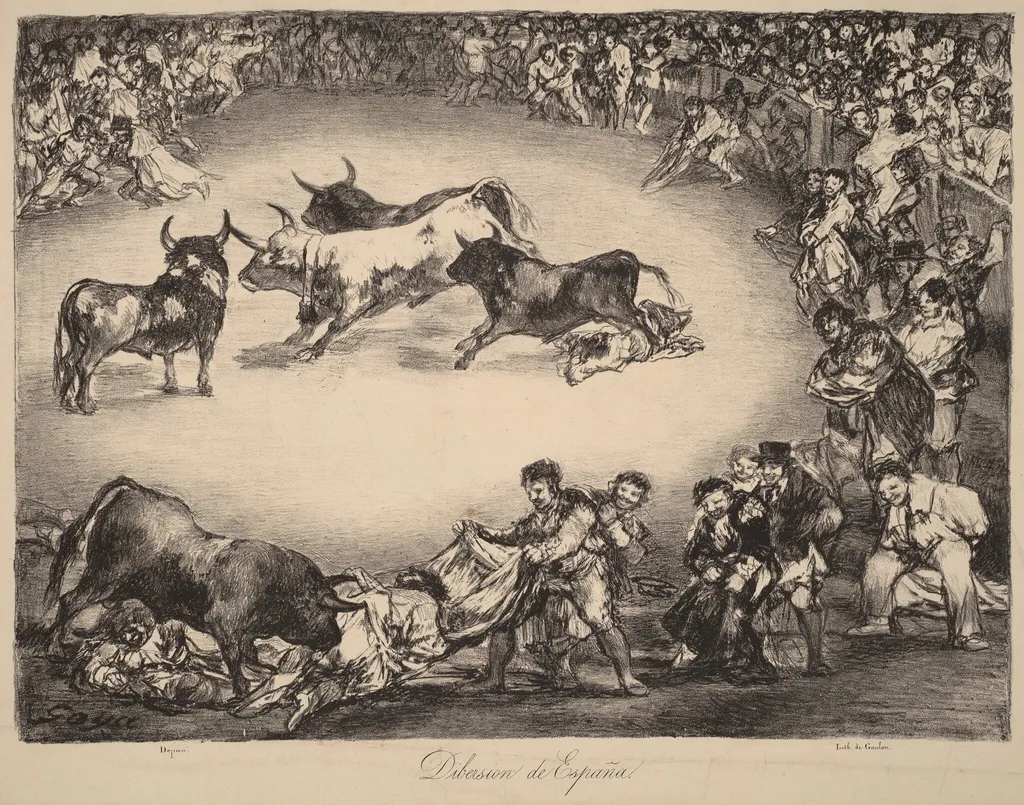
Dibersion de España (Spanish Entertainment) is an ink print by the Romanticist artist Francisco Goya. It dates from 1825 and is held in the collection of the National Gallery of Art.
About this work
Overview
Created in 1825, *Dibersion de España* is a lithograph by Francisco Goya, printed in Bordeaux by the workshop of Gaulon.
Created in 1825, *Dibersion de España* is a lithograph by Francisco Goya, printed in Bordeaux by the workshop of Gaulon. It belongs to a series of late works in which Goya explored民间 and violent spectacles through spontaneous draftsmanship. The print was produced on wove paper, a medium that allowed for greater tonal variation than earlier techniques. Its execution reflects Goya’s increasing interest in printmaking as a vehicle for unfiltered observation.
Subject & Meaning
The scene depicts a disordered public event involving bulls and a crowd in chaotic interaction. Figures reach, stumble, and watch as animals surge through the space, entangled in fabric. The title, meaning 'Spanish Entertainment,' suggests a reference to regional festivities, possibly linked to bull-related rituals. Goya presents the spectacle without romanticism, emphasizing confusion and raw physicality rather than ceremonial order.
Technique & Style
Goya employed lithography to capture rapid, gestural lines that convey motion and disorder. The sketchlike quality, with loose contours and minimal shading, mimics the immediacy of a drawn note. The wove paper absorbed ink unevenly, enhancing the rough texture of the scene. This technique allowed Goya to bypass polished finish, favoring expressive energy over detail, aligning with his late style’s emphasis on emotional rawness.
History & Provenance
Printed in Bordeaux in 1825 during Goya’s exile in France, the work was produced outside Spain, likely without direct oversight. The lithographic stones were sent to Gaulon’s press, a known collaborator of Goya’s late prints. Few impressions were made, and the work remained largely obscure until later 19th-century collectors began to recognize its significance as part of Goya’s final artistic phase.
Context
Created after the Napoleonic Wars and during Goya’s self-imposed exile, the print reflects a disillusioned view of Spanish cultural traditions. While earlier works like the *Disparates* series mocked social folly, *Dibersion de España* strips away irony, presenting chaos as an unvarnished reality. It aligns with a broader European shift toward depicting the uncivilized undercurrents of public life.
Legacy
The print’s raw aesthetic and thematic intensity influenced later artists seeking to break from academic conventions. Its unidealized portrayal of crowd behavior and animal violence prefigured modernist interests in psychological and physical disorder. Though not widely exhibited in Goya’s lifetime, it is now recognized as a pivotal example of his late printmaking, bridging Romantic expression and 20th-century visual language.
Own this work as a print
Artist & collection
Artist
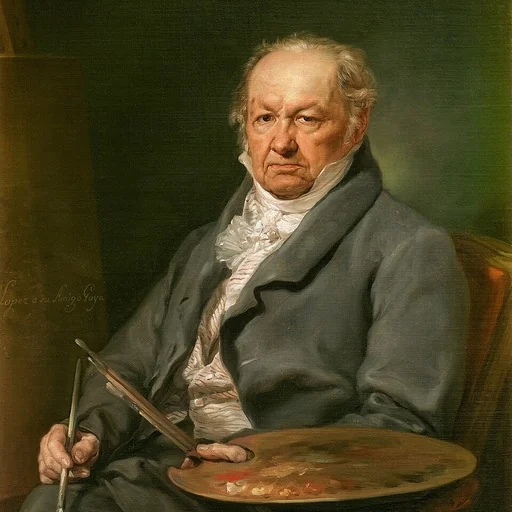
Francisco José de Goya y Lucientes (; Spanish: ; 30 March 1746 – 16 April 1828) was a Spanish romantic painter and printmaker.

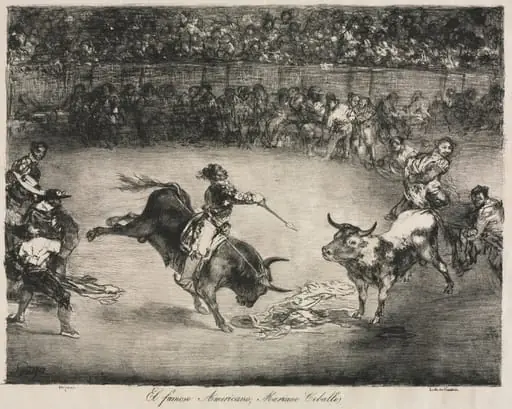 The Bulls of Bordeaux: The Famous American, Mariano Ceballos
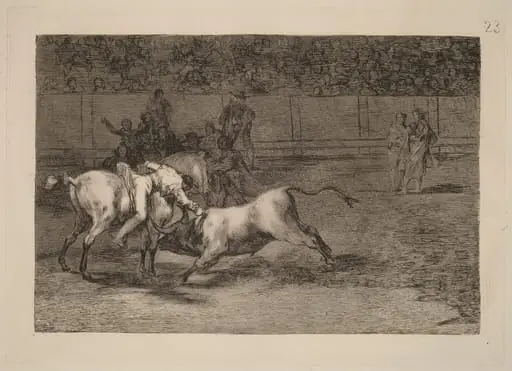 Mariano Ceballos, alias el Indio, mata el toro desde su caballo (Mariano Ceballos, Alias the Indian, Kills the Bull from His Horse)
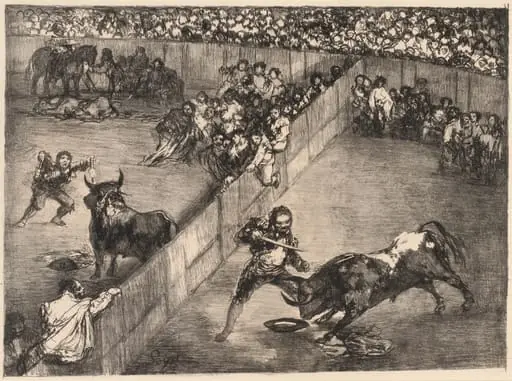 Bullfight in a Divided Ring
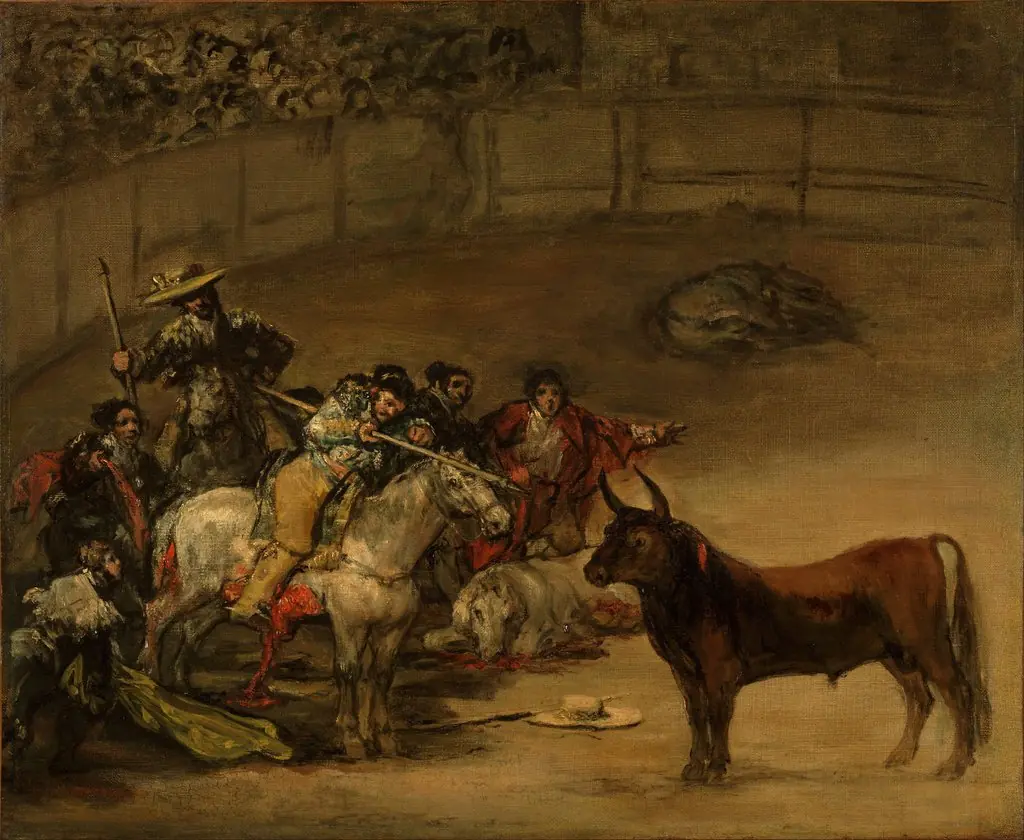 Bullfight, Suerte de Varas
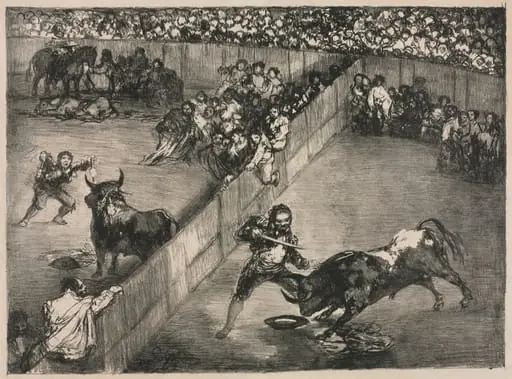 The Bulls of Bordeaux: Bullfight in a Divided Ring
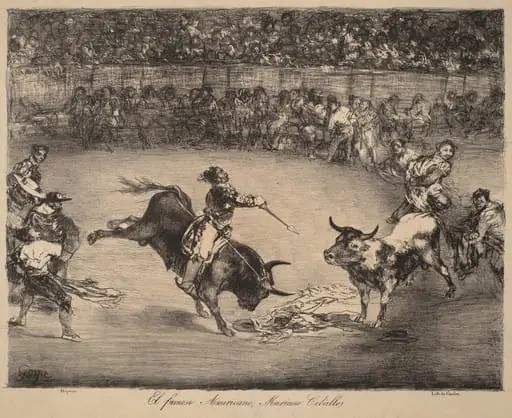 El famoso Americano, Mariano Ceballos (The Famous American, Mariano Ceballos)
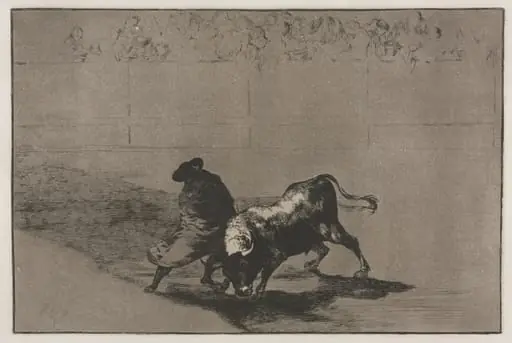 Bullfights: The Very Skilful Student of Falces, Wrapped in his Cape, Tricks the Bull with the Play of his Body
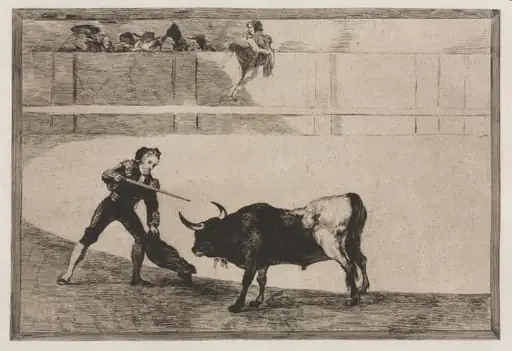 Bullfights: Pedro Romeo Killing the Halted Bull
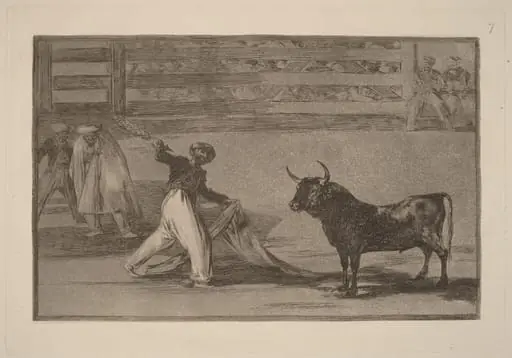 Origen de los arpones o banderillas (Origin of the Harpoons or Banderillas)
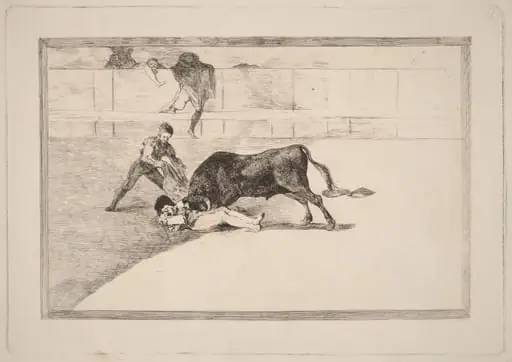 La desgraciada muerte de Pepe Illo en la plaza de Madrid (The Unlucky Death of Pepe Illo in the Ring at Madrid)