Artwork
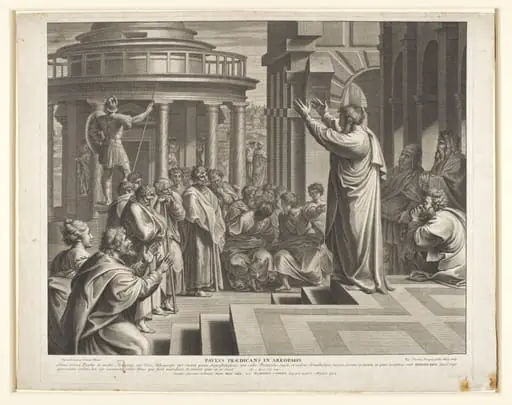
Paul Preaching at Athens
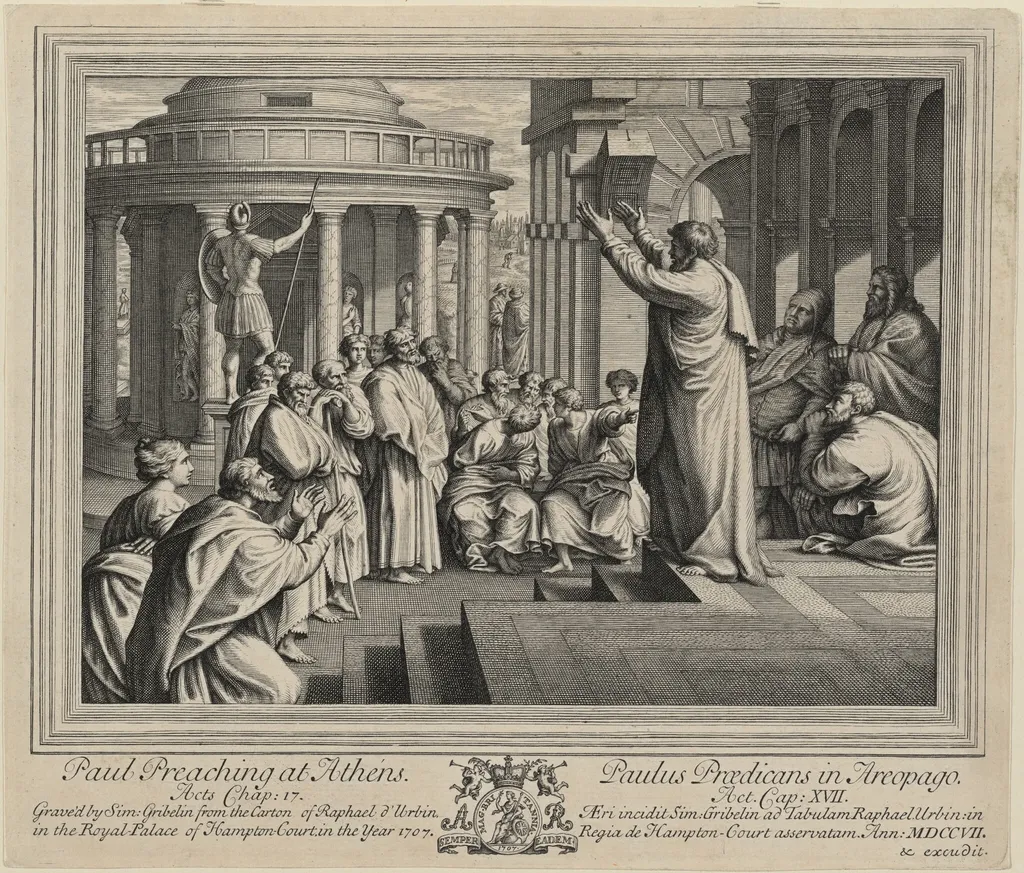
Paul Preaching at Athens is an ink print by the Baroque artist Simon II Gribelin. It dates from 1707 and is held in the collection of the National Gallery of Art.
About this work
Overview
Gribelin translated a composition originally conceived by Raphael into the medium of engraving, adapting its composition through fine linear detail.
Paul Preaching at Athens is a 1707 engraving by Simon II Gribelin, executed in ink on laid paper. It depicts a moment from the Acts of the Apostles, where the apostle Paul addresses an Athenian audience. The print resides in the National Gallery of Art, Washington, as part of its collection of early modern European prints. Gribelin translated a composition originally conceived by Raphael into the medium of engraving, adapting its composition through fine linear detail.
Subject & Meaning
The scene illustrates Paul’s sermon to the philosophers of Athens, as recounted in Acts 17. He stands on a raised platform, gesturing toward a group of varied listeners—some attentive, others doubtful or contemplative. The classical architecture behind him, adorned with statues, evokes the intellectual culture of ancient Athens, contrasting Paul’s message with the city’s pagan traditions. The moment captures the tension between new religious ideas and established belief systems.
Technique & Style
Gribelin employed fine, precise lines typical of engraving to model form and create depth. The texture of drapery, stone, and human figures is rendered through controlled cross-hatching and varying line density. The background architecture is rendered with clarity, while the figures are arranged in a shallow stage-like space. The composition reflects the influence of High Renaissance ideals, filtered through the disciplined conventions of 18th-century printmaking.
History & Provenance
The engraving was produced in 1707 by Simon II Gribelin, a French-born printmaker active in England. It derives from a cartoon by Raphael, likely part of a series commissioned for the Vatican’s Sistine Chapel. Gribelin’s version was one of many reproductive prints circulating in Europe, serving to disseminate Renaissance imagery to broader audiences. The National Gallery of Art acquired it as part of its foundational print collection.
Context
In the early 18th century, reproductive engravings like this one were vital for spreading artistic and religious imagery beyond elite circles. Raphael’s compositions were widely admired and frequently reinterpreted by printmakers. Gribelin’s work reflects the continued reverence for Renaissance models and the role of print in religious education, aligning with Protestant and Catholic efforts to visualize biblical narratives for public understanding.
Legacy
Gribelin’s engraving stands as an example of how Renaissance compositions were preserved and reinterpreted through print culture. While not original in design, its technical precision and faithful adaptation contributed to the transmission of classical and biblical iconography. It remains a reference point for studying the relationship between painting and print in early modern Europe, illustrating the collaborative nature of artistic reproduction.
Artist & collection

![The Seven Famous Cartons [sic] of Raphael Urbin, by Simon II Gribelin](https://artifactworldgallery.com/img/simon-ii-gribelin--the-seven-famous-cartons-sic-of-raphael-urbin--ed7067b13efdece0-w320.webp)