Artwork
Bottles and Bowl
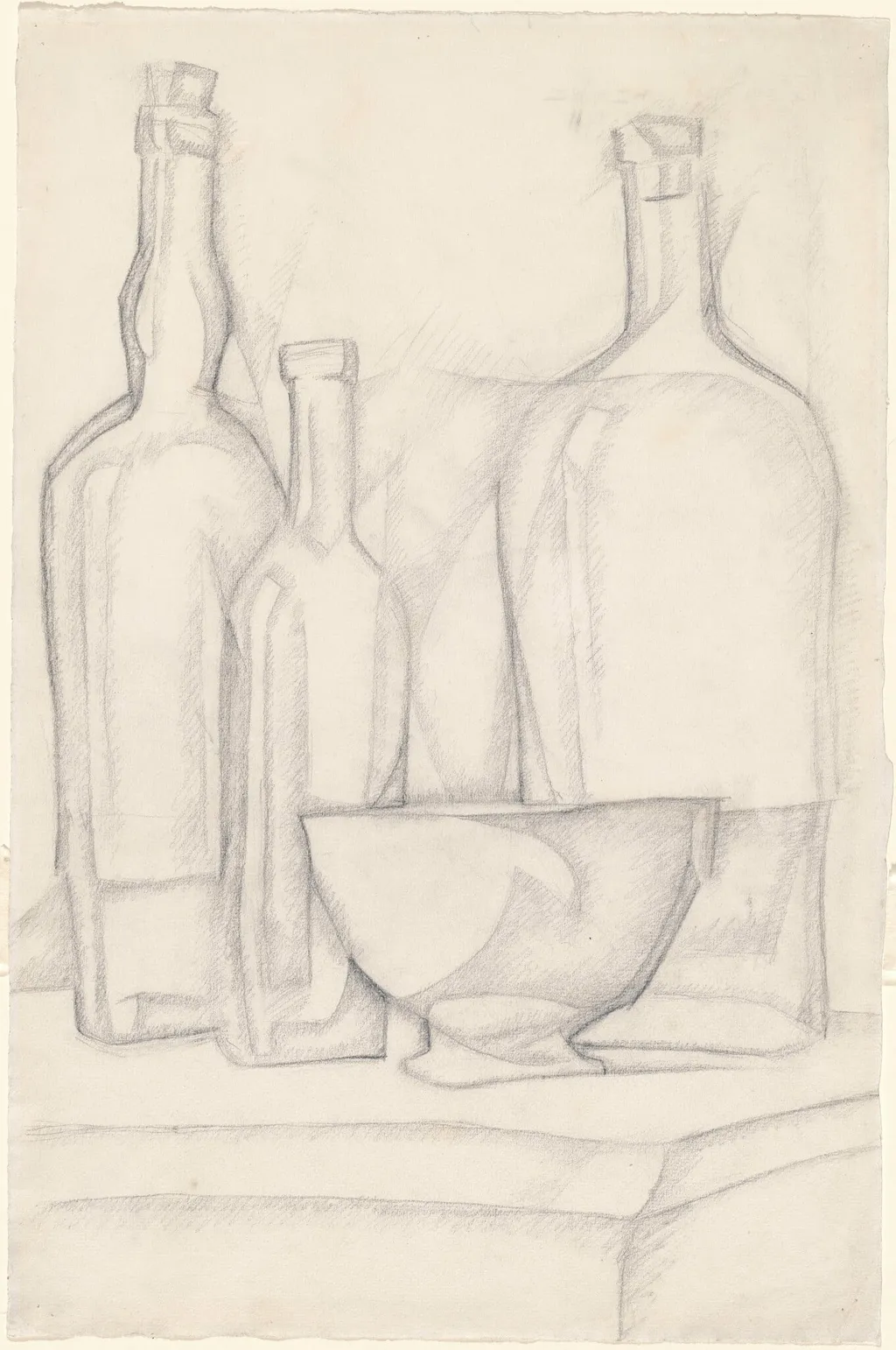
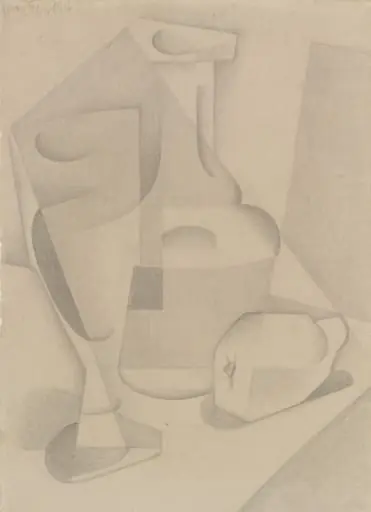
Bottles and Bowl is a graphite drawing by Juan Gris. It dates from 1911 and is held in the collection of the National Gallery of Art.
About this work
Overview
Juan Gris produced this graphite drawing in 1911 during his early engagement with Cubism. Executed on laid paper, the work belongs to a series of intimate studies in which he explored still-life compositions using minimal media. Unlike his later oil paintings, this piece relies on line and tone to suggest volume and spatial relationships, revealing his methodical approach to form.
Subject & Meaning
The drawing presents three common household items—a pair of bottles and a bowl—arranged without narrative or symbolism. Gris treats these objects not as representations of utility but as structural elements to be analyzed and reassembled. Their simplification into angular planes reflects a broader interest in how ordinary things can be deconstructed into essential geometric relationships.
Technique & Style
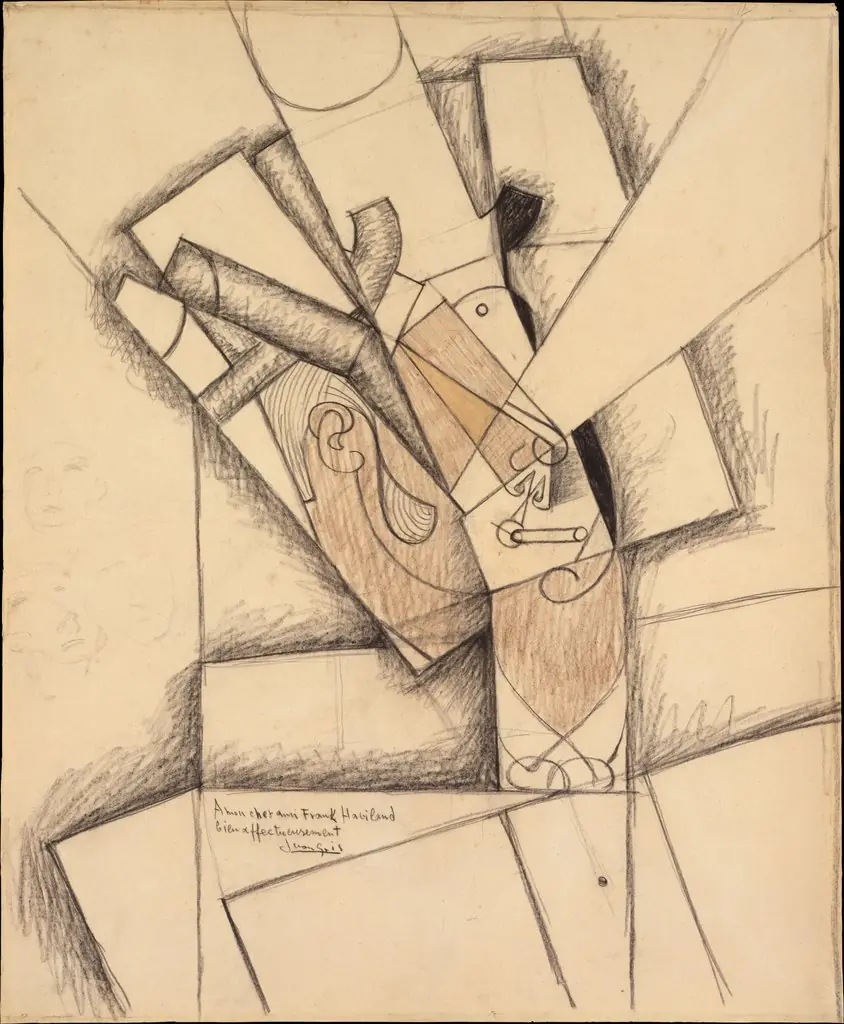
Using only graphite, Gris constructed the composition through precise, overlapping lines and subtle shading. The forms are fractured along multiple viewpoints, a hallmark of Analytic Cubism, yet remain grounded in observable reality. The paper’s texture subtly influences the graphite’s grain, enhancing the tactile quality of the surfaces while maintaining a restrained, intellectual tone.
History & Provenance
Created in Paris during Gris’s formative years among the avant-garde, this drawing emerged alongside his early Cubist experiments with Picasso and Braque.
Created in Paris during Gris’s formative years among the avant-garde, this drawing emerged alongside his early Cubist experiments with Picasso and Braque. It remained in private hands until entering a public collection, where it now serves as a key example of his transition from figurative observation to abstracted structure. Its modest scale and medium reflect the experimental nature of his studio practice at the time.
Context
In 1911, Cubism was shifting from Picasso and Braque’s initial explorations toward a more systematic analysis of form. Gris, though newer to the movement, brought a methodical rigor to its principles. His focus on still life—common among Cubists—allowed him to investigate perception and structure without the complexity of figuration, positioning him as a distinct voice within the group.
Legacy
This drawing exemplifies Gris’s contribution to Cubism’s intellectual development: a balance between observation and abstraction. While less known than his paintings, such works demonstrate his foundational role in refining the movement’s language. They influenced later artists interested in the relationship between drawing and three-dimensional form, cementing his place in modernist practice.
Artist & collection

Artist
José Victoriano González-Pérez , better known as Juan Gris, was a Spanish painter born in Madrid who lived and worked in France for most of his active period.

![Roses in a Bottle [recto], by Paul Cezanne](https://artifactworldgallery.com/img/paul-cezanne--roses-in-a-bottle-recto--7d8cab3439e09800-w320.webp)
![Wash Basin and Scent Bottle [recto], by Paul Cezanne](https://artifactworldgallery.com/img/paul-cezanne--wash-basin-and-scent-bottle-recto--98bc433f4ab4350c-w320.webp)