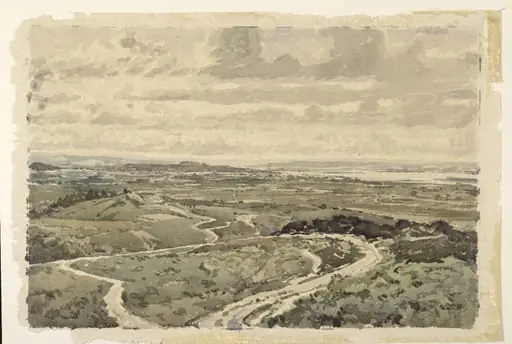
Artwork
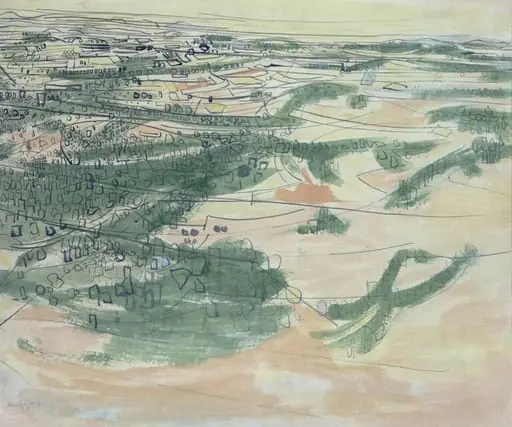
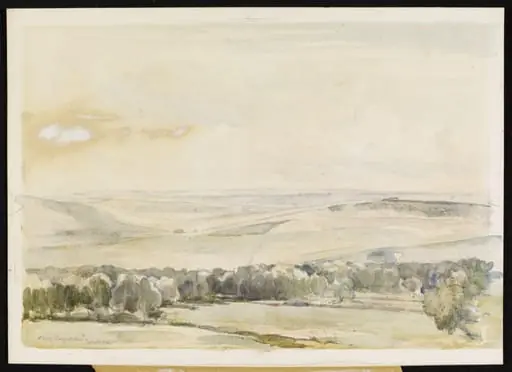
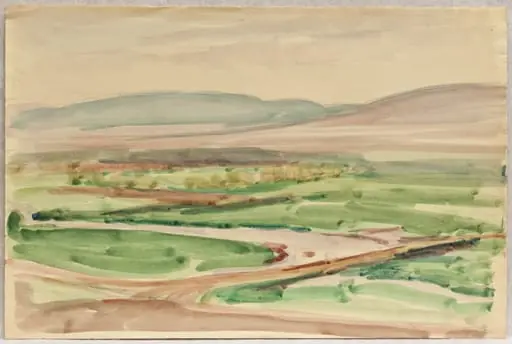
Study for the Valley, Le Boulvé, Lot
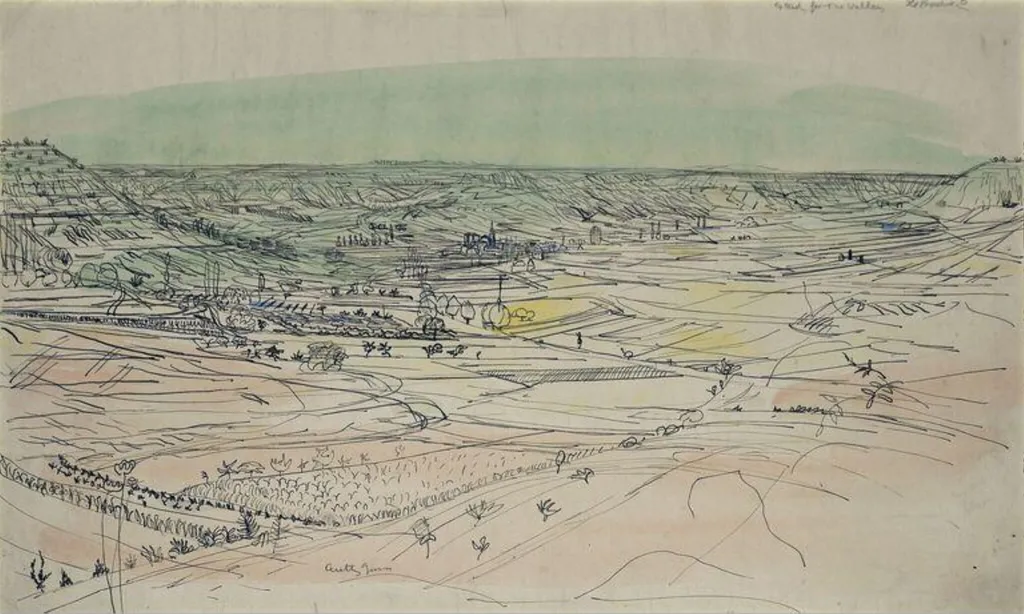
Study for the Valley, Le Boulvé, Lot is a watercolor work on paper by the Contemporary Abstract artist Anthony Gross. It dates from 1957 and is held in the collection of the Victoria and Albert Museum. This watercolor study captures a quiet stretch of the Le Boulvé valley in the Lot region of France.
About this work
Overview
Executed in loose, spontaneous strokes, it conveys the landscape not as a finished piece but as an immediate observation.
This watercolor study captures a quiet stretch of the Le Boulvé valley in the Lot region of France. Executed in loose, spontaneous strokes, it conveys the landscape not as a finished piece but as an immediate observation. The artist employed minimal pigment and exposed paper to suggest form, emphasizing atmosphere over detail. The work reads as a preparatory record, likely made outdoors to document light and topography.
Subject & Meaning
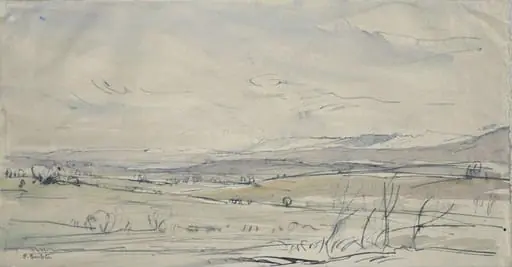
The scene presents an unpopulated rural valley, defined by undulating hills, sparse vegetation, and distant structures barely visible on the horizon. There is no narrative or human activity—only the quiet presence of land. The faint yellow mark may indicate a path or cultivated field, subtly anchoring the viewer’s gaze. The emptiness suggests contemplation of place rather than depiction of event.
Technique & Style
The artist applied diluted watercolor washes over faint pencil underdrawing, allowing the paper’s texture to contribute to the composition. Brushwork is rapid and unrefined, with areas left deliberately bare to imply light and distance. Color is restrained—soft grays, muted greens, and a single pale yellow—creating a sense of atmospheric depth without detail. The method prioritizes immediacy and sensory impression.
History & Provenance
The study is held in the collection of the Victoria and Albert Museum, where it is grouped with other works by the artist’s hand that document French landscapes. Its origin as a field sketch is evident in its scale and condition. It likely passed through private hands before entering institutional care, valued for its insight into the artist’s working process rather than as a standalone image.
Context
Made during a period when artists increasingly turned to direct observation of nature, this study reflects a broader shift toward plein air practice in 19th-century France. Unlike grand historical or idealized landscapes, it records an ordinary, unremarkable locale with honesty. Such works were often private, serving as references for larger studio compositions or personal records of place.
Legacy
This study exemplifies how artists used quick watercolor sketches to capture transient effects of light and terrain. Its modest scale and unfinished quality have preserved its authenticity as a working document. Today, it contributes to understanding the artist’s method and the evolving role of landscape as a subject of direct experience rather than idealized representation.
Artist & collection
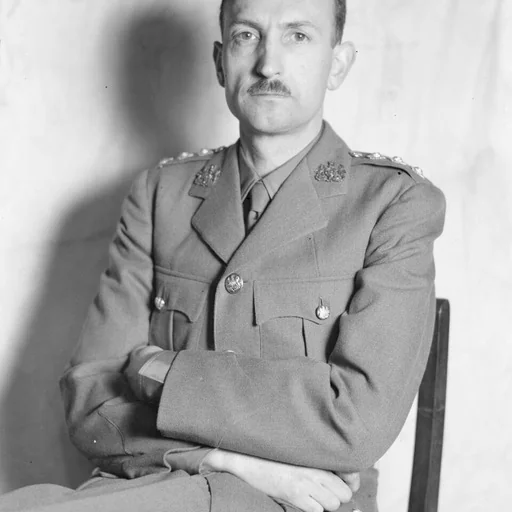
Artist
Anthony Imre Alexander Gross (19 March 1905 – 8 September 1984) was a British printmaker, painter, war artist and film director of Hungarian-Jewish, Italian, and Anglo-Irish descent.