Artwork
Montmarte
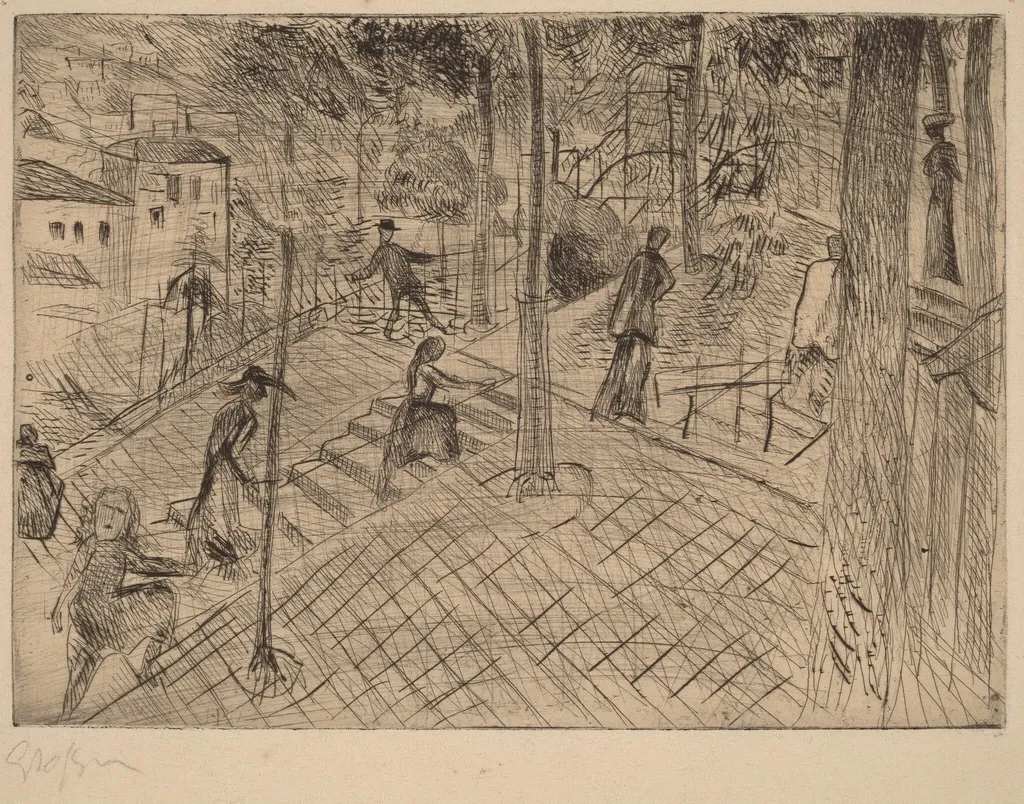
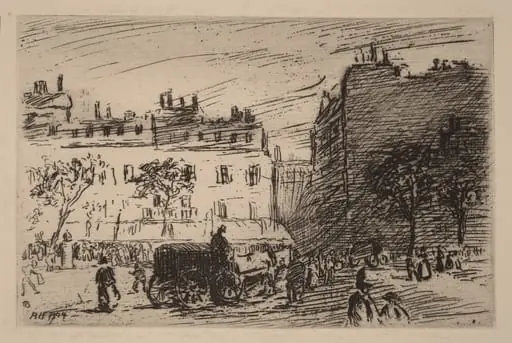
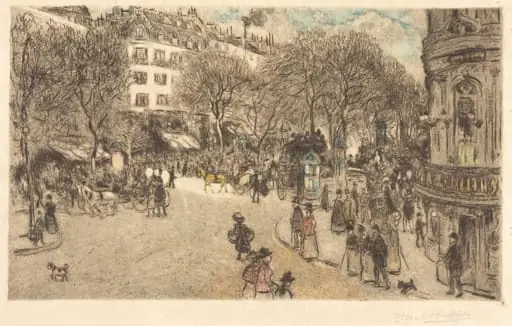
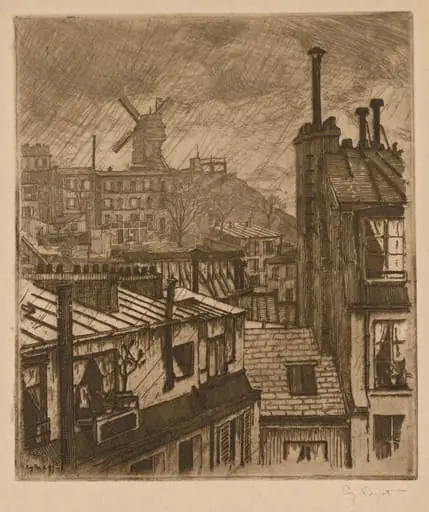
Montmarte is an ink print by Rudolf Grossman. It dates from 1913 and is held in the collection of the National Gallery of Art.
About this work
Overview
Rudolf Grossman’s 1913 print titled “Montmarte” combines etching, drypoint, and aquatint on wove cream paper. The work captures a bustling urban landscape, rendered with a dense network of intersecting lines that convey movement and density. Its surface texture and varied line weights create a sense of depth within the compact composition.
Subject & Meaning
The scene depicts a crowded city street where buildings dominate the left margin, their rooftops tangled with overhead wires. Pedestrians, cyclists, and stationary figures populate the space, while tall trees with twisted branches punctuate the background. The overlapping strokes suggest the chaotic energy of early‑twentieth‑century urban life.
Technique & Style
Grossman employed traditional etching alongside drypoint, enriching the image with the soft, velvety burr of the latter and the crispness of etched lines. Aquatint adds subtle tonal variation, while the wove cream paper’s slightly rough surface enhances the tactile quality of the overlapping marks.
History & Provenance
Created in 1913, “Montmarte” reflects Grossman’s engagement with modern cityscapes during a period of rapid industrial growth. The print has remained within private collections before entering the museum’s holdings, where it is displayed as part of the early modern print series.
Context
The early 1910s saw many artists exploring the dynamism of metropolitan environments through printmaking. Grossman’s approach aligns with contemporaneous experiments in line density and urban representation, echoing the visual language of Futurism and the emerging modernist interest in speed and congestion.
Legacy
While not as widely reproduced as some of his later works, “Montmarte” offers insight into Grossman’s technical versatility and his contribution to the evolution of print media as a vehicle for depicting modern life. It continues to inform studies of early twentieth‑century urban imagery.
Own this work as a print
Artist & collection