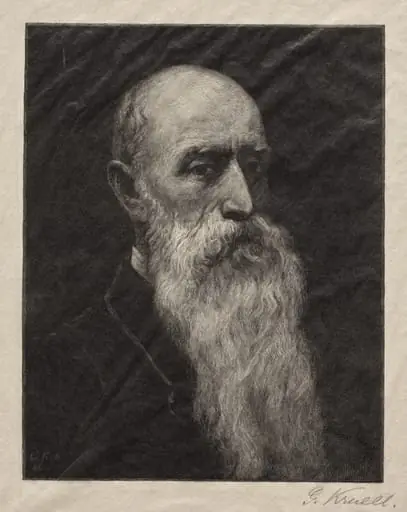
Self-Portrait
1887
From the collection of Cleveland Museum of Art
1887
From the collection of Cleveland Museum of Art
Dominant colour
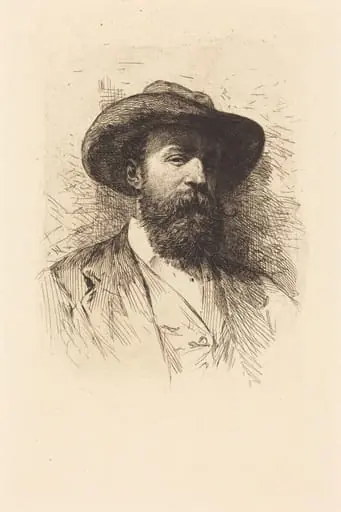
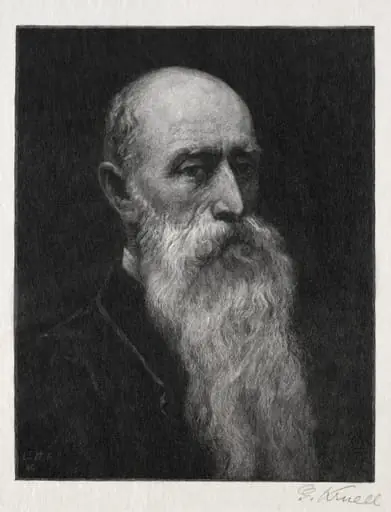
Self-Portrait is a 1887 by Gustav Kruell, a Impressionism work, held at Cleveland Museum of Art.
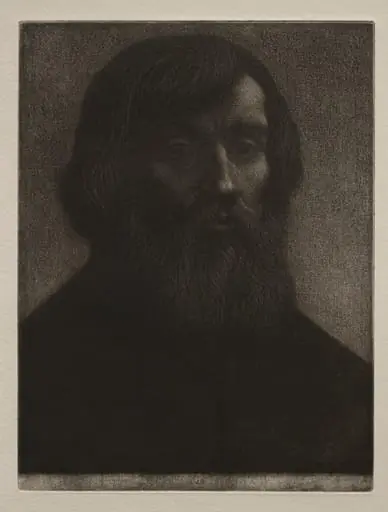
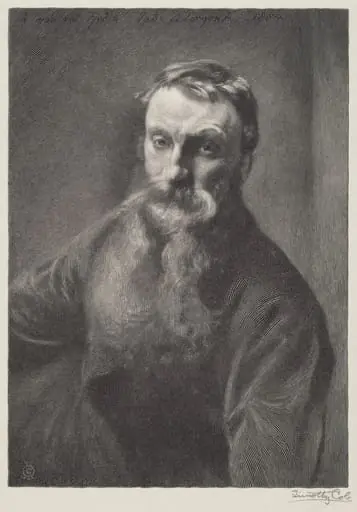
This black-and-white drawing shows a bearded man in a dark, textured coat. His face is serious, with deep shadows under his eyes and around his mouth. The background is plain, letting his face stand out clearly. The artist used shading to create depth, making the man’s features look almost three-dimensional. This style was common in older portrait drawings. Next, look up chiaroscuro to see how artists use light and shadow.
Created in 1887, this black-and-white print is a self-portrait by Gustav Kruell, an artist known for his detailed graphic work. The piece is part of the collection at The Cleveland Museum of Art. Rendered with careful tonal gradations, it presents the artist’s face with restrained intensity, set against an unadorned background that emphasizes his expression and form.
The portrait depicts Kruell himself, bearded and dressed in a dark, heavy coat. His gaze is direct and somber, with pronounced shadows beneath the eyes and along the jawline, suggesting introspection or fatigue. The absence of decorative elements or symbolic objects focuses attention on the psychological presence of the sitter, conveying a quiet, unembellished self-assessment.
Kruell employed fine hatching and cross-hatching to model the face with subtle shifts in tone, achieving a sculptural quality through contrast. The technique draws on traditional printmaking methods, using chiaroscuro to define volume without color. The plain background isolates the figure, enhancing the three-dimensionality of the features and reinforcing the drawing’s focus on form over context.
The print was made in 1887 during Kruell’s active period in the United States, where he worked primarily as an illustrator and engraver. It entered the Cleveland Museum of Art’s collection through documented acquisition, likely as part of a broader effort to preserve American graphic art from the late 19th century. Its condition remains stable, with no evidence of significant restoration.
In the late 1800s, portrait prints by artists like Kruell reflected a shift toward psychological realism in American art. While photography was becoming widespread, hand-drawn portraits retained value for their interpretive depth. Kruell’s work aligns with contemporaries who used print media to explore individual identity beyond mere likeness, often for publication or personal study.
Kruell’s self-portrait stands as a modest but thoughtful example of 19th-century American graphic art. It contributes to the understanding of how artists used print techniques to convey personal presence without theatricality. Though not widely exhibited, it remains a reference point for studies of technique and self-representation in non-painting media of the era.
Read the full account in the museum source.
Your cart is empty
Explore artworks →