Artwork
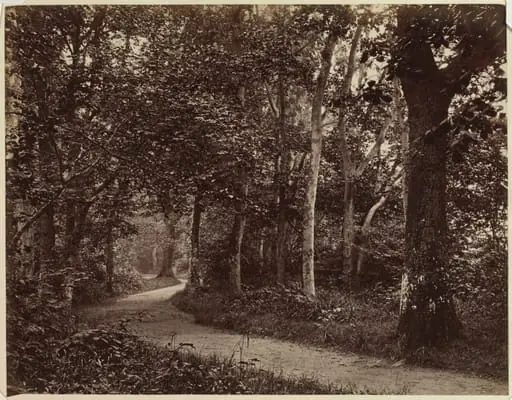
Pathway in the Forest of Fontainebleau
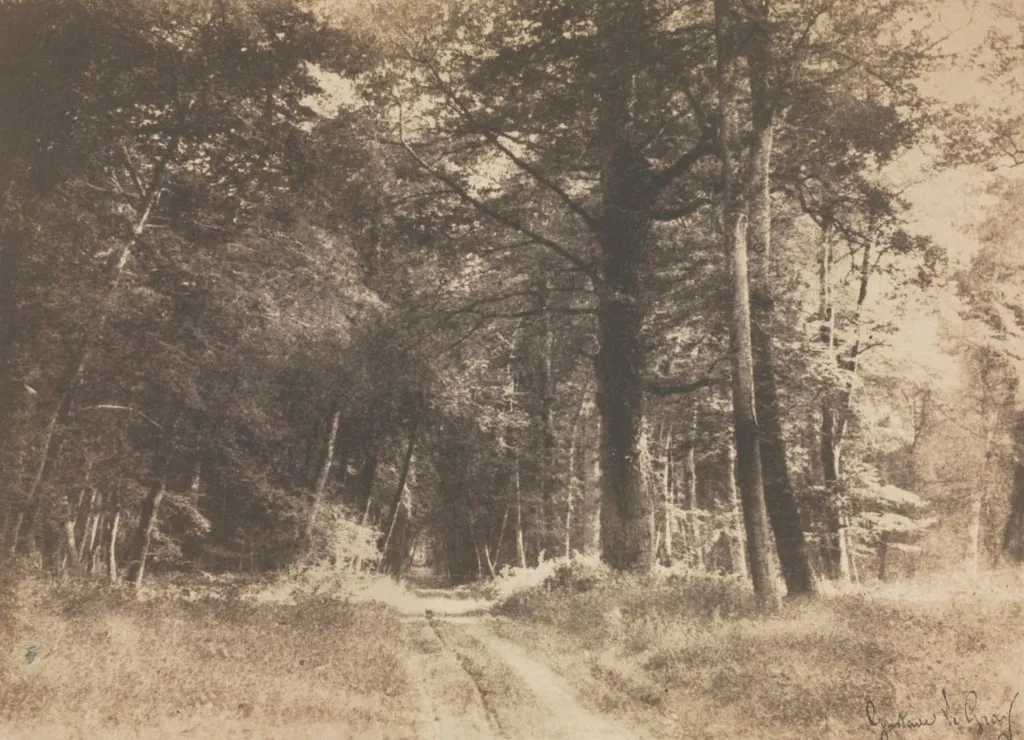
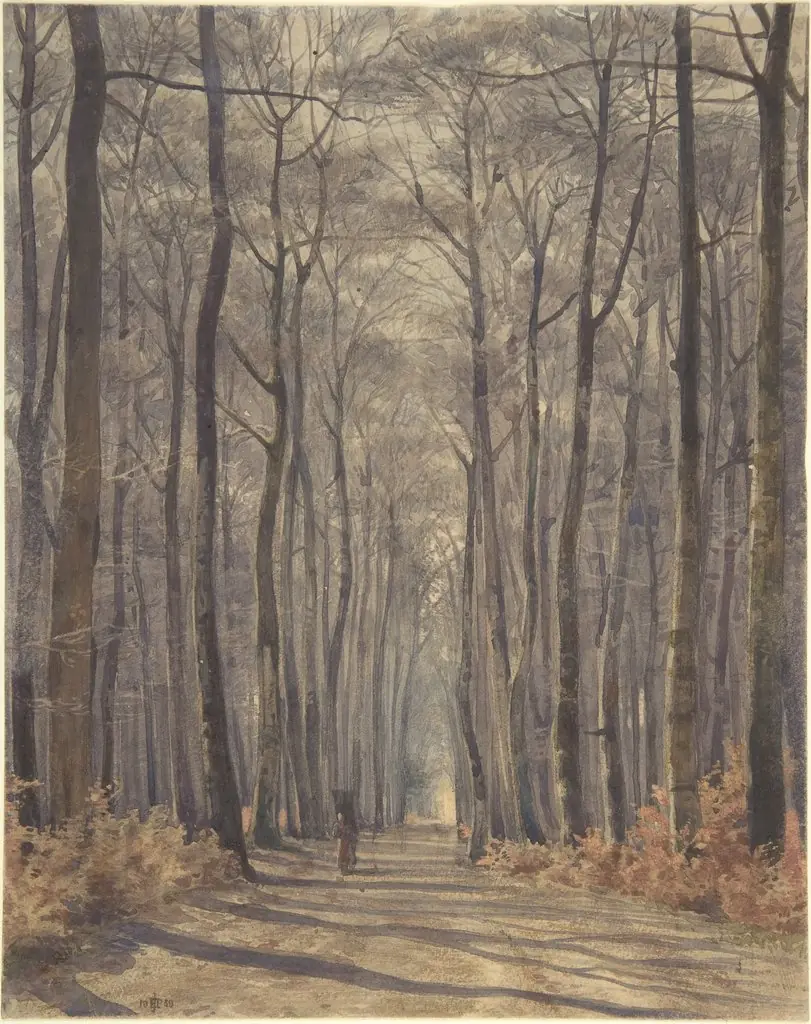
Pathway in the Forest of Fontainebleau is a photography by the Romanticist artist Gustave Le Gray. It dates from 1850 and is held in the collection of the Cleveland Museum of Art.
About this work
He figured out how to show green leaves and dark shadows clearly at a time when cameras struggled with both.
You see a quiet forest path lined by trees, their trunks half in light and half in deep shadow. The ground is damp with fallen leaves. A single figure walks away down the path.
Le Gray took this photo in the Forest of Fontainebleau near Paris. He figured out how to show green leaves and dark shadows clearly at a time when cameras struggled with both.
This looks like a painting but is a photograph. Try looking up Gustave Le Gray (French, 1820–1884).
Overview
Taken in the Forest of Fontainebleau between 1849 and 1857, this photograph by Gustave Le Gray exemplifies early technical innovation in French photography. At a time when capturing both bright light and deep shadow was challenging, Le Gray developed methods to render the subtleties of natural atmosphere. The image presents a quiet woodland path, its mood shaped by dappled sunlight and dense foliage, distinguishing it from the more rigid compositions common in early photographic practice.
Subject & Meaning
The photograph depicts a solitary figure walking along a forest trail, their small scale emphasizing the vastness of the natural environment. The path, framed by towering trees and carpeted with fallen leaves, invites contemplation rather than narrative. This quiet solitude aligns with the Romantic sensibility of the Barbizon artists, who sought to convey the emotional resonance of rural landscapes, transforming the photograph into a meditative space rather than a mere record.
Technique & Style
Le Gray refined the wet-plate collodion process to capture the tonal range of green foliage and shadowed undergrowth, areas where early photographic emulsions typically failed. He balanced exposure to preserve detail in both bright sunlit leaves and dark forest recesses, achieving a luminous depth unusual for the period. The result mimics the tonal harmony of oil painting, blurring the boundary between photography and traditional art while asserting the medium’s expressive potential.
History & Provenance
Le Gray produced this image during a period of intense experimentation in Fontainebleau, where he lived and worked alongside painters of the Barbizon School. The photograph was likely made for private collectors or as part of a series documenting the forest’s changing light. Though few original prints survive, its influence spread through exhibitions and publications, establishing Le Gray as a pivotal figure in the transition of photography from documentation to artistic expression.
Context
The Forest of Fontainebleau was a retreat for artists seeking direct engagement with nature, away from urban life. Le Gray’s photographs emerged alongside the Barbizon painters’ landscapes, sharing their focus on atmosphere and quiet rural scenes. While painters worked in oil, Le Gray used the camera to achieve similar effects, contributing to a broader cultural shift that valued the emotional truth of natural settings over idealized composition.
Legacy
Le Gray’s technical solutions and compositional sensitivity influenced later photographers seeking to elevate the medium beyond mere record-keeping. His ability to render light and texture in natural settings became a benchmark for landscape photography. Though his name faded in the late 19th century, 20th-century scholars recognized his work as foundational to the artistic legitimacy of photography in the modern era.
Artist & collection