Artwork
An Open Carriage
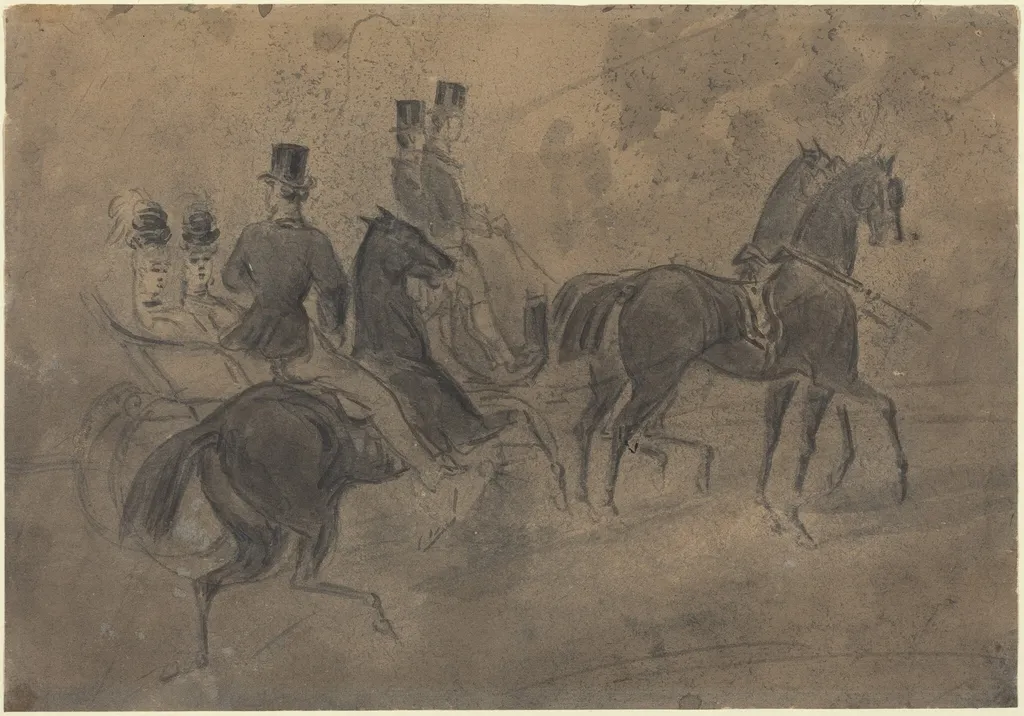
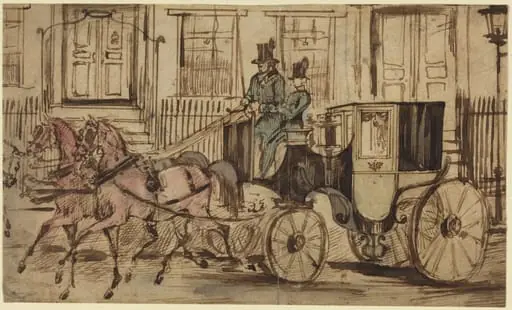
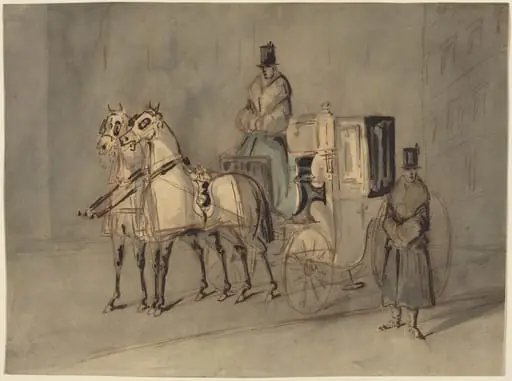
An Open Carriage is a drawing by the Romanticist artist Constantin Guys. It dates from 1848 and is held in the collection of the National Gallery of Art.
About this work
Overview
It captures a moment of motion in urban life, reflecting his role as a visual chronicler of 19th-century Parisian society.
Created in 1848, *An Open Carriage* is a drawing in black wash on wove paper by Constantin Guys. It captures a moment of motion in urban life, reflecting his role as a visual chronicler of 19th-century Parisian society. The work exemplifies his preference for spontaneous, on-the-spot observation over polished studio compositions, aligning with his career as a newspaper illustrator documenting everyday scenes.
Subject & Meaning
The drawing depicts a horse-drawn carriage in motion along a rough path, carrying three figures in dark attire. Their faces are indistinct, emphasizing the transient nature of the encounter rather than individual identity. The urgency of the scene suggests a fleeting glimpse of public life, characteristic of Guys’ interest in the rhythms and anonymity of modern urban existence.
Technique & Style
Guys employed rapid, fluid strokes of black wash to convey motion and energy. The loose, almost sketchlike lines suggest speed, while the contrast between the dark ink and the paper’s pale surface heightens the sense of immediacy. Horses’ muscles and kicking dust are rendered with minimal detail, relying on gesture rather than precision to communicate dynamism and momentum.
History & Provenance
The work originates from Guys’ extensive body of sketches made during his time as a correspondent and illustrator for French and British publications. Though little is documented about its early ownership, it is part of a larger archive of his observational drawings, many of which were later collected by institutions interested in 19th-century visual journalism and urban culture.
Context
In mid-19th-century Paris, rapid urbanization and new modes of transport transformed public life. Guys’ drawings responded to this shift, documenting the pulse of the city with an eye for motion and social nuance. His approach, though not overtly romantic, shares with Romanticism an interest in capturing emotion through movement and atmosphere, rather than idealized form.
Legacy
Guys’ observational style influenced later artists interested in modern life, including Degas and the Impressionists. His ability to distill transient moments into expressive line work helped redefine drawing as a medium for contemporary reportage. *An Open Carriage* remains a quiet testament to the value of the sketch as a record of lived experience.
Artist & collection
Artist
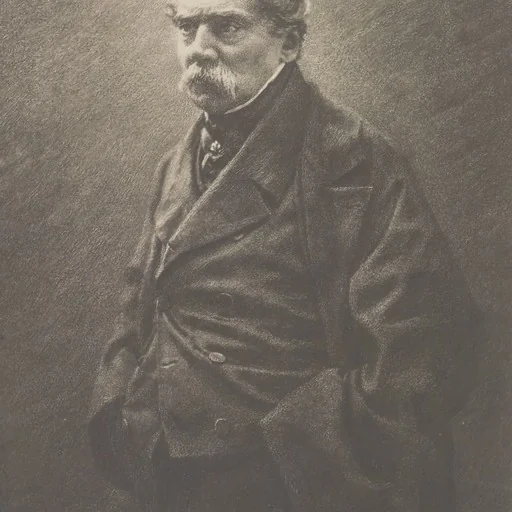
Constantin Guys (born Ernest-Adolphe Guys de Saint-Hélène, December 3, 1802 – December 13, 1892) was a French Crimean War correspondent, water color painter and illustrator for British and French newspapers.

![Caravan with Covered Wagons Resting [recto], by Winslow Homer](https://artifactworldgallery.com/img/winslow-homer--caravan-with-covered-wagons-resting-recto--5a827c4a7f560cf2-w320.webp)