Artwork
The Brighton Coach
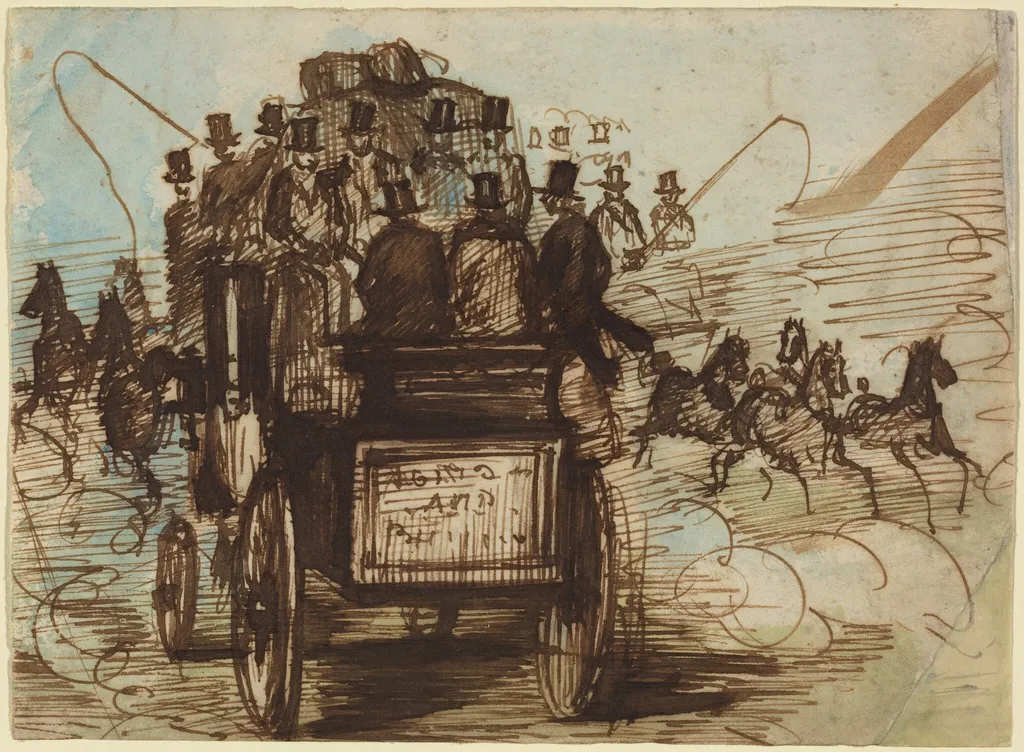
The Brighton Coach is an ink drawing by the Romanticist artist Constantin Guys. It dates from 1848 and is held in the collection of the National Gallery of Art.
About this work
Overview
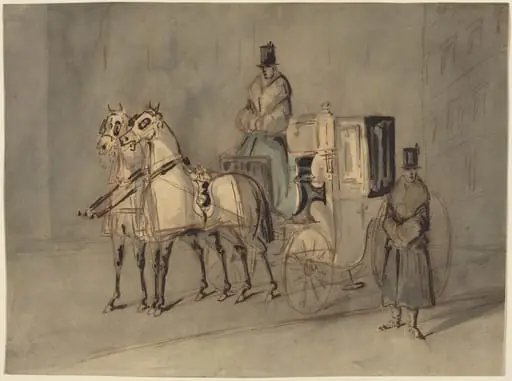
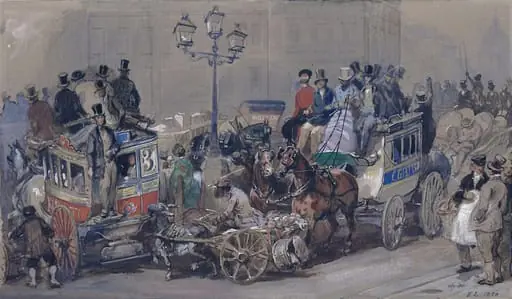
Created in 1848, *The Brighton Coach* is a pen and ink drawing with subtle blue and green washes on wove paper by French artist Constantin Guys.
Created in 1848, *The Brighton Coach* is a pen and ink drawing with subtle blue and green washes on wove paper by French artist Constantin Guys. It captures a moment of everyday transit in mid-19th-century Britain, reflecting Guys’ interest in modern urban life. His work as a correspondent for illustrated newspapers informed his keen observation of public scenes, and this piece exemplifies his rapid, observational style.
Subject & Meaning
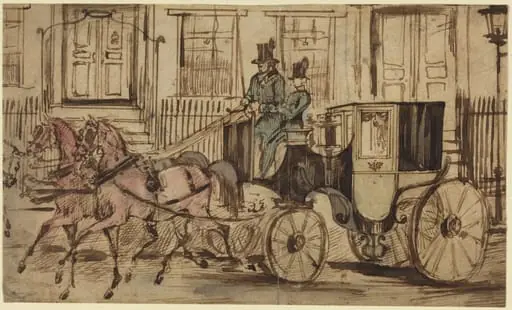
The drawing portrays a luxurious four-horse carriage en route to Brighton, a popular seaside destination for the British middle and upper classes. The driver, perched high, grips the reins tightly, while two passengers are visible within the enclosed cabin. The scene suggests movement and social ritual, highlighting the role of transport in leisure and class distinction during the Victorian era.
Technique & Style
Guys employed fine, scratchy pen lines and layered washes to suggest texture and motion. Parallel and cross-hatched strokes build shadow and volume on the coach and horses, while the light blue background implies atmosphere rather than detailed landscape. The ink’s fluidity and spontaneity convey immediacy, characteristic of on-site sketching, with minimal detail reserved for essential forms.
History & Provenance
The drawing was made during Guys’ active years as a illustrator for French and British periodicals, a period when illustrated journalism was expanding rapidly. Though its early ownership is undocumented, it entered a major public collection in the 20th century, where it remains as part of a broader archive of 19th-century graphic reportage.
Context
In the 1840s, rail travel was rising, but horse-drawn coaches still served as symbols of status and comfort for those traveling to resorts like Brighton. Guys’ focus on such scenes aligns with a broader European interest in documenting modern life, paralleling the emerging realism in painting and literature, yet rendered with the immediacy of journalistic sketching.
Legacy
Guys’ drawings, including *The Brighton Coach*, influenced later artists interested in capturing transient moments of urban existence. His technique—combining precision with spontaneity—became a model for illustrators and graphic artists seeking to convey motion and social nuance without theatricality, bridging reportage and fine art traditions.
Artist & collection
Artist
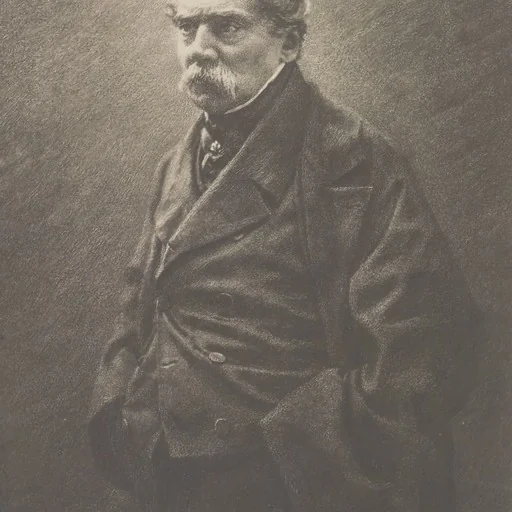
Constantin Guys (born Ernest-Adolphe Guys de Saint-Hélène, December 3, 1802 – December 13, 1892) was a French Crimean War correspondent, water color painter and illustrator for British and French newspapers.

![Caravan with Covered Wagons Resting [recto], by Winslow Homer](https://artifactworldgallery.com/img/winslow-homer--caravan-with-covered-wagons-resting-recto--5a827c4a7f560cf2-w320.webp)