Artwork
Exposition universelle: L'Etranger trouve toutes les facilites desirables...
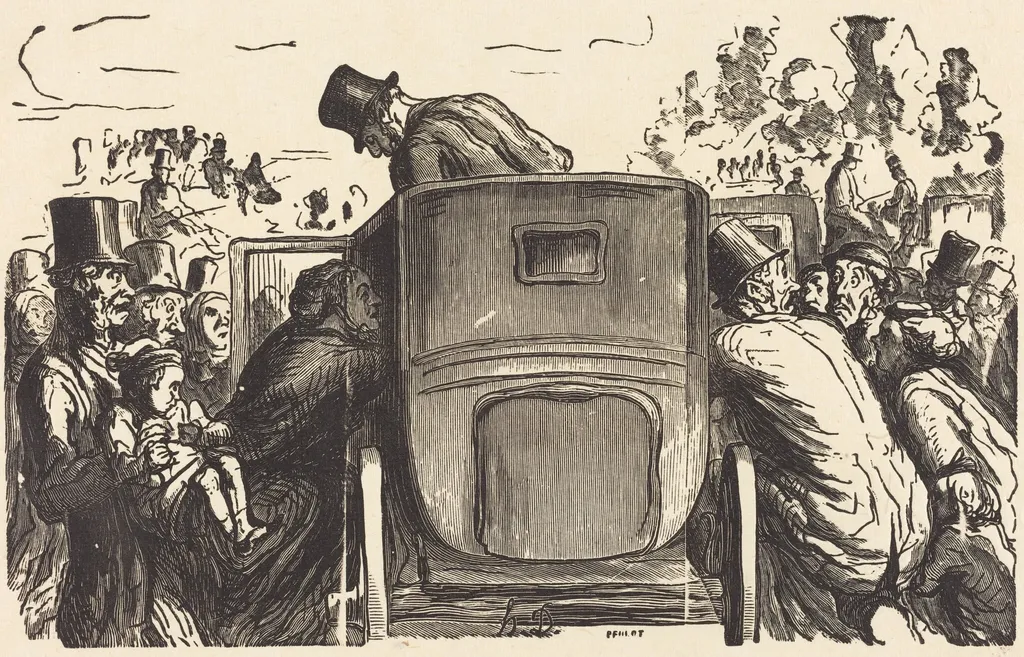
Exposition universelle: L'Etranger trouve toutes les facilites desirables... is an ink print by the Impressionist artist Julien Antoine Peulot. It dates from 1867 and is held in the collection of the National Gallery of Art.
About this work
The artist used tiny cross-hatching lines to create shadows and texture, making the scene feel busy and alive.
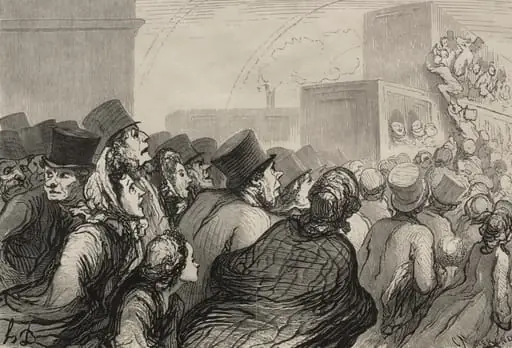
This sketch shows a crowd of people packed around a large, boxy machine with a funnel-shaped top. Some wear top hats, others look confused or curious. A few figures are floating above the crowd, as if lifted by the scene’s energy. The machine has a small square opening in the front, and the whole image is drawn in bold black lines.
The artist used tiny cross-hatching lines to create shadows and texture, making the scene feel busy and alive. This was made for an 1867 world’s fair, where new inventions were on display.
Check out the technique: cross-hatching to see how artists build depth with lines.
Overview
Created in 1867 by Julien Antoine Peulot, this wood engraving was produced as a promotional image for the Exposition universelle in Paris. It captures the public’s fascination with industrial innovation during the fair, depicting a mysterious mechanical device surrounded by a diverse crowd. The composition emphasizes movement and curiosity, rendered entirely in black ink through fine linear techniques typical of 19th-century printmaking.
Subject & Meaning
The central machine, with its funnel-like top and front-facing aperture, suggests a novel invention—perhaps a steam device or communication apparatus—though its exact function remains ambiguous. Figures in top hats and everyday attire react with wonder, confusion, or awe, reflecting societal responses to rapid technological change. The floating figures above the crowd imply a sense of collective excitement or even surreal uplift, symbolizing the transformative allure of progress.
Technique & Style
Peulot employed precise wood engraving with dense cross-hatching to model form and depth, creating texture in clothing, skin, and machinery. Bold outlines define the crowd and machine, while subtle gradations of line density suggest shadow and volume. The intricate patterning gives the scene a dynamic, almost vibrating energy, characteristic of detailed commercial prints designed for mass reproduction and public engagement.
History & Provenance
The print was commissioned for the 1867 Exposition universelle, a major international exhibition showcasing industrial and cultural achievements. It likely appeared in promotional materials or illustrated newspapers to attract visitors. Though its original publication context is unrecorded, surviving impressions are held in institutional collections, reflecting its role as a visual document of the era’s technological optimism.
Context
The 1867 Paris Exposition highlighted innovations in transportation, communication, and manufacturing, drawing millions of visitors. This engraving reflects a broader cultural moment when machines became symbols of modernity, often met with both enthusiasm and unease. Similar imagery appeared across European media, framing new technology as a spectacle accessible to all classes, yet still mysterious in its workings.
Legacy
Peulot’s engraving endures as a visual record of public engagement with industrial progress in the mid-19th century. Its detailed linework and expressive crowd scenes influenced later illustrators documenting technological exhibitions. Though not widely known today, it remains a valuable artifact for understanding how society visually interpreted and responded to the accelerating pace of innovation during the Industrial Age.
Artist & collection


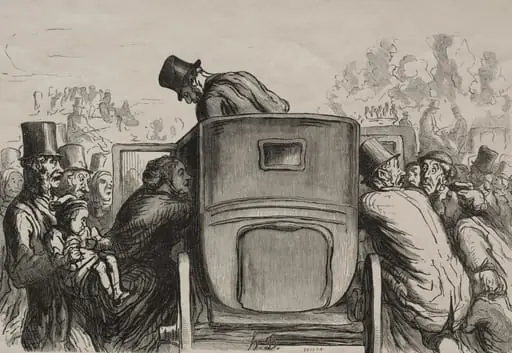 At the Universal Exhibition: The visitor will find all means of transportation desirable to return to his hotel.
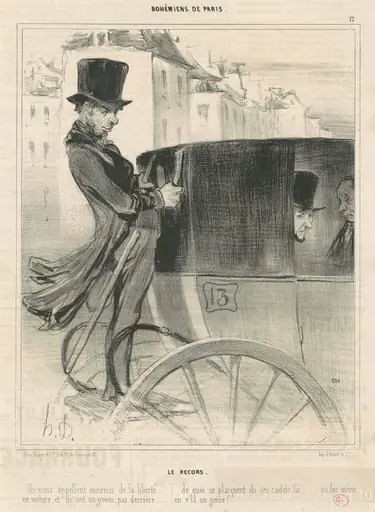 Le recors
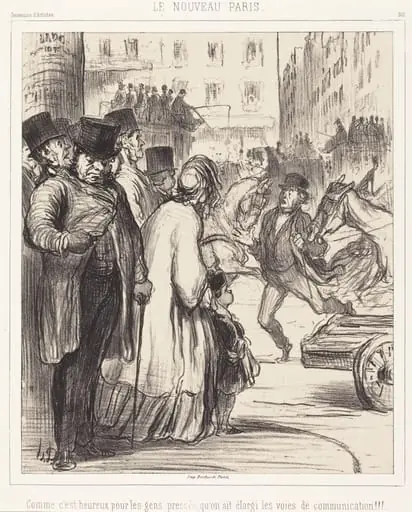 Le Nouveau Paris
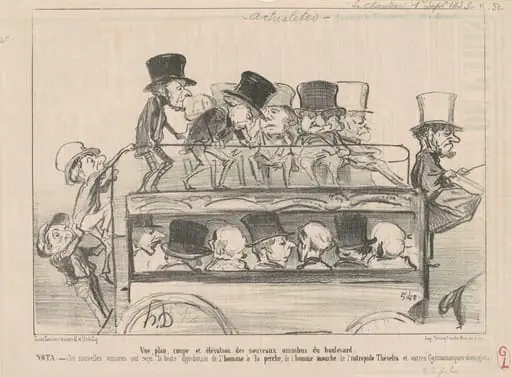 Vue ... et elévation des ... omnibus du boulevard ...
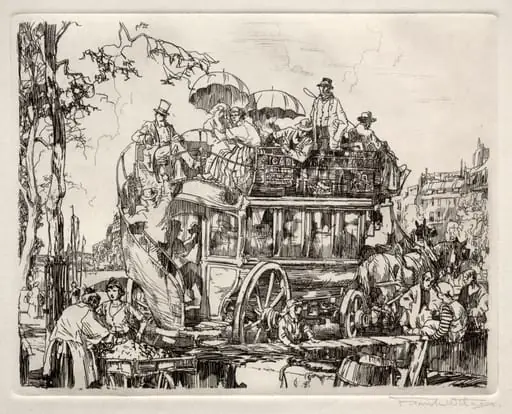 The Omnibus
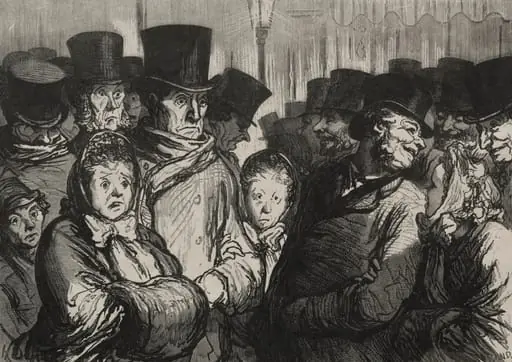 A Street at Midnight: Coming out of a drama. Coming out of a variety show
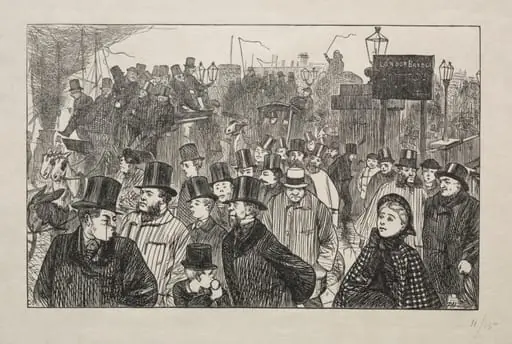 The Living Stream at London Bridge - On the Bridge
 Untitled
 Désolé, citoyenne... je ne reçois pas de chiens...
 The Railway: The Sunday Excursion
 Sunday 1897
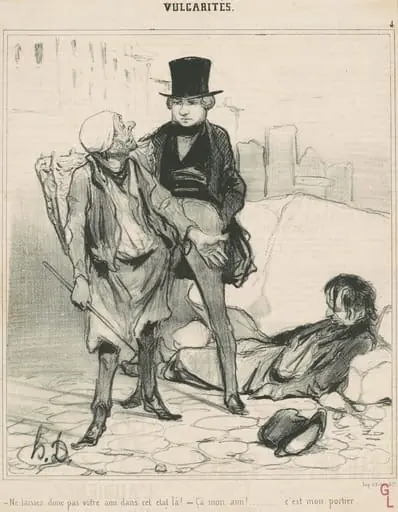 Ne laissez donc pas votre ami dans cet état la!