Artwork
Willow Bridge and Waterwheel
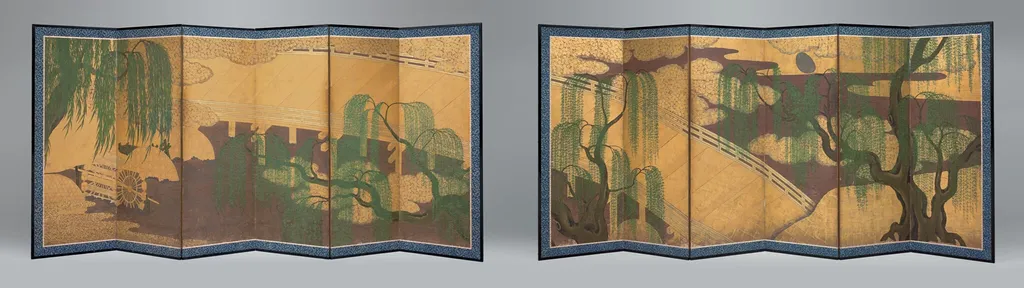
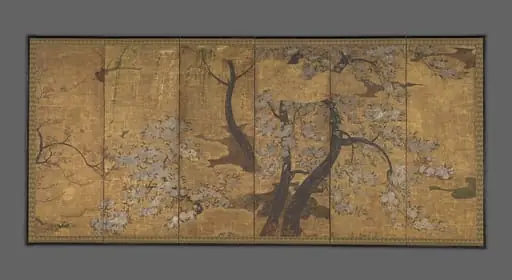
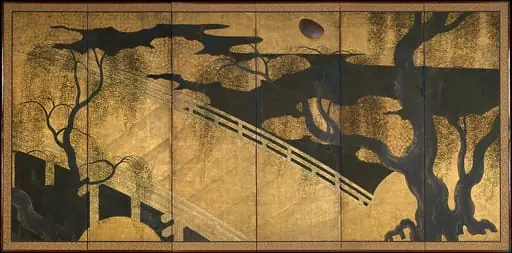
Willow Bridge and Waterwheel is an ink painting by the Baroque artist Hasegawa Sôya. It dates from 1650 and is held in the collection of the Art Institute of Chicago. The work consists of two six‑panel folding screens depicting a gold‑leaf bridge and a waterwheel set in a stylised landscape.
About this work
Overview
The work consists of two six‑panel folding screens depicting a gold‑leaf bridge and a waterwheel set in a stylised landscape. Executed in ink, colour, gold and silver on paper, the screens present a highly decorative scene that integrates metallic leaf with painted elements to convey depth and texture.
Subject & Meaning
The landscape represents Uji, a historic locale that linked the ancient capitals of Nara and Kyoto and held longstanding spiritual resonance. Iconic motifs drawn from classical Japanese poetry—curved bridge, willows, moon, waterwheel, mist and stone‑filled baskets—are arranged to evoke the celebrated scenery of the site.
Technique & Style
The artist employed a range of precious materials: gold and silver leaf adorn the bridge and moon, while cut‑square leaf and powdered leaf create the mist.
The artist employed a range of precious materials: gold and silver leaf adorn the bridge and moon, while cut‑square leaf and powdered leaf create the mist. Lines of flowing water are rendered with metallic pigment, and raised areas such as the baskets and waterwheel receive a coating of gold mixed with gofun (oyster‑shell white) to produce a tactile effect. Notably, the gold leaf on the bridge is applied diagonally, accentuating its arch.
History & Provenance
Created by Hasegawa Sôya, son of the renowned painter Hasegawa Tōhaku, the screens belong to a tradition of large‑scale screen compositions pioneered by his father. The subject—golden bridge spanning twelve panels—was a popular motif, and several comparable examples survive from the same period.
Context
By the Edo period, specific visual cues had become shorthand for the Uji landscape in decorative arts. The inclusion of the bridge, willows, moon, waterwheel, mist and stone baskets reflects a codified visual language that linked poetry, place and visual representation for elite audiences.
Artist & collection