Artwork
The Dimission of Adan and Eve
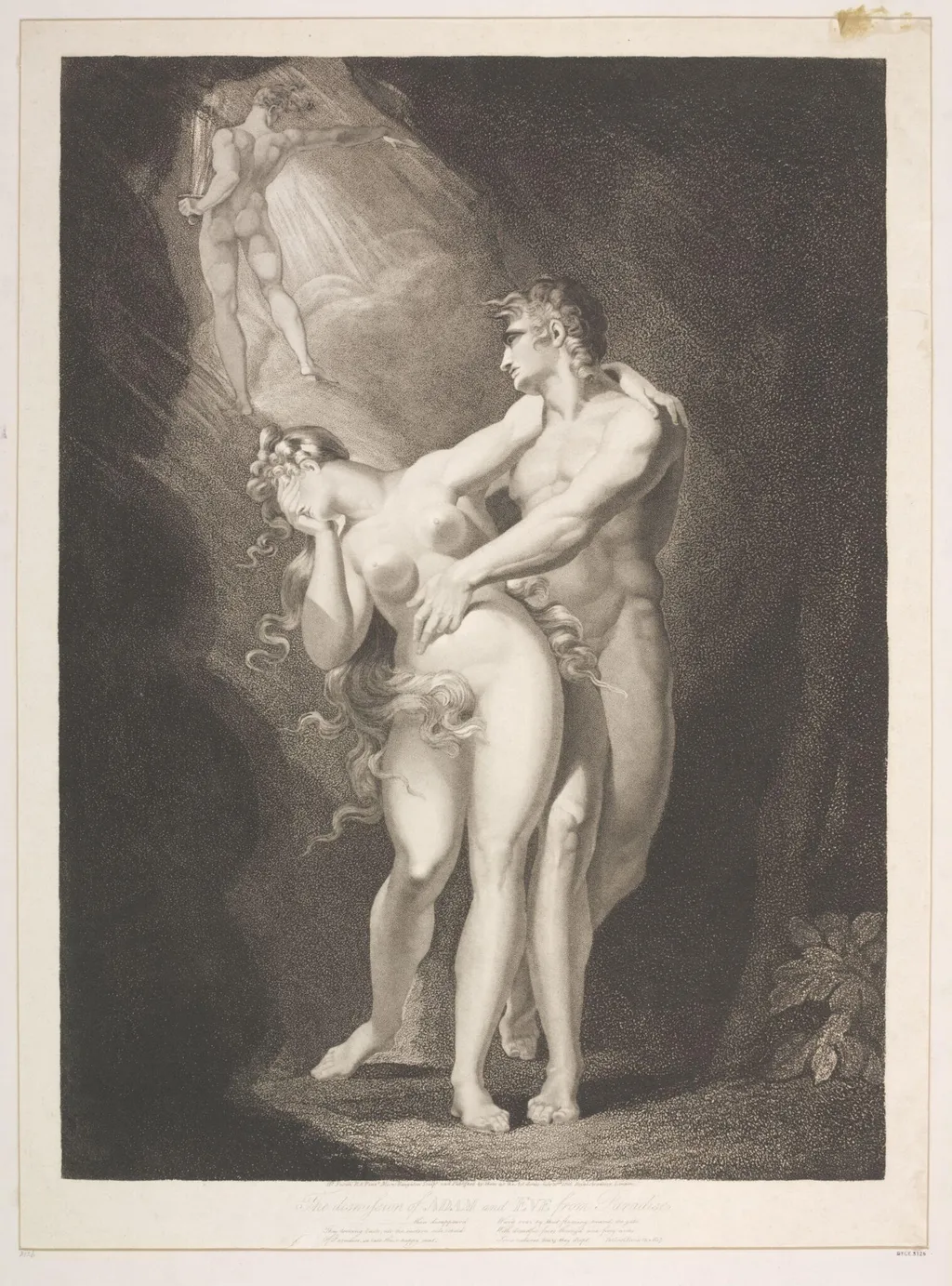
The Dimission of Adan and Eve is a print by Moses Haughton. It dates from 1850 and is held in the collection of the Victoria and Albert Museum.
About this work
Overview
This 1850 print by Moses Haughton is a reproductive engraving of Henry Fuseli’s earlier painting, capturing the expulsion of Adam and Eve from Eden. Executed on paper, it was intended to disseminate Fuseli’s dramatic vision beyond the confines of a single canvas. The medium allowed for broader public access to the scene, aligning with 19th-century trends in illustrated religious imagery.
Subject & Meaning
Their postures convey shame and resignation, bodies turned away from the viewer and the divine presence behind them.
The print illustrates the moment Adam and Eve are cast out of the Garden of Eden, as described in Genesis. Their postures convey shame and resignation, bodies turned away from the viewer and the divine presence behind them. The winged figure above, likely an angel, holds a flaming sword, enforcing their exile. The scene emphasizes divine judgment and the loss of innocence through physical and spatial isolation.
Technique & Style
Haughton employed chiaroscuro to heighten emotional tension, using stark contrasts between light and shadow to define the figures’ musculature and contours. The background remains deeply recessed in darkness, isolating the trio in a spotlight of dramatic illumination. Fine engraving lines render anatomical detail with precision, while the absence of color focuses attention on form and gesture.
History & Provenance
The print was produced in 1850 as part of a broader effort to reproduce popular Romantic-era compositions in accessible formats. Haughton, known for his reproductive engravings, translated Fuseli’s 1790s painting into a graphic medium for collectors and institutions. Its circulation reflects the Victorian era’s interest in biblical narratives and the commercialization of fine art through prints.
Context
In mid-19th-century Britain, religious imagery remained central to public visual culture, even as secularism grew. Engravings like this one bridged elite art and middle-class homes, offering moral lessons through dramatic biblical scenes. Fuseli’s expressive style, with its theatricality and emotional intensity, resonated with contemporary tastes for the sublime and the spiritual.
Legacy
Though not widely exhibited today, the print endures as an example of how Romantic compositions were democratized through printmaking. It preserves Fuseli’s original vision in a format that reached audiences who might never have seen the painting. Its technical precision and emotional gravity reflect the enduring power of engraving as a vehicle for narrative art.
Artist & collection
Artist
Moses Haughton’s engravings feel like stills from a play where the actors forgot to leave the stage.