Artwork
The Lament for Icarus
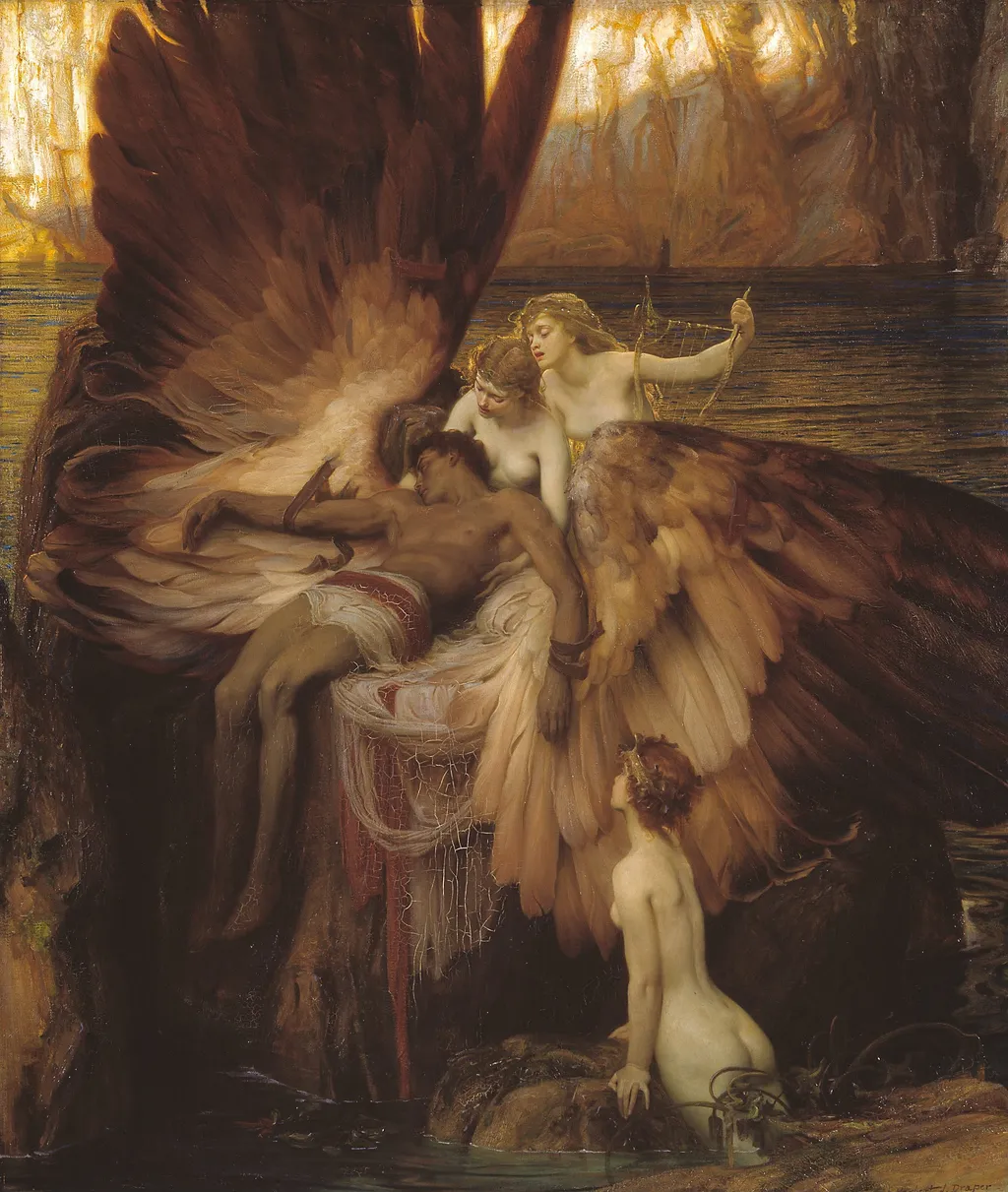
The Lament for Icarus is an oil painting by the Symbolist artist Herbert James Draper. It dates from 1900 and is held in the collection of the National Gallery.
About this work
Overview
An oil painting by Herbert James Draper, The Lament for Icarus depicts the fallen figure of Icarus lying lifeless amid a group of mourning sea nymphs.
An oil painting by Herbert James Draper, The Lament for Icarus depicts the fallen figure of Icarus lying lifeless amid a group of mourning sea nymphs. Created in 1898, the work was acquired directly from the Royal Academy exhibition by the Chantrey Bequest, a public fund established to support contemporary British art. It later received the gold medal at the 1900 Exposition Universelle in Paris, affirming its recognition beyond Britain.
Subject & Meaning
The painting illustrates the myth of Icarus, who flew too close to the sun and fell into the sea. Rather than focusing on his flight, Draper emphasizes the aftermath: the body of the youth, now inert, is cradled by nymphs whose grief underscores the tragedy of human ambition and its limits. The scene evokes classical themes of hubris and loss, rendered with emotional gravity rather than dramatic action.
Technique & Style
Draper employed rich, layered oil paint to render the human form and aquatic surroundings with meticulous detail. The wings of Icarus, though broken, are rendered with intricate patterns inspired by the feathers of the bird-of-paradise, blending naturalistic observation with mythic symbolism. The nymphs’ flowing forms and the cool, reflective sea create a lyrical, almost ethereal atmosphere.
History & Provenance
Completed in 1898, the painting was purchased the same year by the Chantrey Bequest, a fund created by the will of Sir Francis Leggatt Chantrey to acquire works by living British artists for the national collection. Its acquisition by the state marked institutional endorsement. In 1900, it was awarded the gold medal at the Exposition Universelle in Paris, extending its reputation internationally.
Context
The painting emerged during a period when British academic art still drew heavily on classical mythology, even as modernist movements gained ground elsewhere. Draper’s work aligned with the late Victorian taste for mythological narrative and idealized beauty, yet its emotional tone and attention to texture distinguished it from more formulaic treatments of the same subjects.
Legacy
The Lament for Icarus remains a significant example of late 19th-century British academic painting. Its acquisition by the Chantrey Bequest ensured its place in public collections, and its Parisian recognition affirmed the international reach of British art at the turn of the century. Though later overshadowed by modernist trends, it continues to be studied for its technical precision and mythological interpretation.
Own this work as a print
Artist & collection

Artist
Herbert James Draper ((1863-11-26)26 November 1863 – (1920-09-22)22 September 1920) was an English Neoclassicist painter whose career began in the Victorian era and extended through the first two decades of the 20th century.